Free Printable The Songhai Empire Worksheets for Class 8
Explore Class 8 Songhai Empire worksheets and printables that help students master this powerful West African civilization through engaging practice problems, free PDF resources, and comprehensive answer keys.
Explore printable The Songhai Empire worksheets for Class 8
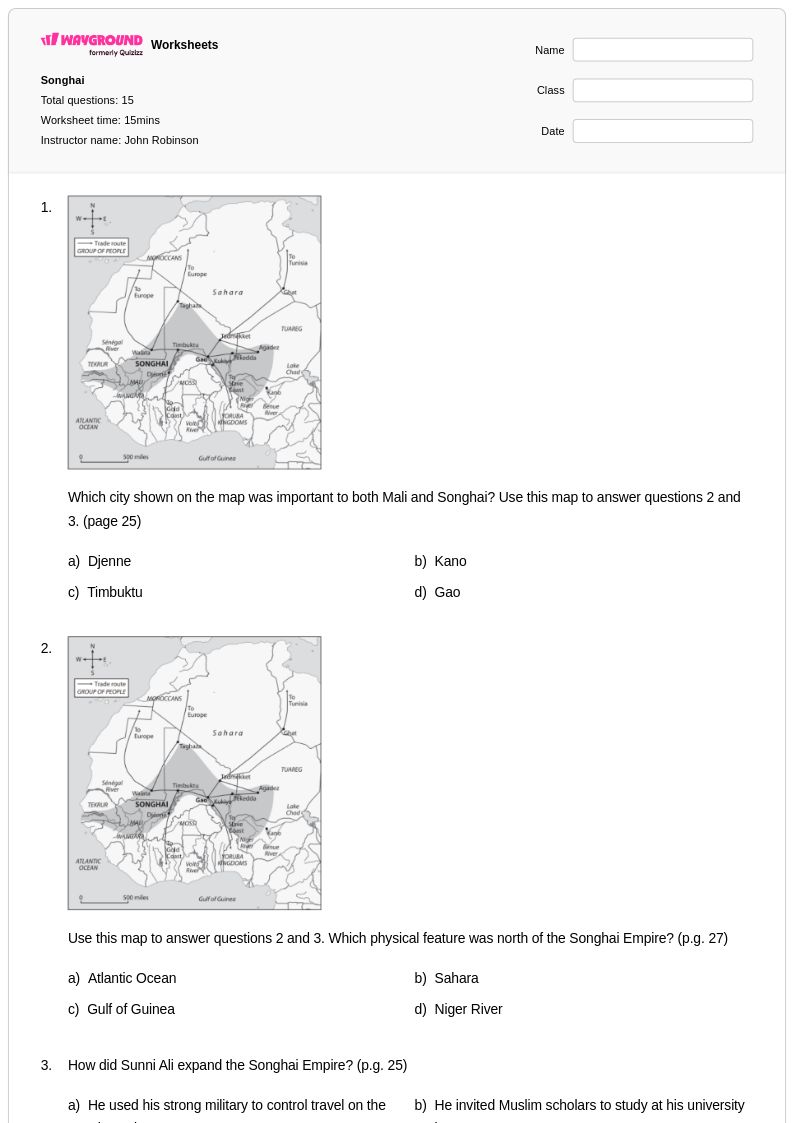
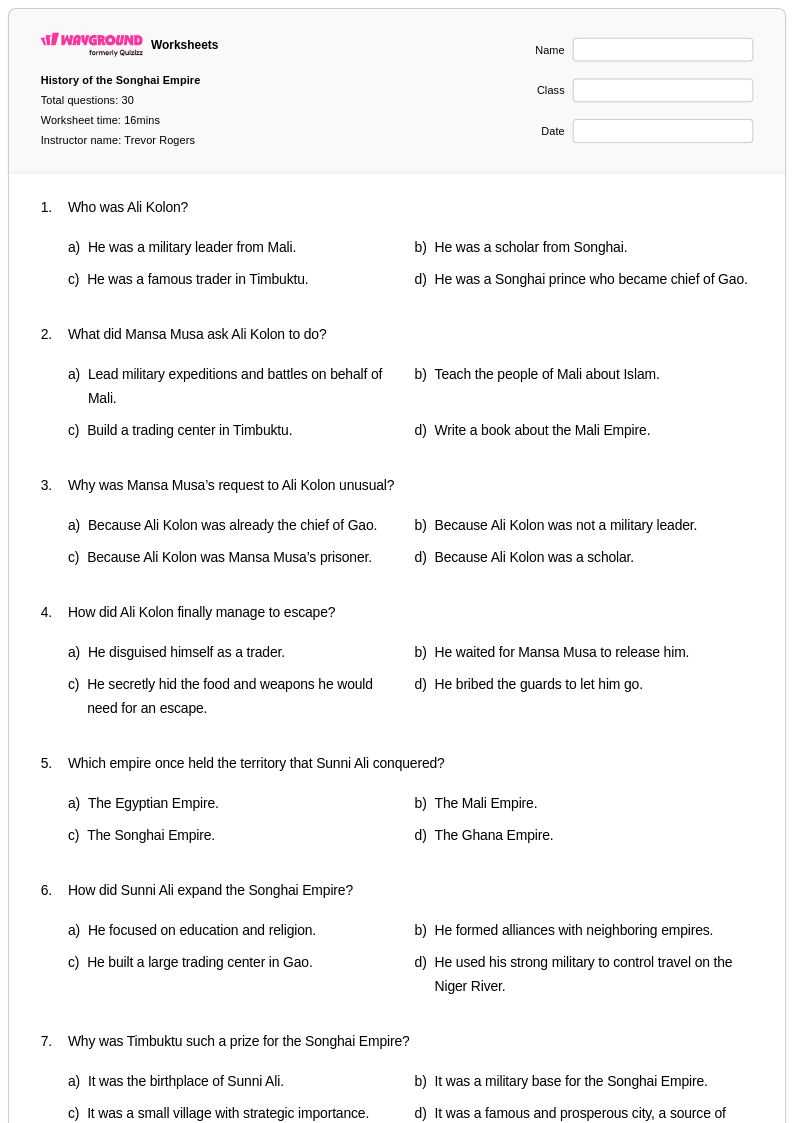
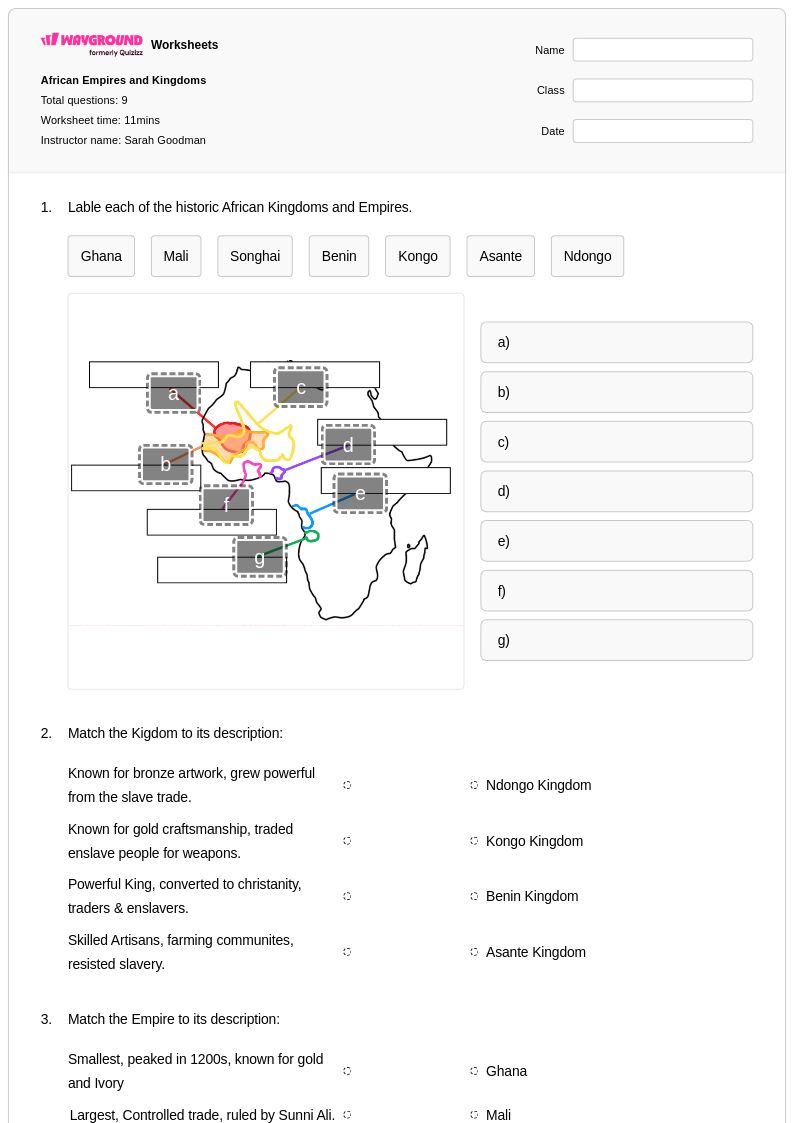
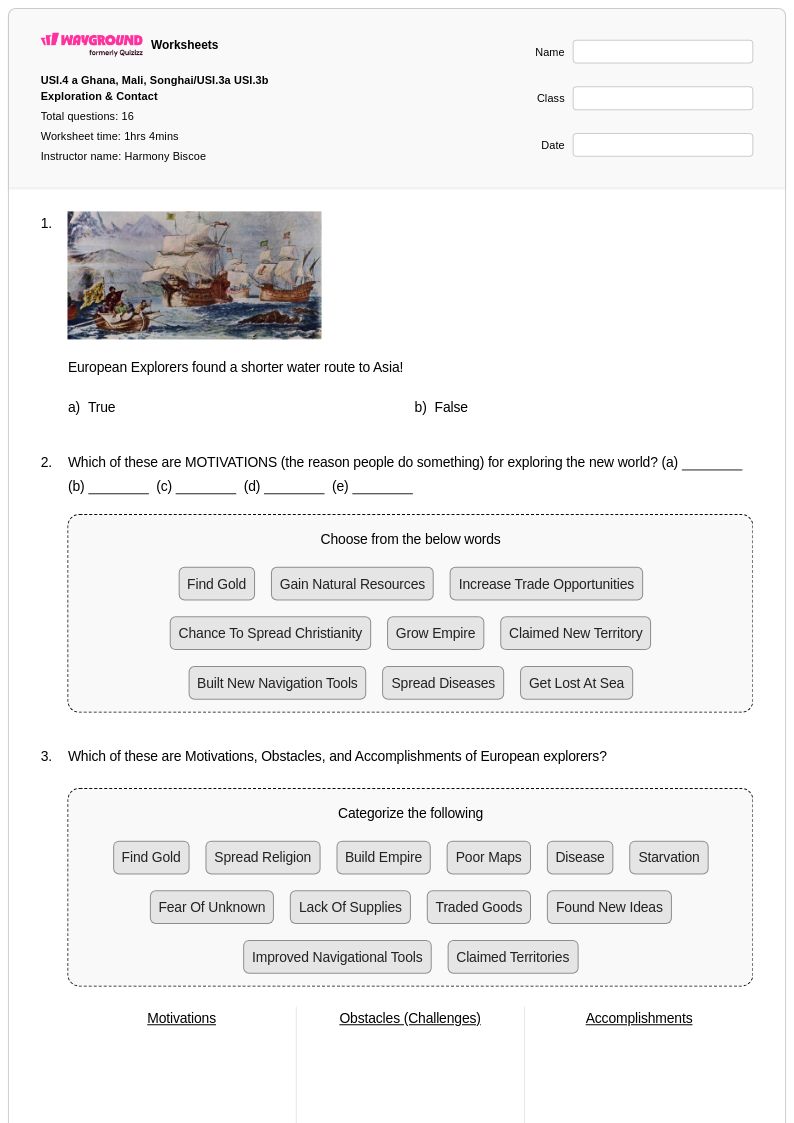
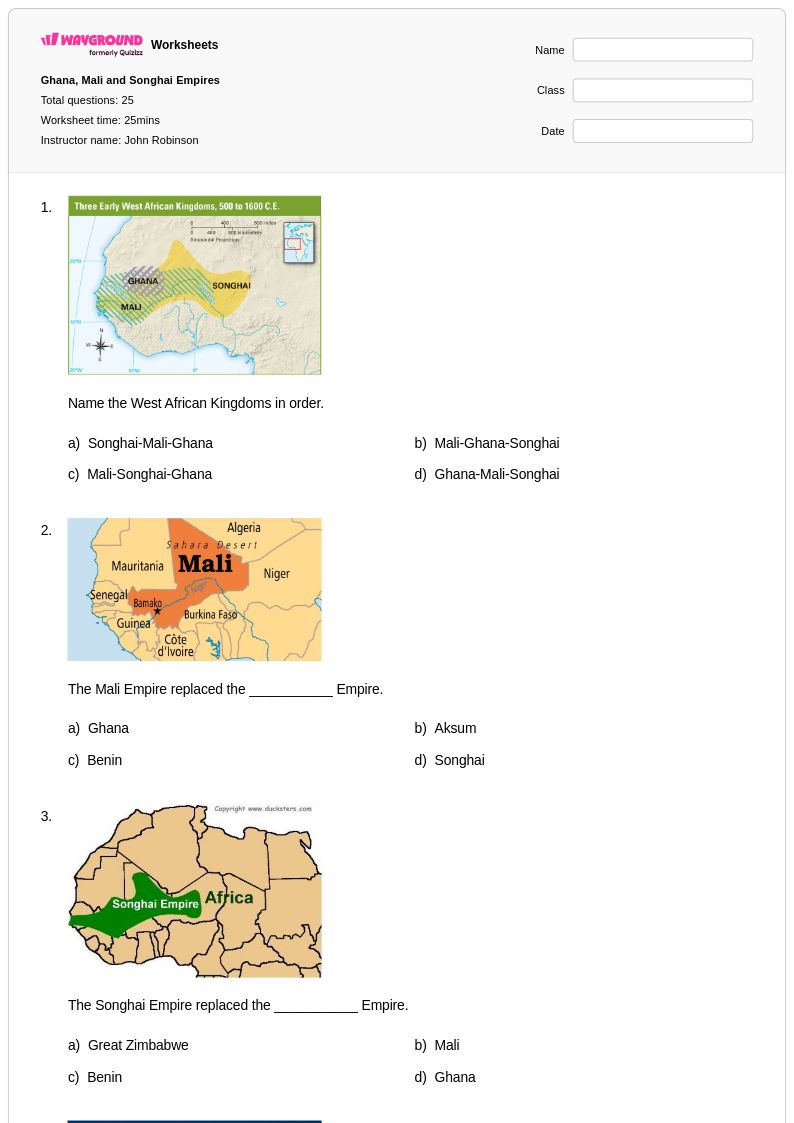
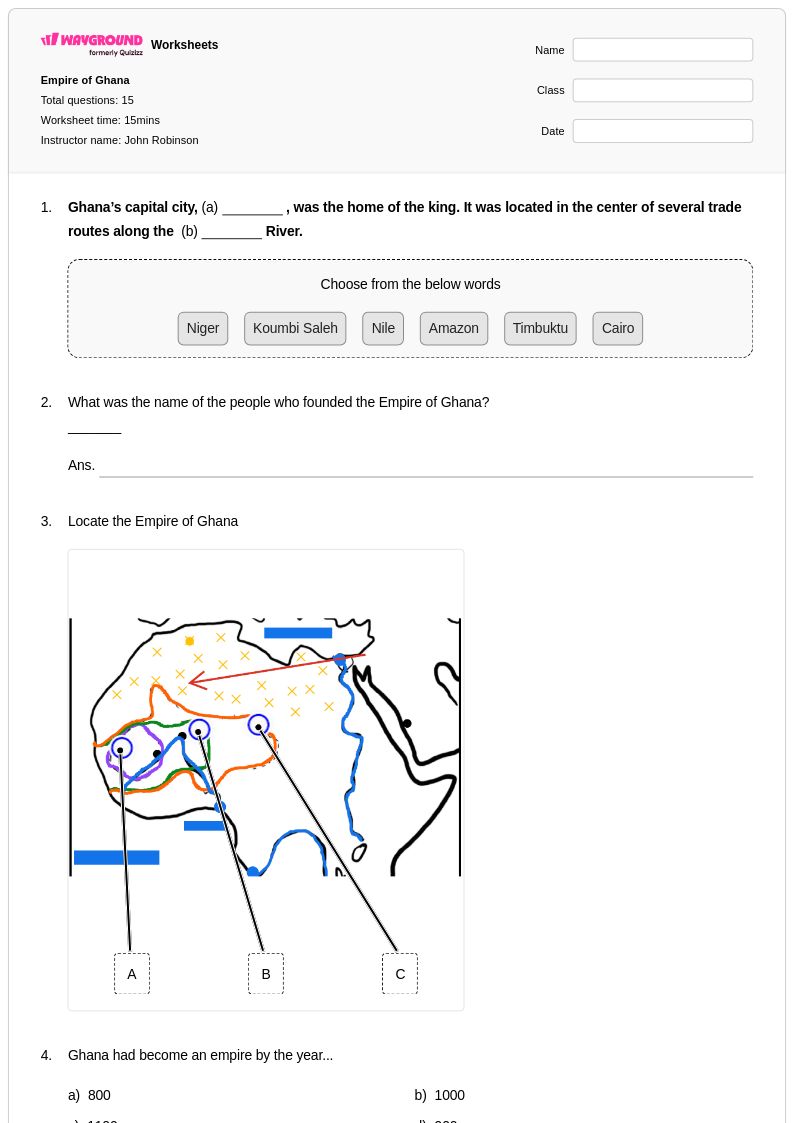
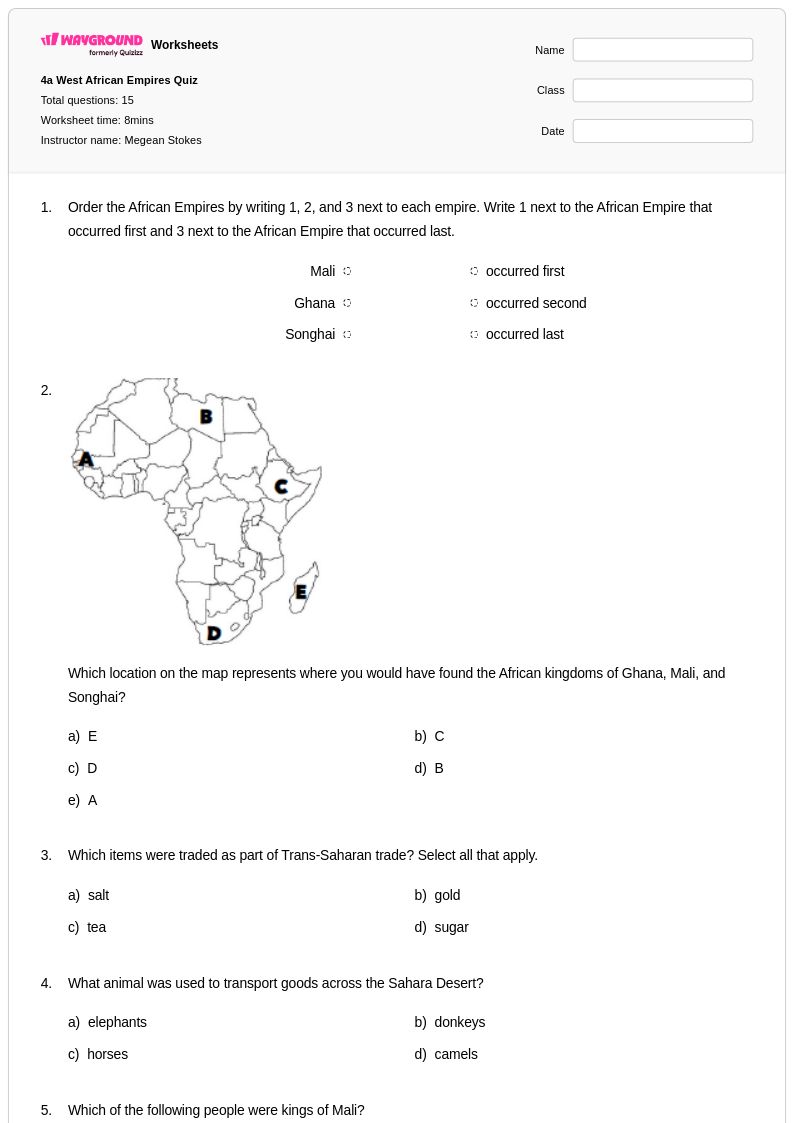
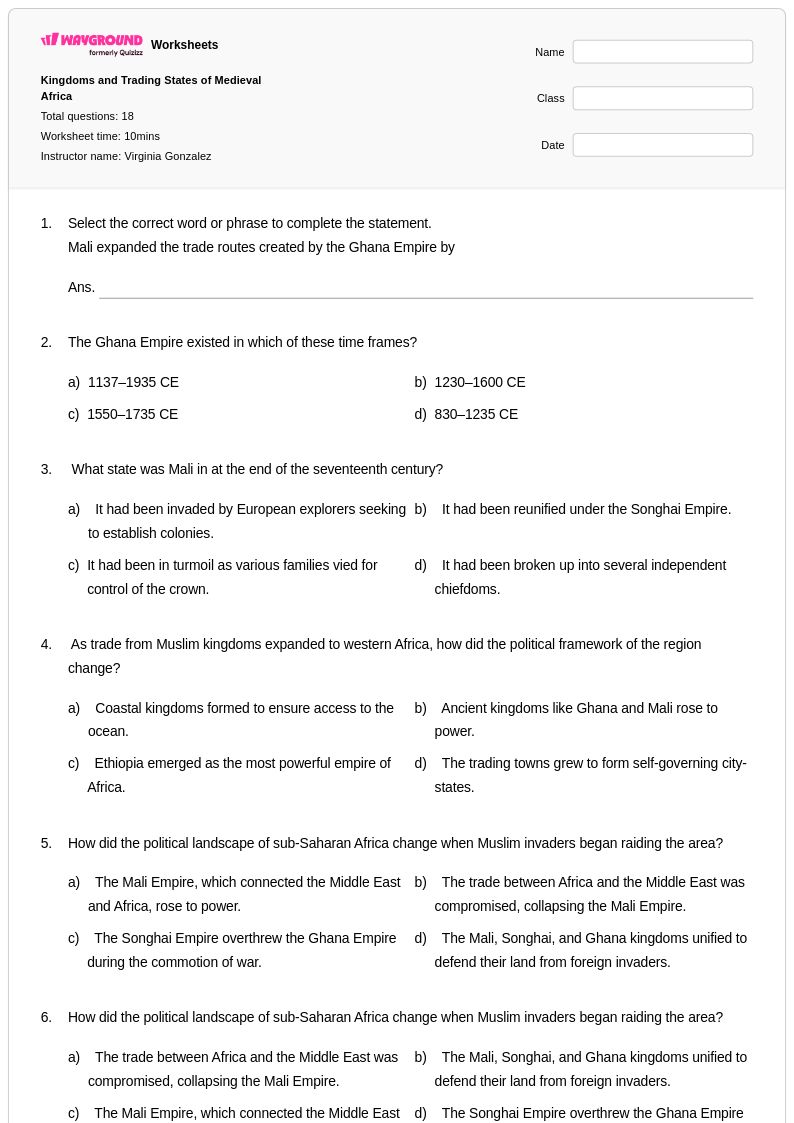
The Songhai Empire worksheets available through Wayground (formerly Quizizz) provide Class 8 students with comprehensive resources to explore one of West Africa's most powerful medieval kingdoms. These educational materials strengthen critical thinking skills through practice problems that examine the empire's political structure, economic foundations built on trans-Saharan trade, and cultural achievements under rulers like Sunni Ali and Askia Muhammad. Students engage with primary source analysis, timeline construction, and comparative studies that highlight Songhai's role in connecting sub-Saharan Africa with Mediterranean civilizations. The collection includes free printables with detailed answer keys, allowing educators to assess student understanding of complex historical concepts while providing opportunities for independent study and review of this influential empire that dominated the Niger River region from the 15th to 16th centuries.
Wayground (formerly Quizizz) supports social studies educators with millions of teacher-created resources specifically designed for middle school history instruction on topics like the Songhai Empire. The platform's robust search and filtering capabilities enable teachers to locate materials that align with state and national history standards, ensuring academic rigor while meeting diverse classroom needs. Digital and printable pdf formats provide flexibility for both in-person and remote learning environments, while built-in differentiation tools allow educators to modify content complexity for varied skill levels within Class 8 classrooms. These comprehensive worksheet collections facilitate effective lesson planning by offering ready-to-use materials for skill practice, targeted remediation for struggling learners, and enrichment opportunities for advanced students exploring medieval African civilizations and their lasting impact on global trade networks.
FAQs
How do I teach the Songhai Empire to middle or high school students?
Teaching the Songhai Empire effectively starts with grounding students in its geographic context along the Niger River before tracing its expansion into the largest empire in African history during the 15th and 16th centuries. From there, anchor instruction around key rulers like Sunni Ali and Askia Muhammad, whose political innovations shaped the empire's structure. Connecting the empire's trade networks, Islamic influence, and cities like Timbuktu and Gao to broader world history themes helps students understand its global significance rather than treating it as an isolated regional topic.
What topics should a Songhai Empire worksheet cover?
A strong Songhai Empire worksheet should cover the empire's geographic origins along the Niger River, its rise to prominence under Sunni Ali, and the administrative and religious reforms of Askia Muhammad. It should also address the economic and cultural role of cities like Timbuktu and Gao, the trans-Saharan trade networks that sustained the empire, the influence of Islam on governance and scholarship, and the factors that led to the empire's eventual decline. Including practice problems that ask students to analyze primary sources or compare the Songhai Empire to other contemporary civilizations deepens historical thinking.
What common mistakes do students make when learning about the Songhai Empire?
Students frequently conflate the Songhai Empire with earlier West African empires like Mali or Ghana, blurring the distinct political and cultural characteristics of each. Another common error is oversimplifying the role of Islam, either dismissing it as purely external influence or ignoring how Askia Muhammad used it as a tool of political legitimacy. Students also tend to underestimate the Songhai Empire's administrative sophistication, often assuming pre-colonial African states lacked complex governance structures. Targeted practice problems that require comparing rulers or analyzing specific administrative decisions can help correct these misconceptions.
How can I use Songhai Empire worksheets to support different learners in my classroom?
Songhai Empire worksheets on Wayground can be used for initial instruction, targeted remediation, or advanced enrichment depending on student needs. Wayground's built-in accommodation tools allow teachers to enable features like Read Aloud for students who benefit from audio support, reduced answer choices to lower cognitive load for struggling learners, and extended time for students who need it. These settings can be applied to individual students while the rest of the class works under default conditions, and they carry over across future sessions without requiring repeated setup.
How do I use Wayground's Songhai Empire worksheets in my classroom?
Wayground's Songhai Empire worksheets are available as printable PDFs for traditional classroom use and in digital formats for technology-integrated environments, including the option to host them as a live quiz on Wayground. Teachers can use the platform's search and filtering tools to locate materials aligned with specific learning standards, then assign them for in-class work, homework, or assessment. Answer keys are included with each worksheet, reducing preparation time and making it straightforward to review student responses after practice or assessment activities.
What exercises help students practice analyzing the Songhai Empire's rise and fall?
Exercises that ask students to sequence key events, from the empire's origins on the Niger River through its peak under Askia Muhammad to its collapse, build a strong chronological foundation. Cause-and-effect questions focused on specific turning points, such as the Moroccan invasion of 1591, push students to think analytically rather than just recall facts. Comparing the empire's trade-based economy to its political vulnerabilities is another effective exercise for developing historical argumentation skills.