Free Printable Water Properties Worksheets for Class 4
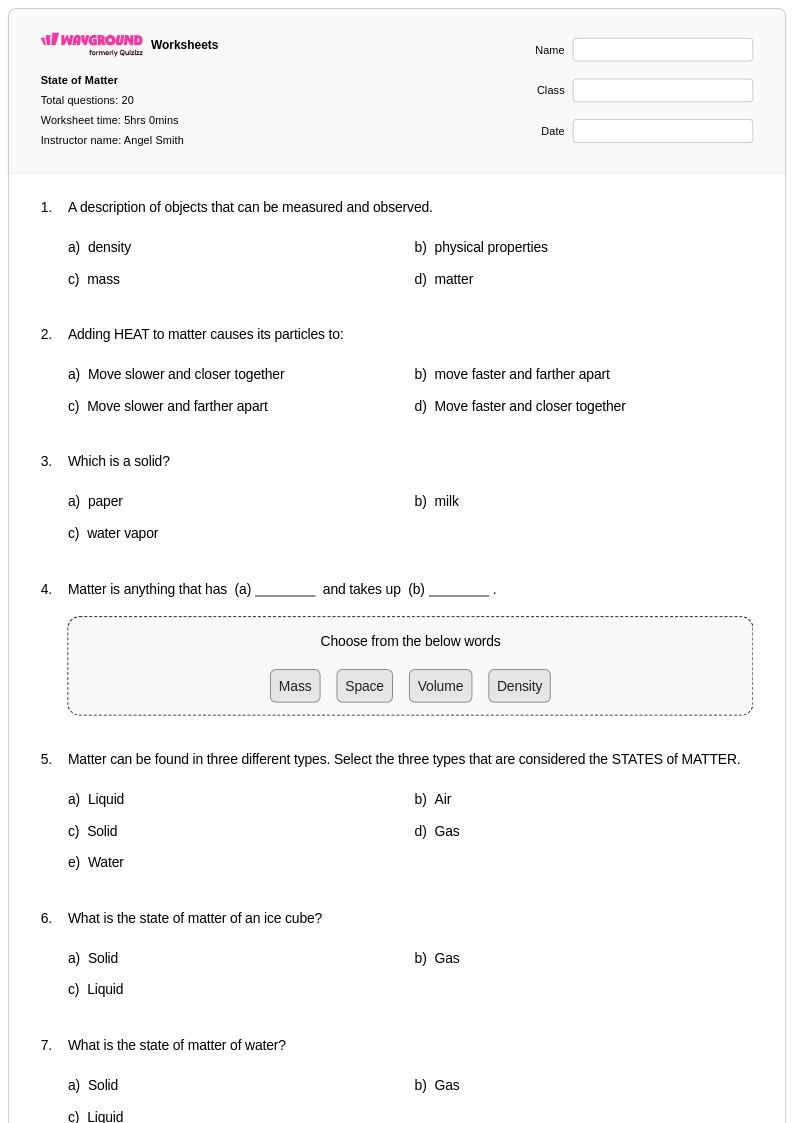
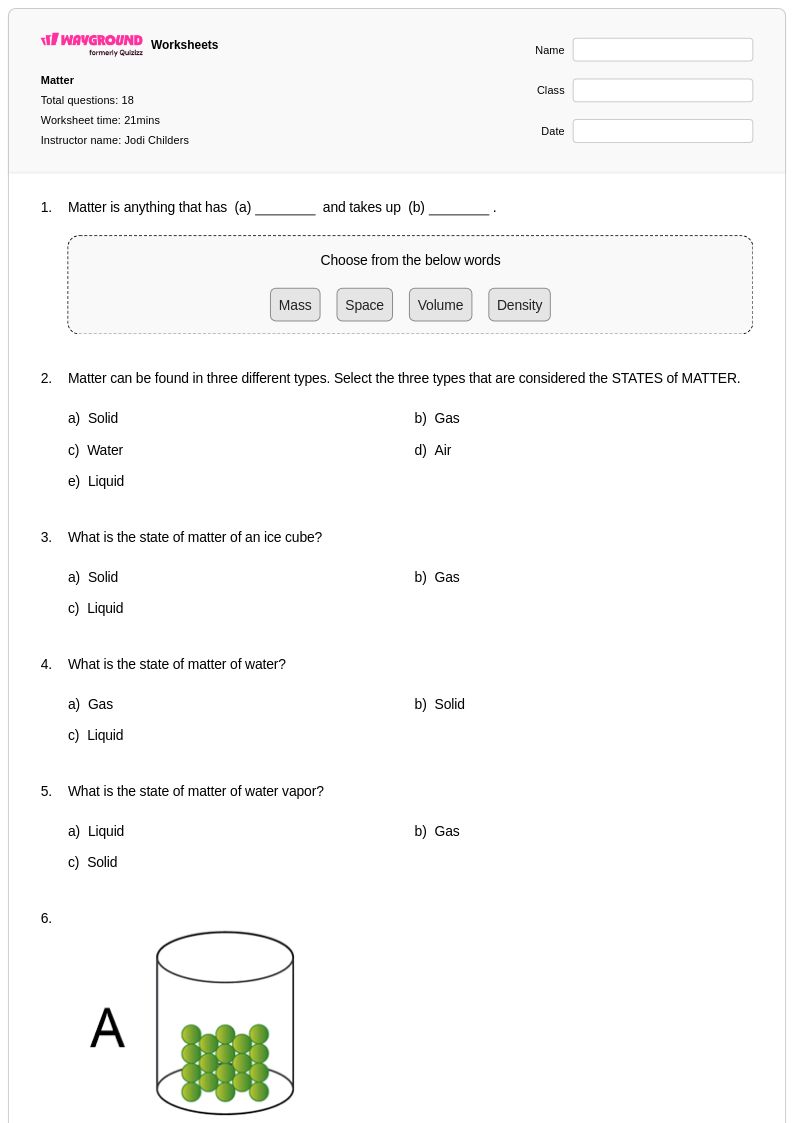
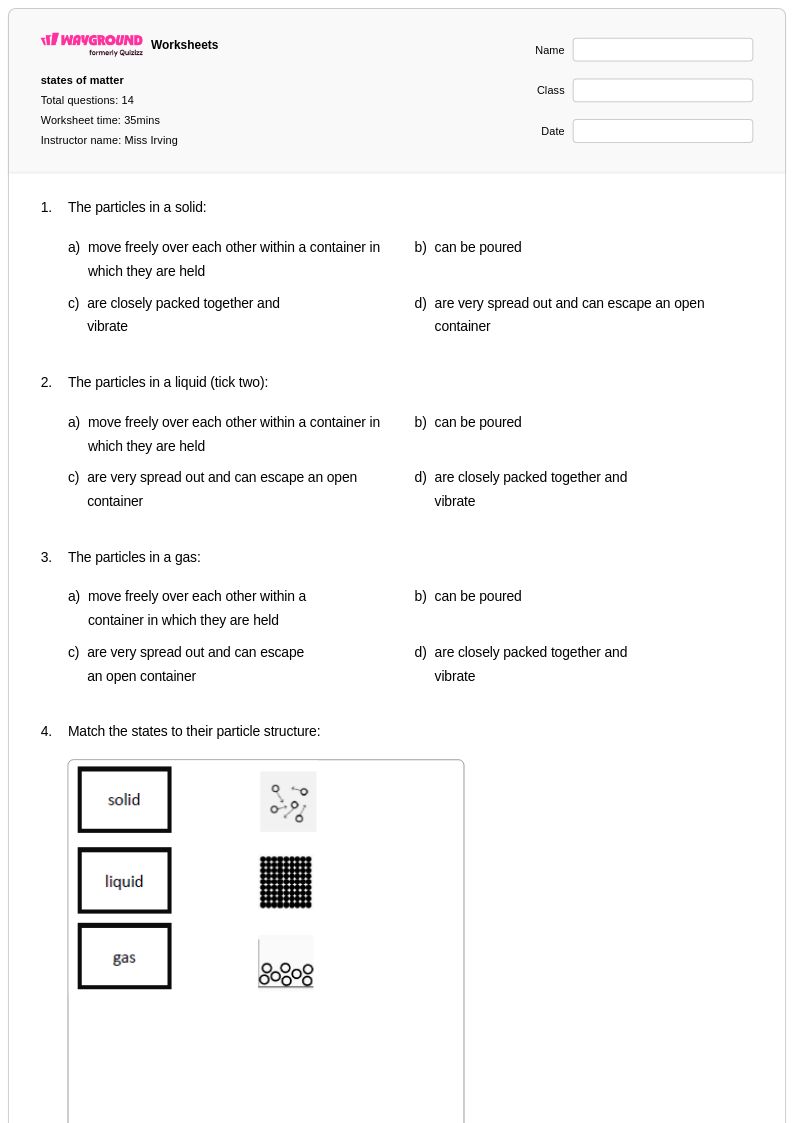
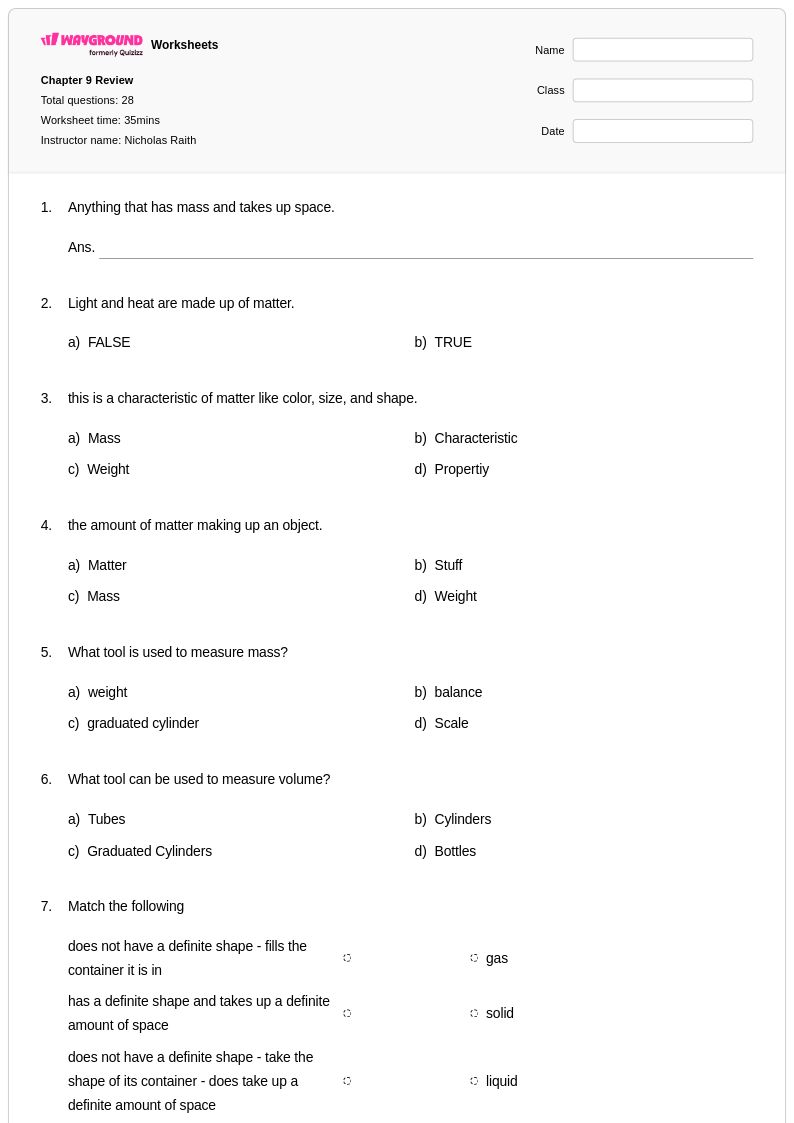
Discover free Class 4 water properties worksheets and printables that help students explore states of matter, density, and physical characteristics through engaging practice problems with complete answer keys.
Explore printable Water Properties worksheets for Class 4
Water properties worksheets for Class 4 students available through Wayground (formerly Quizizz) provide comprehensive exploration of the fundamental characteristics that make water unique and essential to life on Earth. These expertly designed educational materials guide fourth-grade learners through hands-on investigations of water's physical states, density behaviors, surface tension effects, and solvent capabilities. The worksheets strengthen critical scientific observation skills while developing students' ability to conduct controlled experiments, record data systematically, and draw evidence-based conclusions about water's molecular structure and its impact on everyday phenomena. Each resource includes detailed answer keys and is available as free printables in convenient pdf format, featuring age-appropriate practice problems that connect water's properties to real-world applications such as weather patterns, plant growth, and household activities.
Wayground (formerly Quizizz) empowers educators with an extensive collection of teacher-created water properties resources, drawing from millions of high-quality worksheets that align with national science standards for elementary education. The platform's advanced search and filtering capabilities allow teachers to quickly locate materials that match specific learning objectives, whether focusing on states of matter, capillary action, or water's role as the universal solvent. Comprehensive differentiation tools enable instructors to customize content difficulty levels and modify worksheets to accommodate diverse learning needs, while the flexible delivery options support both traditional classroom instruction and digital learning environments. These scientifically accurate resources prove invaluable for lesson planning, targeted remediation of misconceptions about molecular behavior, enrichment activities for advanced learners, and systematic skill practice that builds students' confidence in conducting scientific investigations and interpreting experimental results.
FAQs
How do I teach water properties to science students?
Start by grounding students in water's molecular structure and polarity, since every unique property of water — cohesion, adhesion, surface tension, and thermal stability — stems from hydrogen bonding between water molecules. Visual demonstrations, such as observing water droplets on a leaf or measuring capillary action in a thin tube, help students connect abstract molecular concepts to observable phenomena. From there, structured practice problems that ask students to explain real-world applications (like why ice floats or how water regulates climate) deepen conceptual understanding beyond memorization.
What exercises help students practice water properties?
Effective practice exercises include labeling hydrogen bond diagrams, matching each property (cohesion, adhesion, surface tension, specific heat) to a real-world example, and analyzing data scenarios such as comparing the cooling rates of water versus other liquids. Short-answer questions that ask students to explain why water's polarity enables capillary action in plants or supports aquatic ecosystems push beyond recall and develop scientific reasoning. Combining these question types across a worksheet ensures students practice both identification and application of each property.
What mistakes do students commonly make when learning about water properties?
One of the most common errors is conflating cohesion and adhesion — students often use the terms interchangeably rather than distinguishing water-to-water attraction from water-to-surface attraction. Students also frequently misidentify hydrogen bonds as covalent or ionic bonds, which leads to incorrect explanations of why water has such a high specific heat and boiling point. A third persistent misconception is assuming that surface tension and cohesion are the same property, rather than understanding that surface tension is a consequence of cohesive forces acting at the water-air interface.
How do I differentiate water properties worksheets for students at different levels?
For students who need additional support, reduce cognitive load by providing partially completed diagrams of hydrogen bonding or offering fewer answer choices on identification questions — Wayground allows teachers to apply reduced answer choices to individual students without notifying the rest of the class. Advanced students benefit from open-ended application problems that connect water properties to environmental science contexts, such as analyzing how thermal properties influence ocean circulation. The Read Aloud accommodation on Wayground can also support students who struggle with dense scientific vocabulary in question stems.
How do I use Wayground's water properties worksheets in my classroom?
Wayground's water properties worksheets are available as printable PDFs for traditional classroom use and in digital formats for technology-integrated environments, giving teachers flexibility regardless of their classroom setup. In digital mode, teachers can host the worksheet as a live quiz on Wayground, allowing real-time monitoring of student responses and instant feedback. Answer keys are included with every worksheet, making these resources suitable for independent practice, guided review, or formative assessment without additional teacher preparation.
How does water's polarity connect to its other properties, and how can I explain this to students?
Water's polarity is the root cause of nearly all its distinctive properties, making it the most efficient anchor point for instruction. Because oxygen is more electronegative than hydrogen, each water molecule carries a partial negative charge near the oxygen end and partial positive charges near the hydrogen ends, enabling hydrogen bonds to form between adjacent molecules. These hydrogen bonds are directly responsible for cohesion, adhesion, high surface tension, and water's unusually high specific heat — teaching polarity first gives students a single explanatory framework they can apply to every subsequent property.