

Wayground
Unit 2 Week 5 - Wonders - The Inventor Thinks Up Helicopters - Printable English Worksheets class 3 - Wayground

Unit 2 Week 5 - Wonders - The Inventor Thinks Up Helicopters

16 questions

3rd - 3rd Grade

English

This Grade 3 English worksheet builds close-reading skills through two poems: “The Inventor Thinks Up Helicopters” and “Ornithopter.” Students identify rhyme, similes, alliteration, and repetition; interpret how word choices create motion and intensity; determine each poem’s form; and analyze the poets’ ideas and points of view. They also select text evidence showing how helicopter ideas connect to bugs and how the ornithopter is presented as a silly, unusual invention. The worksheet uses a mix of multiple-choice and multiple-select questions, requiring students to recognize poetic techniques and apply them to quoted lines rather than simply recall definitions. It is designed for Grade 3 English instruction, independent practice, small-group review, or a comprehension check after students read the poems. This free printable worksheet includes a complete answer key, making it practical for guided reading, classroom assessment, or homework.

Worksheet settings

Font size

S
M
L
XL
Worksheets

Unit 2 Week 5 - Wonders - The Inventor Thinks Up Helicopters

Total questions: 16

Name
Class
Date
1.

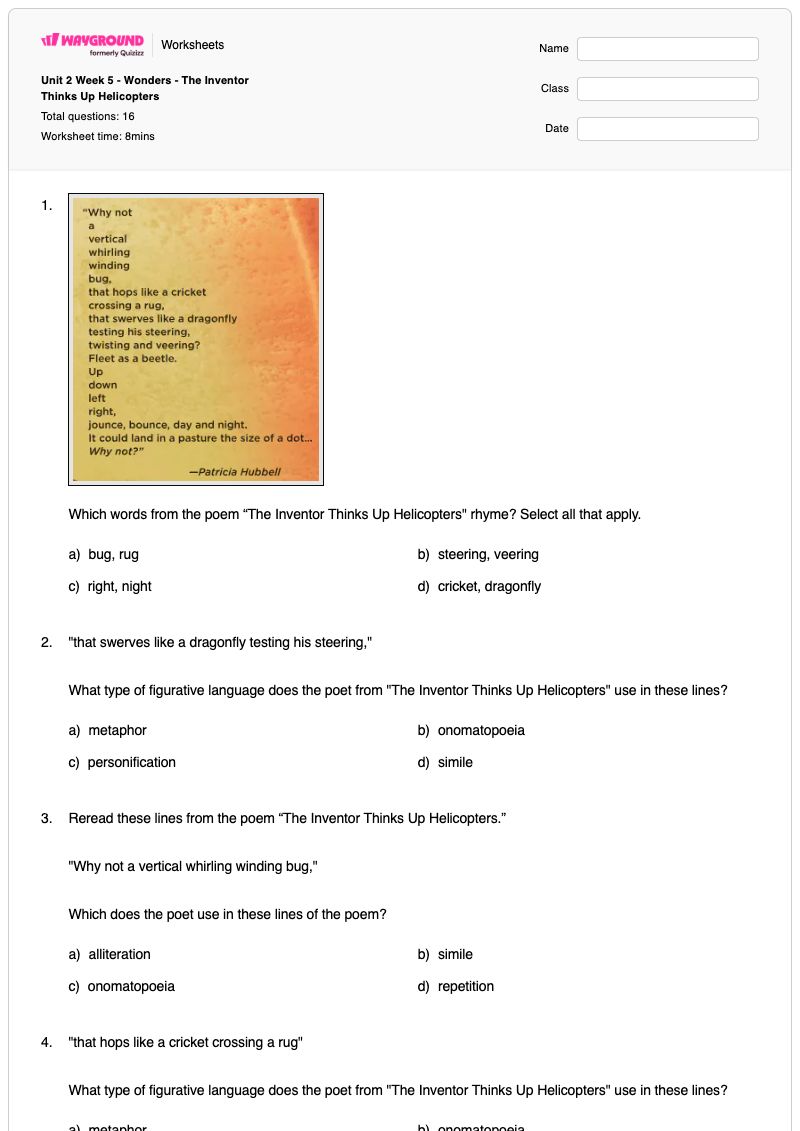
Which words from the poem “The Inventor Thinks Up Helicopters" rhyme? Select all that apply.

a)

bug, rug

b)

steering, veering

c)

right, night

d)

cricket, dragonfly

2.

"that swerves like a dragonfly testing his steering,"


What type of figurative language does the poet from "The Inventor Thinks Up Helicopters" use in these lines?

a)

metaphor

b)

onomatopoeia

c)

personification

d)

simile

3.

Reread these lines from the poem “The Inventor Thinks Up Helicopters.”


"Why not a vertical whirling winding bug,"


Which does the poet use in these lines of the poem?

a)

alliteration

b)

simile

c)

onomatopoeia

d)

repetition

4.

"that hops like a cricket crossing a rug"


What type of figurative language does the poet from "The Inventor Thinks Up Helicopters" use in these lines?

a)

metaphor

b)

onomatopoeia

c)

personification

d)

simile

5.

In "The Inventor Thinks Up Helicopters", what EFFECT does

"whirling and winding",

"up, down, left, right", and

"Jounce, bounce, day and night" create?

Select TWO answers.

a)

It focuses the reader on the motion of the helicopter

b)

It adds speed and intensity to the poem

c)

It makes the reader feel like the helicopter is still

d)

It adds a pause to the poem

6.

Reread the poem “The Inventor Thinks Up Helicopters.”

To what is the poet comparing a helicopter?

a)

bugs

b)

pastures

c)

rugs

d)

spiders

7.

What text evidence (similes) supports that the inventor's ideas for the helicopter came from bugs? (Select THREE).

a)

"hops like a cricket"

b)

"swerves like a dragonfly"

c)

"fleet as a beetle"

d)

"crossing a rug"

8.

Why does the poet from "The Inventor Thinks Up Helicopters" end the poem with

"Why not?"

a)

to show that he does not like to do things that are different

b)

to show that he is an inventor because he takes risks

9.

What type of poem is “The Inventor Thinks

Up Helicopters?”

a)

acrostic

b)

free verse

c)

haiku

d)

limerick

10.

"Needs an engine as light as a feather."


Which does the poet from "Ornithopter" use in these lines of the poem?

a)

alliteration

b)

simile

c)

onomatopoeia

d)

repetition

11.

Which words from the poem “Ornithopter" in Stanza 1 rhyme? Select TWO that apply.

a)

clapping (line 1), snapping (line 2), flapping (line 5)

b)

place (line 3), chase (line 4)

c)

observers (line 1), pilot (line 2)

d)

wings (line 3), wild (line 4)

12.

Which words from the poem “Ornithopter" in Stanza 2 rhyme? Select TWO that apply.

a)

weather (line 1), together (line 2), feather (line 5)

b)

absurd (line 3), bird (line 4)

c)

wind (line 1), wings (line 2)

d)

plane (line 3), think (line 4)

13.

What type of poem is “Ornithopter?”

a)

acrostic

b)

free verse

c)

haiku

d)

limerick

14.

What is the poet's point of view about the ornithopter?

a)

it is a great invention

b)

it is a silly and unusual invention

15.

What lines in the stanza's support the author's point of view that the ornithopter is a silly, unusual invention? (Select THREE)

a)

The pilot was happily snapping bird wings into place for a wild goose chase

b)

On a plane so absurd it thinks it's a bird

c)

The plane needs an engine as light as a feather

d)

But no matter the wind or the weather

16.

How are all the poems ALIKE?

a)

They are all about flying.

b)

They are all about flying machines.

c)

They all have similar rhyming patterns.

d)

They all include similes and metaphors.

Answer Key

Unit 2 Week 5 - Wonders - The Inventor Thinks Up Helicopters

Total questions: 16

1.
a)

bug, rug

, b)

steering, veering

, c)

right, night

2.
d)

simile

3.
a)

alliteration

4.
d)

simile

5.
a)

It focuses the reader on the motion of the helicopter

, b)

It adds speed and intensity to the poem

6.
a)

bugs

7.
a)

"hops like a cricket"

, c)

"fleet as a beetle"

, b)

"swerves like a dragonfly"

8.
b)

to show that he is an inventor because he takes risks

9.
b)

free verse

10.
b)

simile

11.
a)

clapping (line 1), snapping (line 2), flapping (line 5)

, b)

place (line 3), chase (line 4)

12.
a)

weather (line 1), together (line 2), feather (line 5)

, b)

absurd (line 3), bird (line 4)

13.
d)

limerick

14.
b)

it is a silly and unusual invention

15.
a)

The pilot was happily snapping bird wings into place for a wild goose chase

, b)

On a plane so absurd it thinks it's a bird

, c)

The plane needs an engine as light as a feather

16.
b)

They are all about flying machines.

FAQs

What does this worksheet cover about “The Inventor Thinks Up Helicopters” and “Ornithopter”?

This worksheet asks Grade 3 students to analyze rhyme, similes, alliteration, repetition, poem form, point of view, and supporting text evidence in two poems. Students interpret how phrases such as “whirling and winding” create motion, identify “The Inventor Thinks Up Helicopters” as free verse and “Ornithopter” as a limerick, and use quoted lines to support each poem’s ideas.

How can I use this worksheet to teach poetic devices and poem structure?

Have students reread both poems and annotate rhyming word pairs and examples of figurative language before completing the questions. Then discuss how “hops like a cricket” and “as light as a feather” are similes, while repeated motion words increase the poem’s speed and intensity. Finish by asking students to explain how the free-verse structure and limerick form contribute to the poems’ different tones.

What mistakes should I watch for when students complete this poetry worksheet?

Students may select every word pair that sounds related instead of checking whether the words actually rhyme, especially in the multiple-select items. They may also confuse simile with alliteration, choose “crossing a rug” as evidence about bugs even though it is not a bug comparison, or overlook that the questions require multiple correct answers. Remind students to use the quoted lines and the poems’ overall meaning when identifying point of view and text evidence.

How do I assign and grade this worksheet?

Wayground provides this worksheet as a printable PDF and as a digital quiz, and it includes a complete answer key for the multiple-choice and multiple-select questions about the two poems. You can review printable submissions by scanning student work with the Wayground for Teachers app, or assign the digital version for online completion and grading.

How does this worksheet build students’ text-evidence skills?

Several multiple-select questions require students to connect a claim to exact lines from the poems. Students select similes showing that the helicopter ideas came from bugs and identify lines that support the view of the ornithopter as a silly, unusual invention. This practice moves students from naming a poetic feature to explaining how quoted evidence supports an interpretation.

Where can I find more worksheets like this on Wayground?

Wayground offers a broad collection of free printable worksheets and practice problems across subjects, with downloadable PDFs and answer keys to support essential skills and concepts. Browse more resources at https://wayground.com/en-us/worksheets.