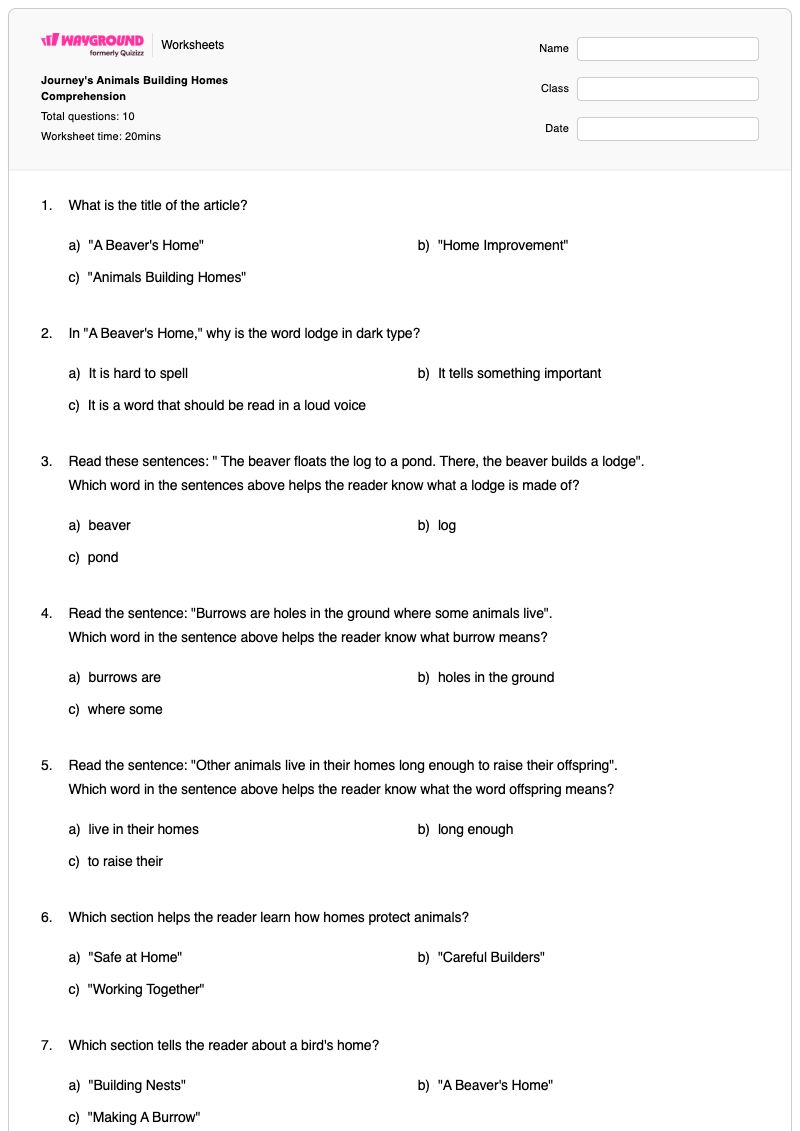
This Grade 2 English worksheet builds reading comprehension through a 10-question multiple-choice study of Animals Building Homes. Students identify the article’s title, use bold print and nearby words to determine the meanings of lodge, burrow, and offspring, locate information in section headings, and connect animals with the homes they build. Questions also ask students to identify details about protection, bird nests, careful building, and animals working together.
Designed for second-grade readers, this worksheet gives students focused practice finding evidence in a nonfiction text rather than relying on general topic knowledge. Use it for guided reading, independent comprehension practice, or a quick check of students’ ability to interpret text features, context clues, headings, and supporting details. It is a free printable worksheet with a complete answer key, making it useful for classroom instruction, homework, or review.
Worksheet settings
Font size
S
M
L
XL
Worksheets
Journey's Animals Building Homes Comprehension
Total questions: 10
Name
Class
Date
1.
What is the title of the article?
a)
"A Beaver's Home"
b)
"Home Improvement"
c)
"Animals Building Homes"
2.
In "A Beaver's Home," why is the word lodge in dark type?
a)
It is hard to spell
b)
It tells something important
c)
It is a word that should be read in a loud voice
3.
Read these sentences: " The beaver floats the log to a pond. There, the beaver builds a lodge".
Which word in the sentences above helps the reader know what a lodge is made of?
a)
beaver
b)
log
c)
pond
4.
Read the sentence: "Burrows are holes in the ground where some animals live".
Which word in the sentence above helps the reader know what burrow means?
a)
burrows are
b)
holes in the ground
c)
where some
5.
Read the sentence: "Other animals live in their homes long enough to raise their offspring".
Which word in the sentence above helps the reader know what the word offspring means?
a)
live in their homes
b)
long enough
c)
to raise their
6.
Which section helps the reader learn how homes protect animals?
a)
"Safe at Home"
b)
"Careful Builders"
c)
"Working Together"
7.
Which section tells the reader about a bird's home?
a)
"Building Nests"
b)
"A Beaver's Home"
c)
"Making A Burrow"
8.
Which animal makes a home called a nest?
a)
a beaver
b)
a mouse
c)
a termite
9.
What does the section called "Careful Builders" tell about?
a)
birds that carefully weave and tie knots
b)
homes that fall apart if they are not built with care
c)
animals that are careful about where they build their home
10.
Which section tells about groups of animals that help each other build a home?
a)
"Building Nests"
b)
"Making a Burrow"
c)
"Working Together"
Answer Key
Journey's Animals Building Homes Comprehension
Total questions: 10
1.
c)
"Animals Building Homes"
2.
b)
It tells something important
3.
b)
log
4.
b)
holes in the ground
5.
c)
to raise their
6.
a)
"Safe at Home"
7.
a)
"Building Nests"
8.
b)
a mouse
9.
a)
birds that carefully weave and tie knots
10.
c)
"Working Together"
140 %
Browse by subjects
Browse by grades
Browse by format
FAQs
What does the Journey's Animals Building Homes comprehension worksheet cover?
This Grade 2 worksheet uses 10 multiple-choice questions to assess comprehension of the nonfiction article Animals Building Homes. Students identify the title and section topics, use surrounding words to infer meanings such as lodge, burrow, and offspring, and locate details about animal homes, protection, nest building, and cooperation.
How can I use this worksheet to teach nonfiction comprehension?
Before students begin, preview the article title and section headings, then model how nearby words can explain an unfamiliar term—for example, how holes in the ground gives a clue to burrow. Have students point to the heading or sentence that supports each multiple-choice answer, especially for questions about Safe at Home, Building Nests, Careful Builders, and Working Together.
What mistakes should I watch for when students complete this worksheet?
Students may choose a familiar animal or home instead of matching an answer to the specific section named in the question, such as confusing a nest with a beaver lodge. They may also select the vocabulary word itself rather than the context clue that explains it, or mistake dark type for an instruction to read aloud instead of recognizing it as emphasis for important information.
How do I assign and grade this Journey's Animals worksheet?
On Wayground, you can assign this worksheet as a printable PDF or as a digital quiz, and it includes a complete answer key for checking the 10 multiple-choice responses. For printable submissions, scan student work with the Wayground for Teachers app to streamline grading.
How can I differentiate this animal-homes comprehension worksheet?
Use the worksheet’s Advanced Settings to adjust font spacing or choose a larger font so the article-based prompts and multiple-choice options are easier to follow. You can also select a dyslexia-friendly font or translate the worksheet into another language when that supports access to the vocabulary and section-heading questions.
Where can I find more worksheets like this on Wayground?
Wayground offers a comprehensive collection of free printable worksheets and practice problems across subjects, with downloadable PDFs and answer keys to help students master essential skills and concepts. Browse more resources at https://wayground.com/en-us/worksheets.


 Worksheets