

Wayground
CER and Critical Thinking Review - Printable English Worksheets class 9 - Wayground

CER and Critical Thinking Review

15 questions

9th - 9th Grade

English

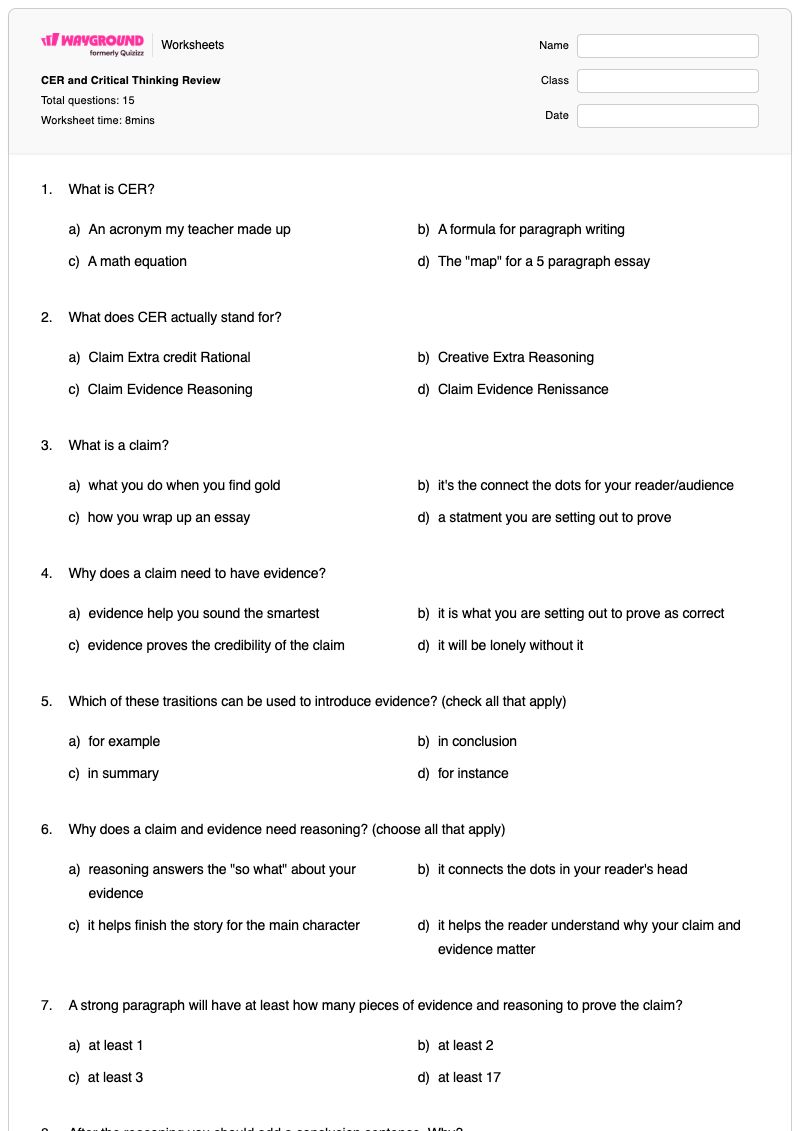
CER and Critical Thinking Review is a free printable Grade 9 English worksheet that checks students’ understanding of Claim, Evidence, and Reasoning as a formula for paragraph writing. The 15-question review includes 12 multiple-choice questions and 3 multiple-select questions covering the meaning and purpose of a claim, why evidence establishes credibility, how reasoning connects evidence to a claim, evidence-introduction transitions, the expectation of at least two evidence-and-reasoning pieces, and the role of a concluding sentence. The worksheet also reinforces critical thinking as a set of strategies for considering and evaluating new ideas. Students identify inference, analysis, evaluation, and interpretation, including recognizing “reading between the lines,” judging an idea using evidence and reasoning, breaking information into parts, and determining meaning. It is designed for Grade 9 English review, formative assessment, or independent practice, and includes a complete answer key for efficient checking.

Worksheet settings

Font size

S
M
L
XL
Worksheets

CER and Critical Thinking Review

Total questions: 15

Name
Class
Date
1.

What is CER?

a)

An acronym my teacher made up

b)

A formula for paragraph writing

c)

A math equation

d)

The "map" for a 5 paragraph essay

2.

What does CER actually stand for?

a)

Claim Extra credit Rational

b)

Creative Extra Reasoning

c)

Claim Evidence Reasoning

d)

Claim Evidence Renissance

3.

What is a claim?

a)

what you do when you find gold

b)

it's the connect the dots for your reader/audience

c)

how you wrap up an essay

d)

a statment you are setting out to prove

4.

Why does a claim need to have evidence?

a)

evidence help you sound the smartest

b)

it is what you are setting out to prove as correct

c)

evidence proves the credibility of the claim

d)

it will be lonely without it

5.

Which of these trasitions can be used to introduce evidence? (check all that apply)

a)

for example

b)

in conclusion

c)

in summary

d)

for instance

6.

Why does a claim and evidence need reasoning? (choose all that apply)

a)

reasoning answers the "so what" about your evidence

b)

it connects the dots in your reader's head

c)

it helps finish the story for the main character

d)

it helps the reader understand why your claim and evidence matter

7.

A strong paragraph will have at least how many pieces of evidence and reasoning to prove the claim?

a)

at least 1

b)

at least 2

c)

at least 3

d)

at least 17

8.

After the reasoning you should add a conclusion sentence. Why?

a)

it reminds the reader of the claim and closes the paragraph

b)

it is pretty

c)

it adds extra words and sentences which all teachers like

d)

it helps the reader understand the importance of everyone speaking their mind at all times

9.

A critical thinker does not necessarily believe everything they hear.

a)

True

b)

False

10.

What are critical thinking skills?

a)

thinking about critical things

b)

ways to answer an essay prompt

c)

ways to determine if you are critically ill

d)

they are strategies people use to consider and evaluate new ideas

11.

What are the four critical thinking skills? (check all that apply)

a)

inference

b)

analyze

c)

claim

d)

evaluate

e)

interpret

12.

When you "read between the lines" that means you are:

a)

making a mountain out of a molehill

b)

interpretation

c)

inference

d)

analysis

13.

When you evaluate an idea or text, what are you doing?

a)

analyzing the source of the problem

b)

making a judgement based on evidence and reasoning

c)

inferring who ate your leftovers

d)

finding similar patterns in a text

14.

When you break something down into its parts, what skill are you using?

a)

performing an analysis

b)

performing an evaluation

c)

making an inference

d)

jumping to a conclusion

15.

To understand the meaning of something in a particular way is to ______________________.

a)

investigate

b)

infer

c)

invent

d)

interpret

Answer Key

CER and Critical Thinking Review

Total questions: 15

1.
b)

A formula for paragraph writing

2.
c)

Claim Evidence Reasoning

3.
d)

a statment you are setting out to prove

4.
c)

evidence proves the credibility of the claim

5.
a)

for example

, d)

for instance

6.
a)

reasoning answers the "so what" about your evidence

, b)

it connects the dots in your reader's head

, d)

it helps the reader understand why your claim and evidence matter

7.
b)

at least 2

8.
a)

it reminds the reader of the claim and closes the paragraph

9.
a)

True

10.
d)

they are strategies people use to consider and evaluate new ideas

11.
a)

inference

, b)

analyze

, d)

evaluate

, e)

interpret

12.
c)

inference

13.
b)

making a judgement based on evidence and reasoning

14.
a)

performing an analysis

15.
d)

interpret

FAQs

What does the CER and Critical Thinking Review worksheet cover?

This Grade 9 English worksheet uses 12 multiple-choice and 3 multiple-select questions to review CER—Claim, Evidence, and Reasoning—and four critical thinking skills: inference, analysis, evaluation, and interpretation. Students identify the purpose of each CER component, select appropriate evidence transitions, explain how reasoning connects evidence to a claim, and distinguish among critical thinking processes.

How can I use this worksheet to teach CER and critical thinking?

Introduce CER by having students define claim, evidence, and reasoning, then model how reasoning answers the “so what?” about evidence. Use the worksheet’s multiple-select items to discuss why “for example” and “for instance” introduce evidence and why a paragraph needs a concluding sentence. Afterward, ask students to explain how inference, analysis, evaluation, and interpretation differ in a paragraph or text they are studying.

What mistakes should I watch for when students complete this CER review?

Students may confuse a claim with a conclusion, select transitions such as “in conclusion” for introducing evidence, or overlook the role of reasoning in connecting evidence to the claim. In the multiple-select questions, watch for students choosing only one correct option or treating all four critical thinking terms as interchangeable—for example, confusing inference with analysis or evaluation.

How do I assign and grade this CER and Critical Thinking Review worksheet?

The worksheet is available as a printable PDF and as a digital quiz on Wayground, and it includes a complete answer key for all 15 questions. You can grade printable submissions by scanning student work with the Wayground for Teachers app, while the digital quiz supports online completion and grading.

Which critical thinking skills are reviewed in this worksheet?

The critical thinking section specifically reviews inference, analysis, evaluation, and interpretation through multiple-choice and multiple-select questions. Students identify inference as reading between the lines, evaluation as making a judgment based on evidence and reasoning, analysis as breaking something into parts, and interpretation as understanding meaning in a particular way.

Where can I find more worksheets like this on Wayground?

Wayground offers a comprehensive collection of free printable worksheets and practice problems across all subjects, with downloadable PDFs and answer keys to help students master essential skills and concepts. Browse more resources at https://wayground.com/en-us/worksheets.