

Wayground
Law of Conservation of Matter - Reactions - Printable Science Worksheets - Wayground

Law of Conservation of Matter - Reactions

15 questions

9th - 9th Grade

Science

Law of Conservation of Matter - Reactions is a free printable Grade 9 science worksheet that helps students connect chemical equations to conservation of matter. The 15-question set includes 13 multiple-choice items and 2 fill-in-the-blank prompts covering single-replacement, double-replacement, synthesis, and decomposition reactions; reactants and products; coefficients and subscripts; atom counting; and mass conservation in a closed system. Students analyze equations such as zinc reacting with hydrochloric acid, identify what coefficients represent, determine whether equations and particle drawings conserve each type of atom, and use conservation of mass to evaluate experimental data. The worksheet also asks students to recognize reactants on the left side and products on the right side of an equation. It is designed for Grade 9 science instruction, review, or assessment and includes a complete answer key for checking student understanding.

Worksheet settings

Font size

S
M
L
XL
Worksheets

Law of Conservation of Matter - Reactions

Total questions: 15

Name
Class
Date
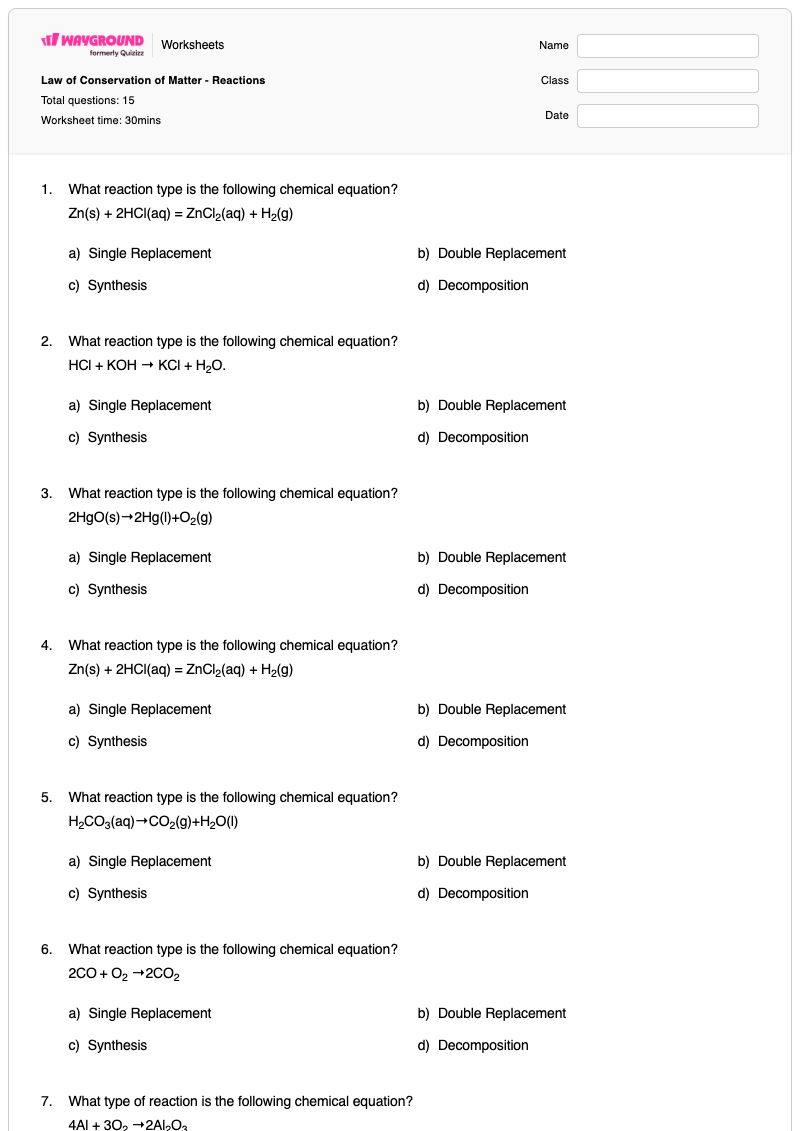
1.

What reaction type is the following chemical equation?

Zn(s) + 2HCl(aq) = ZnCl2(aq) + H2(g)

a)

Single Replacement

b)

Double Replacement

c)

Synthesis

d)

Decomposition

2.

What reaction type is the following chemical equation?

  • HCl + KOH → KCl + H2O.

a)

Single Replacement

b)

Double Replacement

c)

Synthesis

d)

Decomposition

3.

What reaction type is the following chemical equation?

  • 2HgO(s)→2Hg(l)+O2(g)

a)

Single Replacement

b)

Double Replacement

c)

Synthesis

d)

Decomposition

4.

What reaction type is the following chemical equation?

Zn(s) + 2HCl(aq) = ZnCl2(aq) + H2(g)

a)

Single Replacement

b)

Double Replacement

c)

Synthesis

d)

Decomposition

5.

What reaction type is the following chemical equation?

  • H2CO3(aq)→CO2(g)+H2O(l)

a)

Single Replacement

b)

Double Replacement

c)

Synthesis

d)

Decomposition

6.

What reaction type is the following chemical equation?

  • 2CO + O2 →2CO2

a)

Single Replacement

b)

Double Replacement

c)

Synthesis

d)

Decomposition

7.

What type of reaction is the following chemical equation?

4Al + 3O2 →2Al2O3

a)

Single Replacement

b)

Double Replacement

c)

Synthesis

d)

Decomposition

8.

What type of reaction is the following chemical equation?

Fe(s) + CuSO4 (aq)→ FeSO4 (aq) + Cu(s)

a)

Single Replacement

b)

Double Replacement

c)

Synthesis

d)

Decomposition

9.

Jenny wanted to make 3 molecules of a substance made with aluminum and oxygen. How many aluminum and oxygen atoms will she need?

a)

1 aluminum; 1 oxygen

b)

2 aluminum; 3 oxygen

c)

3 aluminum; 6 oxygen

d)

6 aluminum; 9 oxygen

10.

What does the 2 represent in front of H2 represent?

2H2 + O2→2H2O

a)

It indicates that there are 4 hydrogen atoms after you add the coefficient and the subscript

b)

It indicate that there are a total of 4 hydrogen atoms all bonded together as a single molecule

c)

It indicates that there are 2 hydrogen molecules chemical bonded together in the reaction

d)

It indicates that there are 2 separate hydrogen molecules in the reaction

11.

The students' data can be seen here. A chemical reaction clearly took place in the flask. One entry is missing: the mass of the system at the end of the experiment. What amount should be added to the data table?

a)

485.68g

b)

less than 485.68g

c)

more than 485.68g

d)

cannot be determined

12.

A lab group reacts sodium oxide (Na2O) with hydrochloric acid (HCl) to produce sodium chloride (NaCl) and water (H2O). When writing their lab report, they came up with the following equation to represent the reaction:

Na2O + HCl →NaCl + H2O

a)

Yes, since there are 5 reactant atoms and 5 product atoms.

b)

Yes, since there is a subscript of 2 on both sides on the equation.

c)

No, since there are two sodium atoms as reactants, but only one sodium atom as a product.

d)

No, since there is a liquid and a solid as reactants, but a gas and a solid as a product.

13.

A student draws a picture of the products and reactants of a chemical reaction. What, if anything, is wrong with the drawing?

a)

The drawing is wrong because there are more chemicals on the products side.

b)

The drawing is correct because there are 12 compounds on each side of the arrow.

c)

The drawing is wrong because there are different compounds on each side of the arrow.

d)

The drawing is correct because there are 12 atoms of each type on each side of the arrow.

14.

(a)   are located on the LEFT side of the arrow in a chemical reaction.

Example:

  • 2Na(s) + O 2(g) → 2Na 2O(s)

15.

(a)   are located on the RIGHT side of the arrow in a chemical reaction.

Example:

  • 2Na(s) + O 2(g) → 2Na 2O(s)

Answer Key

Law of Conservation of Matter - Reactions

Total questions: 15

1.
a)

Single Replacement

2.
b)

Double Replacement

3.
d)

Decomposition

4.
a)

Single Replacement

5.
d)

Decomposition

6.
c)

Synthesis

7.
c)

Synthesis

8.
a)

Single Replacement

9.
d)

6 aluminum; 9 oxygen

10.
d)

It indicates that there are 2 separate hydrogen molecules in the reaction

11.
a)

485.68g

12.
c)

No, since there are two sodium atoms as reactants, but only one sodium atom as a product.

13.
d)

The drawing is correct because there are 12 atoms of each type on each side of the arrow.

14.
Reactants
15.
Products

FAQs

What does this chemical reactions worksheet cover?

This Grade 9 worksheet combines four reaction classifications—single replacement, double replacement, synthesis, and decomposition—with conservation-of-matter skills. Through 13 multiple-choice questions and 2 fill-in-the-blank items, students interpret coefficients and subscripts, count atoms, identify reactants and products, and use conserved mass to evaluate chemical reactions.

How can I use this worksheet to teach conservation of matter in chemical reactions?

Introduce the worksheet by modeling how to count each type of atom on both sides of an equation, emphasizing that coefficients multiply entire molecules while subscripts describe atoms within a molecule. Then have students classify equations such as Zn + HCl and 2HgO, discuss why the atoms remain accounted for, and finish with the mass-data and particle-drawing questions as applications of the conservation principle.

What mistakes should I watch for when students complete this reactions worksheet?

Students may confuse coefficients with subscripts, such as interpreting the 2 before H₂ as atoms bonded in one molecule instead of two separate hydrogen molecules. They may also classify a decomposition equation as synthesis, count compounds rather than individual atoms in a particle drawing, or assume the mass changes after a reaction. Check that students identify reactants on the left, products on the right, and every atom type on both sides.

How do I assign and grade this chemical reactions worksheet?

Wayground provides this worksheet as a printable PDF and as a digital quiz, and it includes a complete answer key for all 15 items. Assign the digital version for online responses, or print the equation-classification and conservation-of-matter questions for paper practice; printable submissions can be graded by scanning student work with the Wayground for Teachers app.

How can I differentiate this chemical reactions worksheet for my students?

Use the worksheet’s Advanced Settings to adjust font spacing or increase the font size so the chemical equations, answer choices, and fill-in-the-blank prompts are easier to read. You can also enable a dyslexia-friendly font or translate the worksheet into another language while preserving its reaction-classification and conservation-of-matter practice.

Where can I find more worksheets like this on Wayground?

Wayground offers a comprehensive collection of free printable worksheets and practice problems across subjects, with downloadable PDFs and answer keys to support essential skills and concepts. Browse more resources at https://wayground.com/en-us/worksheets.