
DNA and Protein Synthesis is a Grade 8 science worksheet that uses 15 multiple-choice questions to assess core relationships among DNA, RNA, amino acids, and proteins. Students identify how the sequence of nitrogen bases stores genetic information, recognize DNA and RNA differences, apply complementary base-pairing rules, and determine the correct DNA-to-RNA-to-protein sequence.
The questions also distinguish DNA replication, transcription, and translation by the molecules involved in each process. Students apply these ideas to DNA and mRNA sequence examples, including transcribing a DNA strand and identifying which base pairs with uracil. This free printable worksheet with an answer key is useful for introducing, reviewing, or checking Grade 8 understanding of how genetic information is copied and expressed.
Worksheet settings
Font size
S
M
L
XL
Worksheets
DNA and Protein Synthesis
Total questions: 15
Name
Class
Date
1.
What determines the code, or information, of a DNA molecule?
a)
the shape (structure) of the nitrogen bases
b)
the order (sequence) of the nitrogen bases
c)
the color of the nitrogen bases
d)
the frequency (number) of nitrogen bases
2.
When these bond together, they form a protein
a)
Amino Acids
b)
Peptide Bonds
c)
Ribose
d)
Nucleotides
3.
What is the correct sequence?
a)
RNA --> DNA --> Protein
b)
Protein --> RNA --> DNA
c)
DNA --> RNA --> Protein
d)
DNA --> Protein --> RNA
4.
If one strand of DNA has the sequence TTACCG, the sequence of the other strand of the same molecule will be
a)
AATGGC
b)
TTACCG
c)
AACGGC
d)
AATGGG
5.
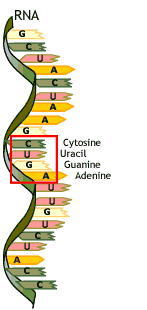
How does RNA differ from DNA?
a)
RNA contains uracil and deoxyribose
b)
RNA contains ribose and thymine
c)
RNA contains uracil and ribose
d)
RNA contains adenine and ribose
6.
How would the DNA sequence GCTATA be transcribed to mRNA?
a)
GCUAUA
b)
CGATAT
c)
CGAUAU
d)
GCUTUT
7.
Which shows the correct complementary base pairing for DNA?
a)
C-A, T-G
b)
A-G, C-T
c)
C-G, U-A
d)
T-A, G-C
8.
Which most directly affects the sequence of amino acids in a protein?
a)
the DNA in the nucleus of the cell
b)
the amino acids found in the cytoplasm
c)
the type of cell in which the protein is made
d)
the region of the cell in which the protein is made
9.
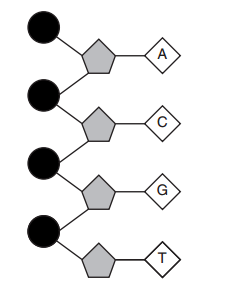
The diagram below represents a portion of a DNA molecule. The letters represent different types of
a)
sugar molecules
b)
nitrogen bases
c)
enzymes
d)
proteins
10.
What is the most basic function of DNA? (all answers are arguably correct, but which one is the most correct)
a)
DNA holds the genetic code that makes protein
b)
DNA keeps us healthy and alive
c)
DNA allows us to reproduce
d)
DNA helps us create energy
11.
Which of the following represents what is occurring during translation?
a)
DNA --> DNA
b)
DNA --> mRNA
c)
mRNA --> amino acid chain (protein)
d)
DNA --> protein
12.
Which of the following represents what is occurring during DNA replication?
a)
DNA --> DNA
b)
DNA --> mRNA
c)
mRNA --> amino acid chain (protein)
d)
DNA --> protein
13.
Which of the following represents what is occurring during DNA transcription?
a)
DNA --> DNA
b)
DNA --> mRNA
c)
mRNA --> amino acid chain (protein)
d)
DNA --> protein
14.
Which of the following represents what is occurring during translation?
a)
DNA --> DNA
b)
DNA --> mRNA
c)
mRNA --> amino acid chain (protein)
d)
DNA --> protein
15.
In RNA, Uracil pairs with ______.
a)
cytosine
b)
adenine
c)
guanine
d)
thymine
Answer Key
DNA and Protein Synthesis
Total questions: 15
1.
b) the order (sequence) of the nitrogen bases
2.
a)
Amino Acids
3.
c) DNA --> RNA --> Protein
4.
a) AATGGC
5.
c) RNA contains uracil and ribose
6.
c) CGAUAU
7.
d) T-A, G-C
8.
a) the DNA in the nucleus of the cell
9.
b) nitrogen bases
10.
a)
DNA holds the genetic code that makes protein
11.
c)
mRNA --> amino acid chain (protein)
12.
a)
DNA --> DNA
13.
b)
DNA --> mRNA
14.
c)
mRNA --> amino acid chain (protein)
15.
b) adenine
140 %
Browse by subjects
Browse by grades
Browse by format
FAQs
What does the DNA and Protein Synthesis worksheet cover?
This Grade 8 science worksheet contains 15 multiple-choice questions on how DNA stores and expresses genetic information. Students identify complementary DNA and RNA base pairs, transcribe DNA into mRNA, distinguish replication from transcription and translation, and connect the sequence DNA → RNA → protein with amino acid formation.
How can I use this worksheet to teach DNA transcription and protein synthesis?
Introduce the worksheet by modeling the information flow from DNA to mRNA to an amino acid chain, then review the base-pairing rules students need for the sequence questions. Have students explain why transcription is DNA → mRNA and translation is mRNA → protein, using the worksheet’s sequence items as evidence before completing the remaining multiple-choice questions independently.
What mistakes should I watch for when students complete this worksheet?
Watch for students reversing the DNA complementary strand, pairing RNA uracil with thymine instead of adenine, or using DNA bases when transcribing mRNA. Students may also confuse replication, transcription, and translation, so check whether they identify the correct starting and ending molecules in each process rather than choosing every answer that mentions DNA or protein.
How do I assign and grade the DNA and Protein Synthesis worksheet?
This worksheet is available as a printable PDF and as a digital quiz on Wayground, and it includes a complete answer key for all 15 multiple-choice questions. Printable submissions can be graded by scanning student work with the Wayground for Teachers app, while the digital version supports online assignment and grading.
How can I differentiate this DNA and Protein Synthesis worksheet for my students?
Use the worksheet’s Advanced Settings to adjust font spacing or choose a larger font size so the base-pairing, transcription, and process-sequence questions are easier to read. You can also apply a dyslexia-friendly font or translate the worksheet into another language when those options support access to the science content.
Where can I find more worksheets like this on Wayground?
Wayground offers a comprehensive collection of free printable worksheets and practice problems across all subjects, with downloadable PDFs and answer keys to help students master essential skills and concepts. Browse more resources at https://wayground.com/en-us/worksheets.