

Wayground
Macroeconomics - Intro Class - Printable Social studies Worksheets kindergarten - Wayground

Macroeconomics - Intro Class

Amrisha Bhardwaj

Created by Amrisha Bhardwaj

10 questions

University

Social studies

This Grade 13 Social Studies worksheet introduces core economic reasoning through opportunity cost and production possibilities curves. Students identify the value of the best alternative forgone, distinguish constant from increasing opportunity cost, interpret straight and concave curves, and analyze how points on a curve represent production choices, resource use, efficiency, and economic growth. The 11-question set combines seven multiple-choice questions, a fill-in-the-blank opportunity-cost calculation using Mars and Venus production data, two open-ended responses, and a video-comprehension item. Students also explain econometrics and identify economic terms in a scene from The Big Short, connecting graphical and numerical reasoning to real-world economic language. This is a free printable worksheet with a complete answer key for classroom practice, review, or assessment.

Worksheet settings

Font size

S
M
L
XL
WaygroundWorksheets

Macroeconomics - Intro Class

Total questions: 10

Name
Class
Date
1.

The value of the best alternative forgone when a decision is made defines

a)

economic good

b)

opportunity cost

c)

scarcity

d)

trade-off

2.

In which way does a straight line production possibilities curve differ from a concave production possibilities curve?

a)

A straight line production possibilities curve has a decreasing opportunity cost.

b)

A straight line production possibilities curve has a constant opportunity cost.

c)

A straight line production possibilities curve has an increasing opportunity cost.

d)

A straight line production possibilities curve does not show opportunity cost.

e)

There is no difference between the two production possibilities curves.

3.

The law of increasing opportunity cost is reflected in the shape of the

a)

production possibilities curve concave to the origin.

b)

production possibilities curve convex to the origin.

c)

horizontal production possibilities curve.

d)

straight-line production possibilities curve.

e)

upward-sloping production possibilities curve.

4.
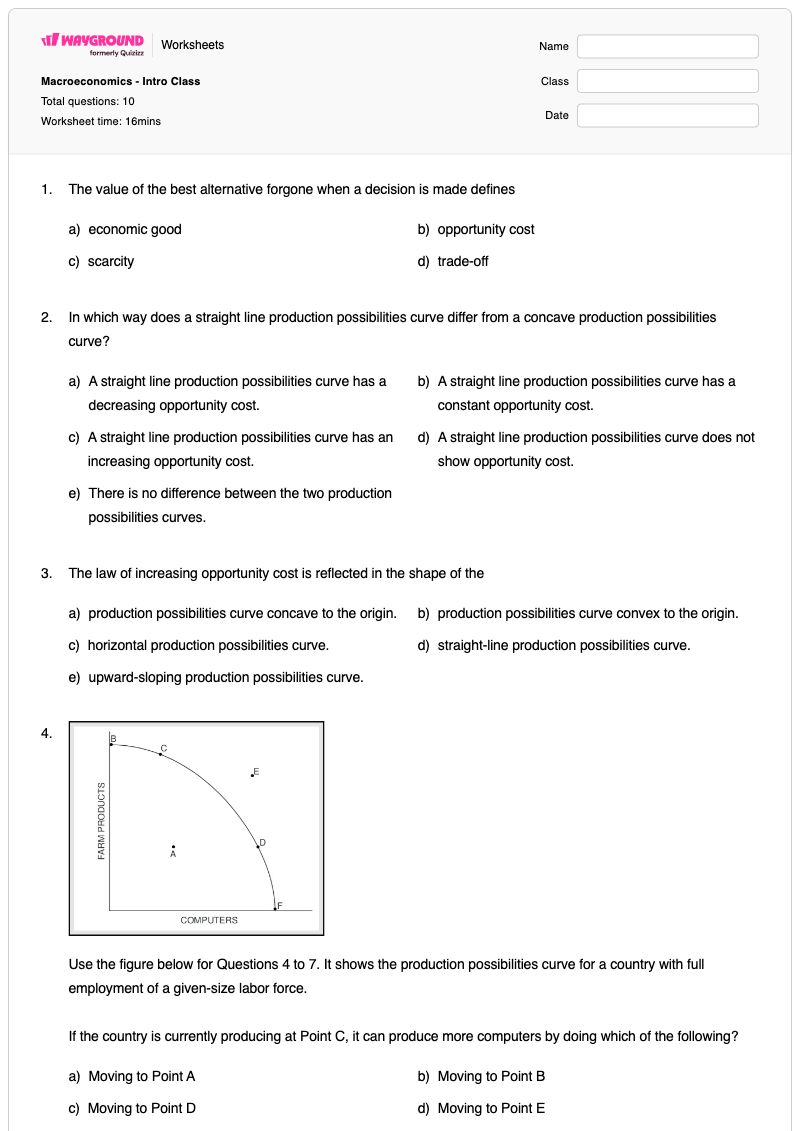
Use the figure below for Questions 4 to 7. It shows the production possibilities curve for a country with full employment of…

Use the figure below for Questions 4 to 7. It shows the production possibilities curve for a country with full employment of a given-size labor force.

If the country is currently producing at Point C, it can produce more computers by doing which of the following?

a)
  1. Moving to Point A

b)
  1. Moving to Point B

c)
  1. Moving to Point D

d)
  1. Moving to Point E

e)
  1. Remaining at Point C, since computer production is maximized

5.

Which of the following statements about the

production possibilities curve is true?

a)
  1.  Point A is not attainable in a developed society.

b)
  1. Point D is not attainable given the society’s resources.

c)
  1. The relative position of Points C and D reflect production alternatives rather than relative prices.

d)
  1. Elimination of unemployment will move the production possibilities curve to the right, closer to Point E.

e)
  1. Point E lies outside the production possi- bilities curve because it represents a combi- nation of resources not desired by the citi- zens of the country.

6.

How might Point E be attained?

a)

If the country’s resources were more fully employed

b)

If the country’s resources were shifted to encourage more efficient use of scarce resources

c)

If improvements in technology occurred in either the computer sector or the farm products sector

d)

If firms decreased their output of computers

e)

If the nation used more of its scarce resources to produce farm products

7.

Which of the following points would most likely lead to a rightward shift of the production possibilities curve over time?

a)

Point A

b)

Point B

c)

Point C

d)

Point D

e)

Point E

8.
Two nations, Mars and Venus, each produce food and clothing. The table above gives points on each nation’s production…

Two nations, Mars and Venus, each produce food and clothing. The table above gives points on each nation’s production possibilities curve. The asterisks indicate their current point of production.

In Mars, the opportunity cost of obtaining the first two units of food is how many units of clothing?

(a)  

9.

What do you understand by Econometrics?

4 lines

10.

Answer the questions below after watching the video

10.

Explain any 3 Economics termed being used in this scene from the movie 'Big Short'.

4 lines
WaygroundAnswer Key

Macroeconomics - Intro Class

Total questions: 10

1.
b)

opportunity cost

2.
b)

A straight line production possibilities curve has a constant opportunity cost.

3.
a)

production possibilities curve concave to the origin.

4.
c)
  1. Moving to Point D

5.
c)
  1. The relative position of Points C and D reflect production alternatives rather than relative prices.

6.
c)

If improvements in technology occurred in either the computer sector or the farm products sector

7.
e)

Point E

8.
6
9.
n/a
10.
10.
n/a

FAQs

What does this worksheet cover, and how does it build introductory economics skills?

This worksheet focuses on opportunity cost, production possibilities curves, constant and increasing opportunity cost, resource allocation, efficiency, and economic growth. Its multiple-choice items require students to interpret curve shapes and labeled points, while the Mars-and-Venus fill-in-the-blank item applies opportunity-cost calculation to production data. The open-ended and video-comprehension questions extend the work to econometrics and economic terminology in a real-world film context.

How can I use this worksheet to teach opportunity cost and production possibilities curves?

Use the first questions to establish that opportunity cost is the best alternative forgone, then have students compare the meanings of straight and concave production possibilities curves. When students reach the figure-based questions, ask them to explain what moving among Points A–E changes: the production combination, resource use, or the economy’s productive capacity. Finish with the Mars-and-Venus calculation so students connect the graph-based reasoning to a numerical opportunity-cost example.

What mistakes should I watch for when students complete this economics worksheet?

Students may choose “trade-off” instead of “opportunity cost” without identifying that the question asks for the value of the best alternative forgone. They may also confuse a straight-line curve’s constant opportunity cost with the increasing opportunity cost represented by a concave curve, or treat a point outside the curve as merely undesirable rather than currently unattainable. For the Mars-and-Venus item, check that students calculate the clothing forgone for the specified first two units of food rather than using the total table change; in the open-ended responses, look for defined economic terms and explanations rather than isolated examples.

How do I assign and grade this macroeconomics worksheet?

This worksheet is available as a printable PDF and as a digital quiz on Wayground, with a complete answer key for the multiple-choice and fill-in-the-blank items. You can grade printable submissions by scanning student work with the Wayground for Teachers app, then review the open-ended responses separately for accurate explanations of econometrics and the economic terms from The Big Short. The printable format also supports schools that want to reduce screen time.

How can I differentiate this production possibilities curve worksheet for my students?

In the worksheet’s Advanced Settings, adjust font spacing or choose a larger font size to make the labeled curve, answer choices, and Mars-and-Venus data easier to read. You can also enable a dyslexia-friendly font for students who benefit from that format or translate the worksheet into another language while preserving its graph-analysis and opportunity-cost tasks.

Where can I find more free worksheets like this on Wayground?

Wayground offers a comprehensive collection of free printable worksheets and practice problems across subjects, with downloadable PDFs and answer keys to support mastery of essential skills and concepts. Browse more resources at https://wayground.com/en-us/worksheets.