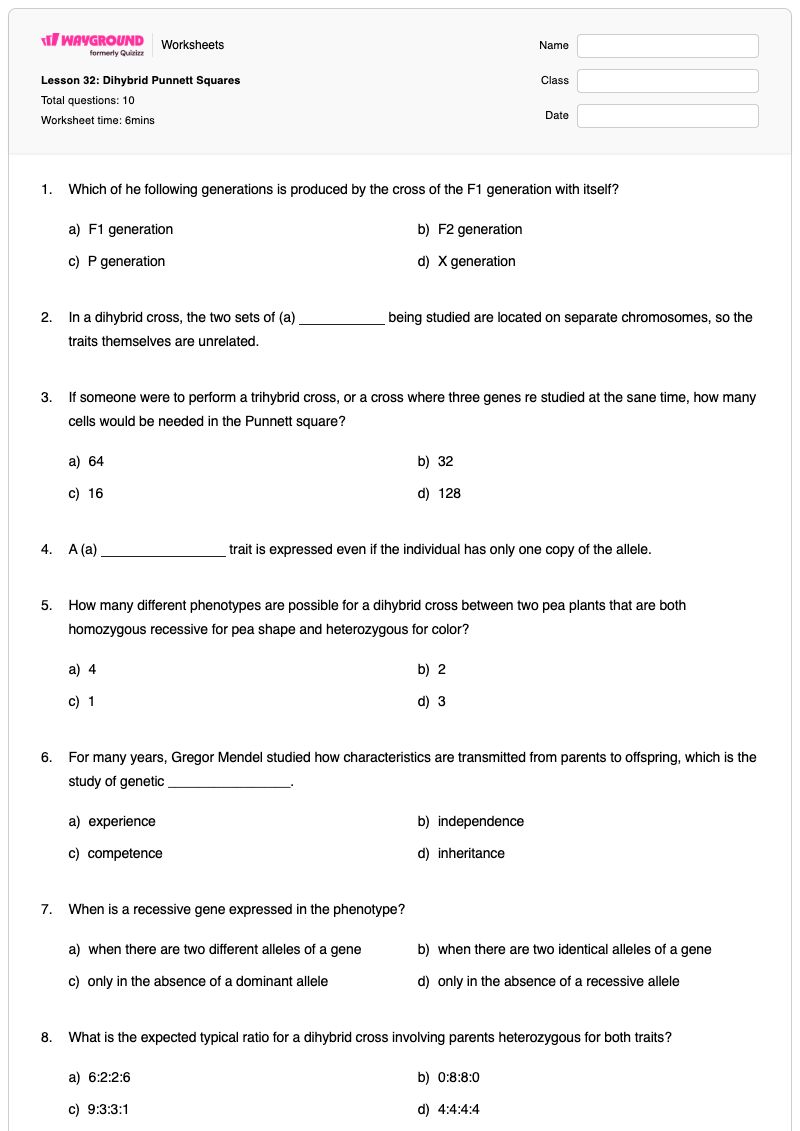
Lesson 32: Dihybrid Punnett Squares is a Grade 9–12 science worksheet that builds understanding of how two traits are inherited at the same time. Students identify F1 and F2 generations, distinguish dominant and recessive allele expression, recall genetic inheritance vocabulary, determine possible genotypes and phenotypes, calculate Punnett square sizes, and recognize the expected 9:3:3:1 phenotypic ratio for a standard dihybrid cross.
The worksheet uses seven multiple-choice questions, two fill-in-the-blank items, and one multiple-select question. Students apply dihybrid-cross reasoning to parent genotypes, including homozygous and heterozygous combinations, and identify the gametes a Wwgg tomato plant can produce. This free printable worksheet is designed for high school biology practice, review, or formative assessment and includes a complete answer key for efficient checking.
Worksheet settings
Font size
S
M
L
XL
Worksheets
Lesson 32: Dihybrid Punnett Squares
Total questions: 10
Name
Class
Date
1.
Which of he following generations is produced by the cross of the F1 generation with itself?
a)
F1 generation
b)
F2 generation
c)
P generation
d)
X generation
2.
In a dihybrid cross, the two sets of (a) being studied are located on separate chromosomes, so the traits themselves are unrelated.
3.
If someone were to perform a trihybrid cross, or a cross where three genes re studied at the sane time, how many cells would be needed in the Punnett square?
a)
64
b)
32
c)
16
d)
128
4.
A (a) trait is expressed even if the individual has only one copy of the allele.
5.
How many different phenotypes are possible for a dihybrid cross between two pea plants that are both homozygous recessive for pea shape and heterozygous for color?
a)
4
b)
2
c)
1
d)
3
6.
For many years, Gregor Mendel studied how characteristics are transmitted from parents to offspring, which is the study of genetic ________________.
a)
experience
b)
independence
c)
competence
d)
inheritance
7.
When is a recessive gene expressed in the phenotype?
a)
when there are two different alleles of a gene
b)
when there are two identical alleles of a gene
c)
only in the absence of a dominant allele
d)
only in the absence of a recessive allele
8.
What is the expected typical ratio for a dihybrid cross involving parents heterozygous for both traits?
a)
6:2:2:6
b)
0:8:8:0
c)
9:3:3:1
d)
4:4:4:4
9.
How many different genotypes are possible for a dihybrid cross between a parent that is homozygous dominant for both traits and a parent that is heterozygous for both traits?
a)
8
b)
2
c)
4
d)
6
10.
A tomato plant has a genotype Wwgg. Select all possible genetic combinations that could be present in a single grain of pollen from this plant.
a)
wg
b)
WwGg
c)
Wg
d)
WG
e)
wwgg
Answer Key
Lesson 32: Dihybrid Punnett Squares
Total questions: 10
1.
b)
F2 generation
2.
genes
3.
a)
64
4.
dominant
5.
b)
2
6.
d)
inheritance
7.
c)
only in the absence of a dominant allele
8.
c)
9:3:3:1
9.
c)
4
10.
a)
wg
, c)
Wg
140 %
Browse by subjects
Browse by grades
Browse by format
FAQs
What does the Dihybrid Punnett Squares worksheet cover?
This worksheet practices interpreting dihybrid inheritance through multiple-choice, fill-in-the-blank, and multiple-select questions. Students identify F1 and F2 generations, apply dominant and recessive allele rules, determine possible genotypes and phenotypes, calculate Punnett square cell requirements, recognize the 9:3:3:1 ratio, and select valid gametes from a Wwgg genotype.
How can I use this worksheet to teach dihybrid Punnett squares?
Introduce the worksheet by reviewing how a dihybrid cross tracks two genes and how homozygous or heterozygous parent genotypes produce different gametes. Have students explain their reasoning for the genotype and phenotype questions, then use the Wwgg pollen item to connect allele separation to the gametes placed in a Punnett square. Finish by discussing why a heterozygous cross for both traits produces the expected 9:3:3:1 phenotypic ratio.
What mistakes should I watch for when students complete this dihybrid-cross worksheet?
Students may confuse the F1 and F2 generations, treat a dominant trait as requiring two dominant alleles, or choose gametes that contain two alleles for the same gene instead of one allele from each gene. Watch for errors in distinguishing genotype counts from phenotype counts, misremembering the 9:3:3:1 ratio, and selecting invalid pollen combinations such as WwGg or wwgg from a Wwgg plant.
How do I assign and grade this Dihybrid Punnett Squares worksheet?
The worksheet is available as a printable PDF and as a digital quiz on Wayground, so you can assign the format that fits your biology lesson. It includes a complete answer key for the seven multiple-choice, two fill-in-the-blank, and one multiple-select items. For printable submissions, scan student work with the Wayground for Teachers app to support grading.
How can I differentiate this dihybrid Punnett squares worksheet for my students?
Use the worksheet’s Advanced Settings to adjust font spacing and font size so the allele combinations, ratios, and answer choices are easier to read. You can also enable a dyslexia-friendly font or translate the worksheet into another language while keeping its dihybrid-cross question format.
Where can I find more worksheets like this on Wayground?
Wayground offers a comprehensive collection of free printable worksheets and practice problems across subjects, with downloadable PDFs and answer keys to help students master essential skills and concepts. Browse more resources at https://wayground.com/en-us/worksheets.


 Worksheets