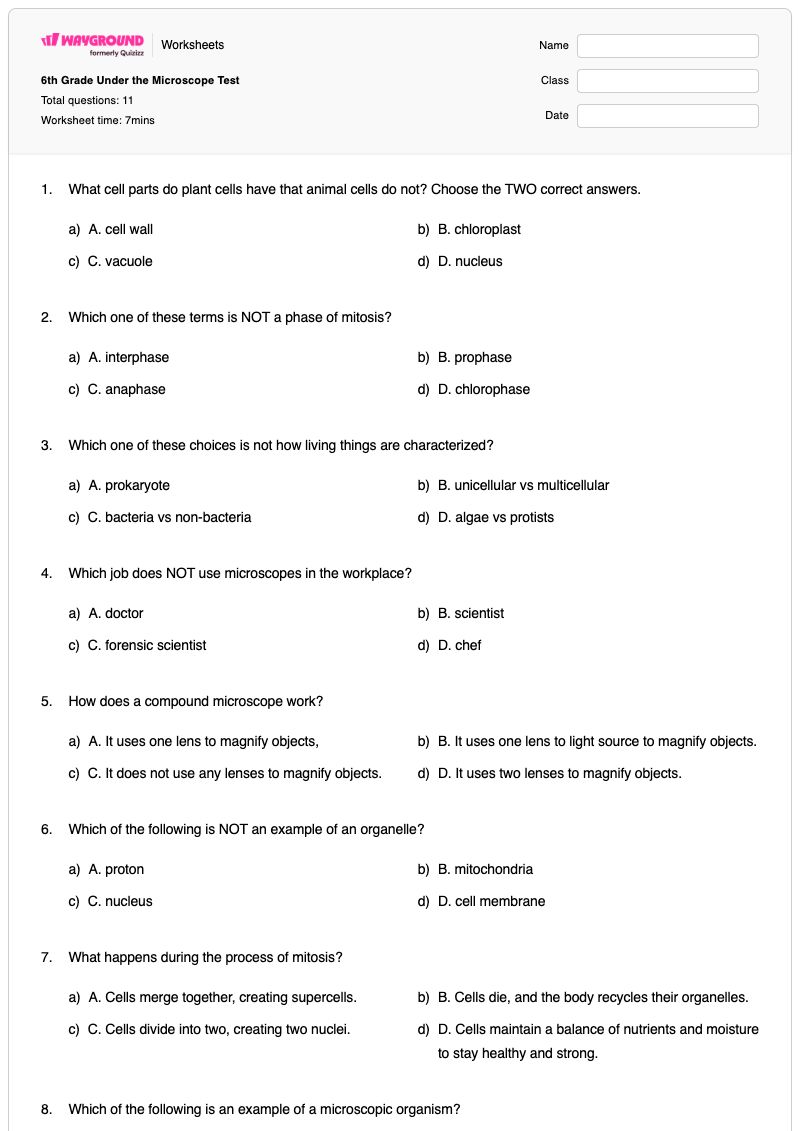
6th Grade Under the Microscope Test is a free printable science worksheet for Grade 6 students reviewing how microscopes support the study of cells and microscopic organisms. Its 11 items include one multiple-select question, nine multiple-choice questions, and one drag-and-drop image-labeling task. Students identify plant-cell structures that distinguish them from animal cells, recognize organelles, describe the purpose of magnification and the objective lens, and identify the basic outcome of mitosis. They also distinguish microscope-related vocabulary and applications from unrelated terms or jobs.
The final drag-and-drop activity asks students to label a plant cell using cell membrane, cytoplasm, mitochondria, cell wall, nucleus, chloroplast, and vacuole. This combination checks both science vocabulary recognition and visual identification of cell structures. Use the worksheet as a review, independent practice activity, or end-of-unit check for understanding. It includes a complete answer key and is available as a free printable worksheet for classroom or take-home use.
Worksheet settings
Font size
S
M
L
XL
Worksheets
6th Grade Under the Microscope Test
Total questions: 11
Name
Class
Date
1.
What cell parts do plant cells have that animal cells do not? Choose the TWO correct answers.
a)
A. cell wall
b)
B. chloroplast
c)
C. vacuole
d)
D. nucleus
2.
Which one of these terms is NOT a phase of mitosis?
a)
A. interphase
b)
B. prophase
c)
C. anaphase
d)
D. chlorophase
3.
Which one of these choices is not how living things are characterized?
a)
A. prokaryote
b)
B. unicellular vs multicellular
c)
C. bacteria vs non-bacteria
d)
D. algae vs protists
4.
Which job does NOT use microscopes in the workplace?
a)
A. doctor
b)
B. scientist
c)
C. forensic scientist
d)
D. chef
5.
How does a compound microscope work?
a)
A. It uses one lens to magnify objects,
b)
B. It uses one lens to light source to magnify objects.
c)
C. It does not use any lenses to magnify objects.
d)
D. It uses two lenses to magnify objects.
6.
Which of the following is NOT an example of an organelle?
a)
A. proton
b)
B. mitochondria
c)
C. nucleus
d)
D. cell membrane
7.
What happens during the process of mitosis?
a)
A. Cells merge together, creating supercells.
b)
B. Cells die, and the body recycles their organelles.
c)
C. Cells divide into two, creating two nuclei.
d)
D. Cells maintain a balance of nutrients and moisture to stay healthy and strong.
8.
Which of the following is an example of a microscopic organism?
a)
A. plankton
b)
B. jellyfish
c)
C. sharks
d)
D. dolphins
9.
Why would you want to magnify an object?
a)
A. You want to get rid of the smell coming from an object.
b)
B. You want to make the image smaller so you can fit the picture on your screen.
c)
C. You want to clean the object so that no new diseases are brought into the lab.
d)
D. You want to make the image larger to examine it more closely.
10.
What does the objective lens do in a microscope?
a)
A. It is where you put your slide to view it.
b)
B. It forms the image of the object being studied.
c)
C. It is what makes the objects larger or smaller.
d)
D. It reflects the light for better resolution.
11.
Label the parts of the plant cell
a)
cell membrane
b)
cytoplasm
c)
mitochondria
d)
cell wall
e)
nucleus
f)
chloroplast
g)
vacuole
1
2
3
4
5
6
7
1)
2)
3)
4)
5)
6)
7)
Answer Key
6th Grade Under the Microscope Test
Total questions: 11
1.
a)
A. cell wall
, b)
B. chloroplast
2.
d)
D. chlorophase
3.
d)
D. algae vs protists
4.
d)
D. chef
5.
d)
D. It uses two lenses to magnify objects.
6.
a)
A. proton
7.
c)
C. Cells divide into two, creating two nuclei.
8.
a)
A. plankton
9.
d)
D. You want to make the image larger to examine it more closely.
10.
b)
B. It forms the image of the object being studied.
11.
e
f
g
d
c
b
a
140 %
Browse by subjects
Browse by grades
Browse by format
FAQs
What does the 6th Grade Under the Microscope Test help students learn?
This Grade 6 science worksheet assesses students’ understanding of microscope use, magnification, the objective lens, plant-cell structures, organelles, microscopic organisms, and mitosis. Nine multiple-choice questions and one multiple-select question require students to identify accurate terms, functions, and examples, while the drag-and-drop item requires them to label key parts of a plant cell. Together, these tasks build science-vocabulary recognition and visual identification skills.
How can I use this worksheet to teach microscope and cell concepts?
Introduce the worksheet by reviewing a microscope’s purpose, how magnification helps observation, and the role of the objective lens. Then have students complete the multiple-choice items and explain why each selected answer fits, especially when distinguishing organelles from non-organelles. Finish with the drag-and-drop plant-cell labeling task so students connect the vocabulary to a visual model.
What mistakes should I watch for when students complete this worksheet?
Students may select only one response on the multiple-select plant-cell question, overlook that the item requires two answers, or confuse plant-cell structures with parts shared by animal cells. They may also mix up the objective lens with the slide platform or light-related microscope components, and confuse a cell structure such as a mitochondrion with a non-organelle term. In the labeling activity, check whether students place cell wall, cell membrane, chloroplast, vacuole, and nucleus in the correct plant-cell locations.
How do I assign and grade this Under the Microscope worksheet?
Assign it as a printable PDF or as a digital quiz on Wayground, and use the complete answer key to grade the multiple-select, multiple-choice, and plant-cell labeling responses. Printable submissions can also be graded by scanning student work with the Wayground for Teachers app.
How can I differentiate this plant-cell and microscope worksheet for my students?
Use the worksheet’s Advanced Settings to adjust font spacing and font size so the microscope questions and plant-cell labels are easier to read. You can also enable a dyslexia-friendly font or translate the worksheet into another language, which can support access to the science vocabulary and labeling directions.
Where can I find more free worksheets like this on Wayground?
Wayground offers a broad collection of free printable worksheets and practice problems across subjects, with downloadable PDFs and answer keys to help students master essential skills and concepts. Browse more resources at https://wayground.com/en-us/worksheets.

 Worksheets