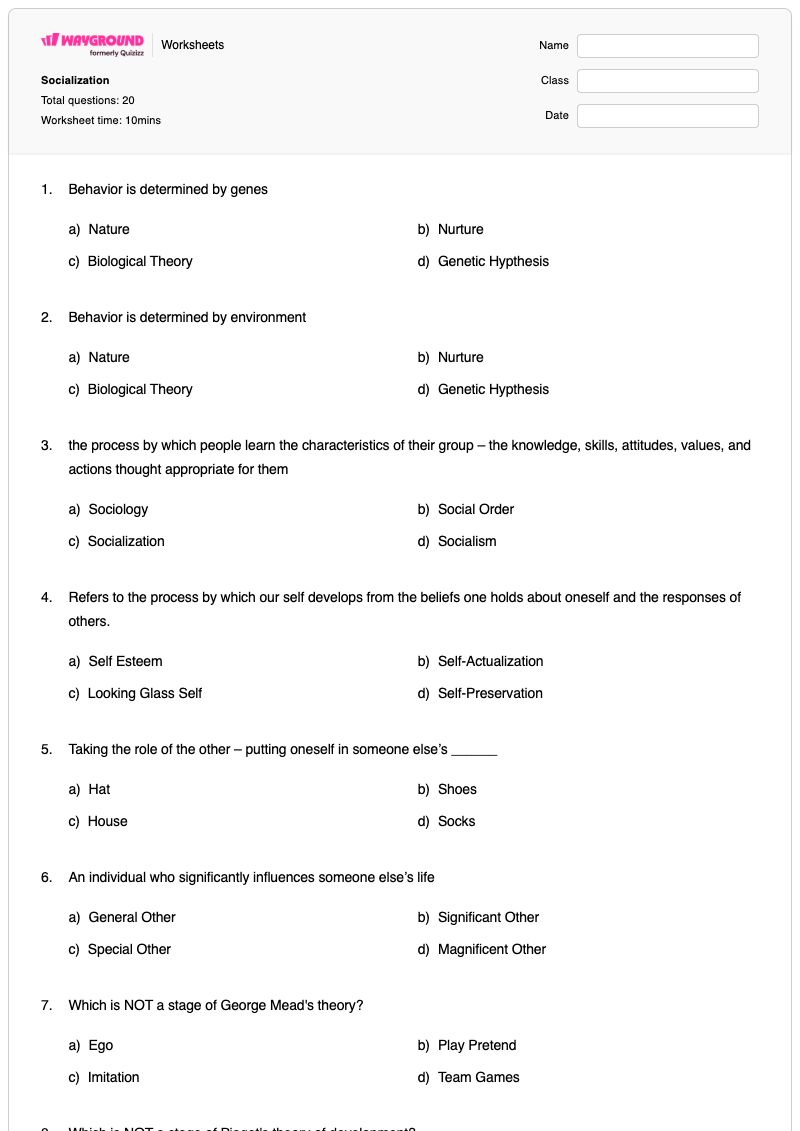
This Grade 12 Social Studies worksheet uses 20 multiple-choice questions to review core concepts in socialization and human development. Students distinguish nature from nurture, define socialization, identify the looking-glass self and significant other, and recognize the stages associated with George Mead’s and Piaget’s theories. Additional items address Freud’s id, ego, and superego; Kohlberg’s moral development theory; Carol Gilligan’s critique of Kohlberg; and the six global emotions.
The question set asks students to select the correct term, identify an incorrect stage or category, and connect theorists with key ideas. It provides focused practice with vocabulary and foundational comparisons across major perspectives on how people develop within society. This free printable worksheet is designed for Grade 12 social studies review, independent practice, or an introductory assessment, and it includes a complete answer key for efficient checking.
Worksheet settings
Font size
S
M
L
XL
Worksheets
Socialization
Total questions: 20
Name
Class
Date
1.
Behavior is determined by genes
a)
Nature
b)
Nurture
c)
Biological Theory
d)
Genetic Hypthesis
2.
Behavior is determined by environment
a)
Nature
b)
Nurture
c)
Biological Theory
d)
Genetic Hypthesis
3.
the process by which people learn the characteristics of their group – the knowledge, skills, attitudes, values, and actions thought appropriate for them
a)
Sociology
b)
Social Order
c)
Socialization
d)
Socialism
4.
Refers to the process by which our self develops from the beliefs one holds about oneself and the responses of others.
a)
Self Esteem
b)
Self-Actualization
c)
Looking Glass Self
d)
Self-Preservation
5.
Taking the role of the other – putting oneself in someone else’s ______
a)
Hat
b)
Shoes
c)
House
d)
Socks
6.
An individual who significantly influences someone else’s life
a)
General Other
b)
Significant Other
c)
Special Other
d)
Magnificent Other
7.
Which is NOT a stage of George Mead's theory?
a)
Ego
b)
Play Pretend
c)
Imitation
d)
Team Games
8.
Which is NOT a stage of Piaget's theory of development?
a)
Post-operational
b)
Formal Operational
c)
Sensorimotor
d)
Concrete Operational
9.
Our most basic human drive:
a)
Id
b)
Ego
c)
Superego
d)
Megaego
10.
Balancing force between the Id and Superego
a)
Id
b)
Ego
c)
Superego
d)
Megaego
11.
The conscience, part of a person's mind that acts self-critical reflecting social standards set by role models
a)
Id
b)
Ego
c)
Superego
d)
Megaego
12.
Which is NOT a stage of Kohlberg's development theory?
a)
Post-Conventional
b)
Amoral
c)
Formal
d)
Conventional
13.
Who questioned Kohlberg's theory?
a)
LeBron James
b)
Jean Piaget
c)
George Mead
d)
Carol Gilligan
14.
Gilligan questioned Kohlberg because he only interviewed:
a)
Teens
b)
Adults
c)
Boys
d)
Girls
15.
The six global emotions are anger, sadness, happiness, disgust, fear, and _____
a)
Guilt
b)
Surprise
c)
Jealousy
d)
Rage
16.
The ways in which society sets children onto different courses in life because they are male or female
a)
Gender Models
b)
Gender Roles
c)
Gender Norms
d)
Gender Socialization
17.
A group of individuals of roughly the same age who are linked by common interests
a)
Pal Groups
b)
Tweens
c)
Peer Groups
d)
Significant Others
18.
Mass Media does NOT include:
a)
Local Papers
b)
Radio
c)
TV
d)
Internet
19.
The behaviors and attitudes considered appropriate because one is male or female
a)
Gender Norms
b)
Gender Values
c)
Gender Socialization
d)
Gender Roles
20.
Which is an example of a gender role?
a)
Men are construction workers
b)
Women can be anything
c)
Men and women are equal
d)
Men are taller
Answer Key
Socialization
Total questions: 20
1.
a)
Nature
2.
b)
Nurture
3.
c)
Socialization
4.
c)
Looking Glass Self
5.
b)
Shoes
6.
b)
Significant Other
7.
a)
Ego
8.
a)
Post-operational
9.
a)
Id
10.
b)
Ego
11.
c)
Superego
12.
c)
Formal
13.
d)
Carol Gilligan
14.
c)
Boys
15.
b)
Surprise
16.
d)
Gender Socialization
17.
c)
Peer Groups
18.
a)
Local Papers
19.
d)
Gender Roles
20.
a)
Men are construction workers
140 %
Browse by subjects
Browse by grades
Browse by format
FAQs
What does this socialization worksheet cover?
This Grade 12 worksheet covers key socialization and human development concepts through 20 multiple-choice questions. Students identify nature versus nurture, socialization, the looking-glass self, significant others, Mead’s and Piaget’s theories, Freud’s id-ego-superego model, Kohlberg’s theory, Gilligan’s critique, and the six global emotions. Selecting among closely related terms helps students connect each definition, theorist, or developmental idea with the correct concept.
How can I use this worksheet to teach socialization theories?
Introduce the worksheet by grouping its questions into themes: socialization and self, developmental theories, Freud’s personality structure, moral development, and emotions. Before students answer, have them build a quick comparison chart for Mead, Piaget, Kohlberg, and Gilligan, then use the multiple-choice items as retrieval practice. Ask students to explain why an option such as “Ego” is not a stage in Mead’s theory or why Gilligan questioned Kohlberg’s research sample.
What mistakes should I watch for when students complete this worksheet?
Students may reverse nature and nurture, confuse the looking-glass self with self-esteem, or select “General Other” instead of “Significant Other.” The “NOT” questions require careful reading: students must identify the term that does not belong in Mead’s, Piaget’s, or Kohlberg’s listed stages. They may also confuse Freud’s id, ego, and superego or overlook that Gilligan questioned Kohlberg’s interviews because they included boys.
How do I assign and grade this socialization worksheet?
You can assign this 20-question multiple-choice worksheet as a printable PDF or as a digital quiz on Wayground. It includes a complete answer key, and printable submissions can be graded by scanning student work with the Wayground for Teachers app.
How can I differentiate this socialization worksheet for my students?
Use the worksheet’s Advanced Settings to increase font size or spacing when students need more room to read the definitions and four answer choices. You can also apply a dyslexia-friendly font or translate the multiple-choice questions into another language, helping students access terms such as “looking-glass self,” “superego,” and “post-conventional” without changing the practice format.
Where can I find more worksheets like this on Wayground?
Wayground offers a broad collection of free printable worksheets and practice problems across subjects, with downloadable PDFs and answer keys to support essential skills and concepts. Browse more resources at https://wayground.com/en-us/worksheets.


 Worksheets