
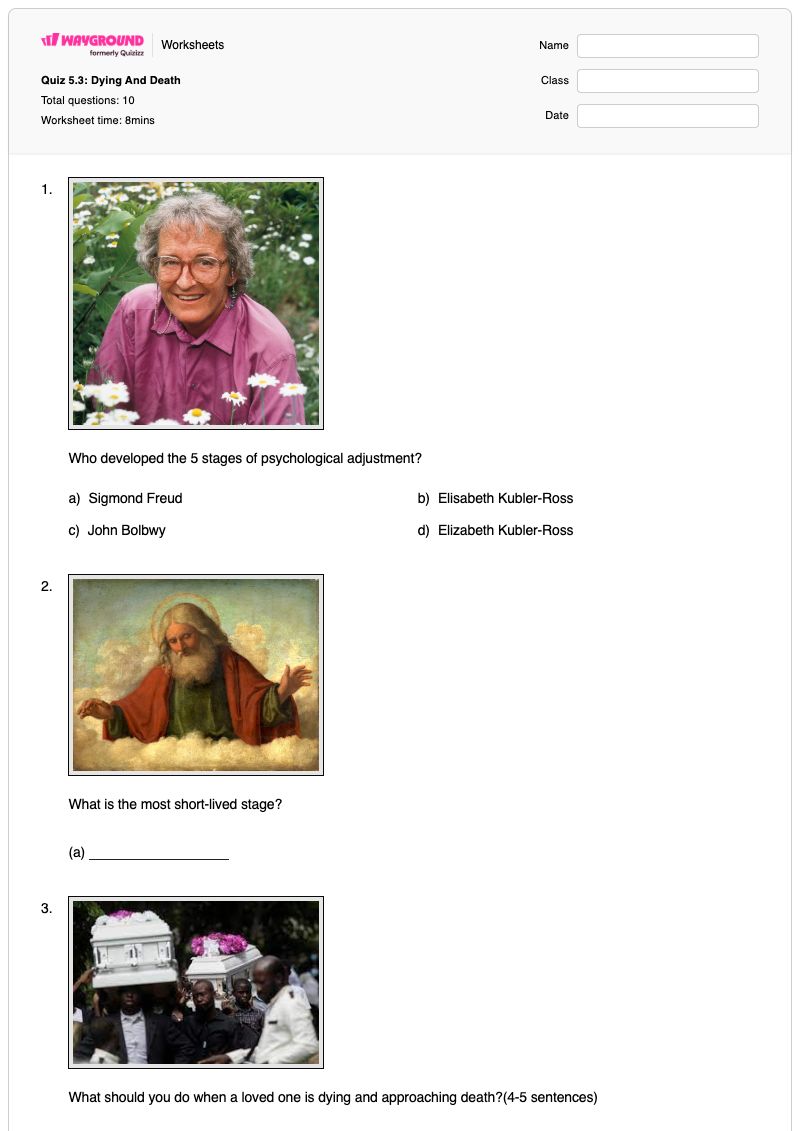

Quiz 5.3: Dying and Death is a Grade 5 Moral Science worksheet that examines psychological adjustment, grieving, and responses to approaching death. Its 10 questions include six multiple-choice items, two multiple-select items, one fill-in-the-blank item, and one open-ended prompt requiring students to write 4–5 sentences about supporting a loved one who is dying.
Students identify Elisabeth Kübler-Ross, recognize examples associated with denial, anger, and bargaining, and recall that adjustment stages are not guaranteed to occur in a fixed order or for everyone. The worksheet also checks understanding of the term Thanatology, the second stage of grieving, and the possibility of becoming stuck in a stage. It is a free printable worksheet with a complete answer key, suitable for guided Moral Science instruction, independent practice, or a short understanding check.
Worksheet settings
Font size
S
M
L
XL
Worksheets
Quiz 5.3: Dying And Death
Total questions: 10
Name
Class
Date
1.
Who developed the 5 stages of psychological adjustment?
a)
Sigmond Freud
b)
Elisabeth Kubler-Ross
c)
John Bolbwy
d)
Elizabeth Kubler-Ross
2.
What is the most short-lived stage?
(a)
3.
What should you do when a loved one is dying and approaching death?(4-5 sentences)
4 lines
4.
What might a person say or do in the "Denial" stage?
a)
"No, this can't be happening to me"
b)
They might accuse the doctor of being incompetent or wrong.
c)
They might get a second opinion from another doctor.
d)
They start crying and begging God for his forgiveness.
e)
They get angry at the doctor and sue him.
5.
Are these stages guranteed to happen in order or at all for everyone?
a)
Yes
b)
No
6.
Which stage would a person become religious and beg a higher power for more time?
a)
3rd
b)
4th
c)
1st
d)
2nd
7.
What word does Thanatology get it's meaning from?
a)
Thanatos
b)
Thanos
c)
It is a unique word with no meaning behind it
d)
Thana-
8.
Who is a person in the "anger" stage angry at?
a)
Fate
b)
Funeral Directors
c)
Everyone who comes into their life
d)
The Power's That May Be
9.
Can you get stuck in stages of death?
a)
Yes, you can
b)
No, you eventually get over with it.
10.
What is the 2nd stage of grieving?
a)
Yearning and Searching
b)
Shock and Numbness
c)
Disorientation and Disorganization
d)
Reorganization and Resolution
e)
Close Family forgets about them and lives happily ever after in a few weeks.
Answer Key
Quiz 5.3: Dying And Death
Total questions: 10
1.
b)
Elisabeth Kubler-Ross
2.
Bargaining, Bargain
3.
n/a
4.
b)
They might accuse the doctor of being incompetent or wrong.
, c)
They might get a second opinion from another doctor.
, a)
"No, this can't be happening to me"
5.
b)
No
6.
a)
3rd
7.
a)
Thanatos
8.
a)
Fate
, c)
Everyone who comes into their life
, d)
The Power's That May Be
9.
a)
Yes, you can
10.
a)
Yearning and Searching
140 %
Browse by subjects
Browse by grades
Browse by format
FAQs
What does this worksheet cover about dying, death, and grieving?
This Grade 5 Moral Science worksheet uses multiple-choice, multiple-select, fill-in-the-blank, and open-ended questions to examine psychological adjustment and grieving in the context of dying and death. Students identify examples of denial and anger, recognize bargaining as the third stage in the worksheet’s framework, recall the second stage of grieving, and explain a compassionate response to a loved one who is approaching death. It also reinforces that these stages are not guaranteed to occur in order or for everyone.
How can I use this worksheet to teach the stages of adjustment and grieving?
Introduce the key vocabulary first, including Thanatology and its connection to Thanatos, then discuss the worksheet’s adjustment and grieving frameworks without presenting the stages as universal or strictly sequential. Have students justify their choices in the denial, anger, and bargaining questions by identifying the response described. Finish with the 4–5 sentence open-ended prompt so students can apply the ideas to a respectful, supportive response to someone approaching death.
What mistakes should I watch for when students complete this worksheet?
Students may confuse the stages of grieving with the numbered psychological adjustment stages, especially when answering the question about the second stage of grieving and the question about bargaining. In the multiple-select items, they may choose every negative reaction rather than distinguishing denial responses from anger responses, or overlook that more than one option can be correct. Also watch for misspellings of Thanatos, confusion between Elisabeth Kübler-Ross and the other names, and answers to the open-ended prompt that do not address supportive behavior in 4–5 sentences.
How do I assign and grade this dying and death worksheet?
You can assign Quiz 5.3: Dying and Death as a printable PDF or as a digital quiz on Wayground. The worksheet includes a complete answer key for the objective items, and printable submissions can be graded by scanning student work with the Wayground for Teachers app. The printable format also gives schools an option for reducing screen time.
How can I differentiate this worksheet for my students?
Use the worksheet’s Advanced Settings to adjust font spacing and font size so the multiple-choice, multiple-select, and open-ended items are easier to read and complete. You can also enable a dyslexia-friendly font or translate the worksheet into another language, which may support access to its grief and dying vocabulary and its 4–5 sentence written response.
Where can I find more worksheets like this on Wayground?
Wayground offers a comprehensive collection of free printable worksheets and practice problems across subjects, with downloadable PDFs and answer keys to help students master essential skills and concepts. Browse more resources at https://wayground.com/en-us/worksheets.