Free Printable World History Worksheets for Class 7
Explore our comprehensive Class 7 World History worksheets and printables that help students master ancient civilizations, historical events, and cultural developments through engaging practice problems, free PDF resources, and detailed answer keys.
Explore printable World History worksheets for Class 7
World History worksheets for Class 7 students available through Wayground (formerly Quizizz) provide comprehensive coverage of pivotal civilizations, empires, and global developments that shaped human society from ancient times through the early modern period. These educational resources strengthen critical thinking skills by engaging students with primary source analysis, timeline construction, cause-and-effect relationships, and comparative studies of different cultures and historical periods. The worksheets feature practice problems that challenge students to examine topics such as the rise and fall of ancient civilizations, medieval societies, exploration and trade routes, and cultural exchanges across continents. Each resource includes detailed answer keys to support independent learning and assessment, with free printable pdf formats that make implementation seamless for both classroom instruction and homework assignments.
Wayground's extensive collection of Class 7 World History worksheets draws from millions of teacher-created resources, offering educators powerful search and filtering capabilities to locate materials that align with specific curriculum standards and learning objectives. The platform's differentiation tools enable teachers to customize worksheets for diverse learning needs, providing both remediation support for struggling students and enrichment opportunities for advanced learners. These versatile resources are available in both printable and digital formats, including downloadable pdf versions that facilitate flexible lesson planning and accommodate various instructional approaches. Teachers can efficiently organize skill practice sessions, design targeted review activities, and create comprehensive assessment materials that reinforce essential historical concepts while developing students' analytical and research capabilities across multiple historical periods and geographical regions.
Frequently asked questions
Effective world history instruction builds chronological reasoning by connecting events across time periods rather than treating them as isolated facts. Teachers should anchor each unit around a compelling question — such as 'Why do empires fall?' or 'How does trade reshape societies?' — so students develop analytical habits rather than just memorizing dates. Using primary sources alongside structured note-taking and timelines helps students trace cause-and-effect relationships across civilizations and eras.
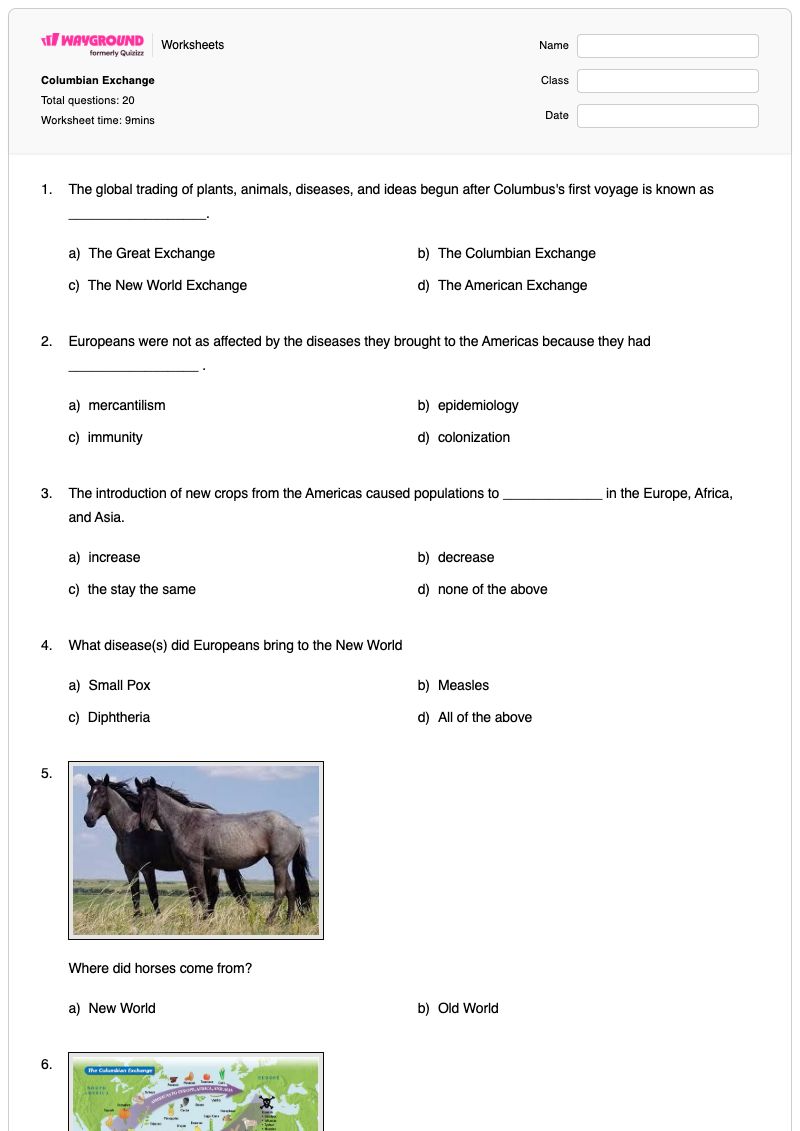
World history practice is most effective when it combines document analysis, timeline sequencing, compare-and-contrast tasks, and map interpretation. Exercises that ask students to evaluate the causes and consequences of specific events — such as the Columbian Exchange, the Treaty of Versailles, or the Russian Revolution — build the analytical skills assessed on standardized tests and in essay writing. Vocabulary practice for period-specific terms and short-answer responses tied to primary sources round out a strong practice routine.
One of the most common errors is treating history as a sequence of disconnected facts rather than understanding the causal relationships between events. Students often struggle to distinguish correlation from causation — for example, assuming the assassination of Franz Ferdinand 'caused' World War I without understanding the underlying tensions. Another frequent misconception is applying present-day values anachronistically when evaluating historical figures or systems like feudalism, the caste system, or colonialism.
World history worksheets on Wayground can be paired with platform accommodations to support diverse learners without singling anyone out. Teachers can enable Read Aloud for students who struggle with complex historical texts, reduce answer choices for students who need lower cognitive load on multiple-choice items, and grant extended time for students who need it on timed digital activities. These settings are saved per student and apply automatically in future sessions, making differentiation efficient across a full class roster.
Wayground's world history worksheets are available as printable PDFs for traditional classroom use and in digital formats for technology-integrated environments, including the option to host them as an interactive quiz directly on the platform. Teachers can assign worksheets by subtopic — such as the Holocaust, the Cold War, or Medieval Europe — to align with specific units. Each worksheet includes a complete answer key, making them practical for independent practice, homework, or formative assessment without additional prep work.
Teaching students to distinguish correlation from causation requires structured analysis of historical evidence. Have students build argument maps that separate background conditions, triggering events, and long-term causes for major events like World War I or the fall of the Roman Empire. Asking students to rank causes by significance and defend their reasoning in writing is one of the most effective methods for developing this skill, and it also prepares them for document-based question formats on AP and state assessments.
A rigorous full-year world history course typically anchors around major thematic threads: human migration and early civilizations, the rise and fall of empires, religious and cultural diffusion, colonization and its consequences, industrial and political revolutions, and 20th-century conflicts and their aftermath. Topics like the Columbian Exchange, the Scramble for Africa, the World Wars, and the Cold War are foundational because they demonstrate how regional events generate global consequences. Pairing thematic units with skills like source analysis and change-over-time reasoning gives students both content knowledge and transferable historical thinking tools.