
 Worksheets
The Heart and Circulation
Total questions: 20
Worksheet time: 46mins
Name
Class
Date
1.

The pointed, inferior portion of the heart, known as the ________ rests on the diaphragm and is oriented towards the left hip.
a)
base
b)
mediastinum
c)
apex
d)
pericardium
2.
The two superior receiving chambers of the heart are known as the _________
a)
atria
b)
ventricles
3.
The valves between the atria and ventricles are known as the ________ valves.
a)
atrioventricular
b)
aortic
c)
semilunar
d)
pulmonary
4.
Blood leaves the right ventricle through the ___________.
a)
pulmonary trunk
b)
aorta
c)
superior vena cava
d)
coronary sinus
5.
The term that means heart contraction is ________.
a)
diastole
b)
systole
c)
tachycardia
d)
fibrillation
6.
The VOLUME of blood pumped out of a ventricle with each heartbeat is known as ________
a)
Heart Rate
b)
Stroke Volume
c)
Cardiac Output
d)
Blood Pressure
7.
Large blood vessels that carry blood away from the heart are called:
a)
arteries
b)
capillaries
c)
veins
d)
venae cavae
8.
Tunica _______, the middle layer of a typical blood vessel, contains smooth muscle and elastic fibers.
a)
intima
b)
externa
c)
media
d)
adventitia
9.
Arteries are normally depicted as red while veins are colored blue. The exceptions to this rule are the _______ arteries and veins.
a)
systemic
b)
hepatic
c)
coronary
d)
pulmonary
10.
Pulmonary circulation involves blood flow to and from the heart and the _______.
a)
body
b)
digestive organs
c)
brain
d)
lungs
11.
When the ventricles contract, the bicuspid (mitral) valve prevents blood from flowing from the ________.
a)
right ventricle to right atrium
b)
left ventricle to left atrium
c)
left atrium to the right atrium
d)
right atrium to the left atrium
12.
The sinoatrial node is located in the ________.
a)
aorta
b)
right atrium
c)
left atrium
d)
right ventricle
13.
Which one of the following represents the correct path for the transmission of an impulse in the intrinsic conduction system of the heart?
a)
AV node, Bundle of His, SA node, Purkinje fibers, bundle branches
b)
SA node, AV node, Bundle of His, bundle branches, Purkinje fibers
c)
SA node, Bundle of His, AV node, Purkinje fibers, bundle branches
d)
SA node, Bundle of His, bundle branches, Purkinje fibers, AV node
14.
A person with a heart rate of 75 beats per minute and stroke volume of 60 mL per beat has a cardiac output of _______.
a)
4500 mL/min
b)
1.25 mL/min
c)
0.8 mL/min
d)
120 mL/min
15.
The heart sounds "lub" and "dup" result from ________.
a)
opening of the heart valves
b)
firing of the nodes of the intrinsic conduction system
c)
blood rushing through the chambers
d)
closure of heart valves
16.
Exchanges between blood and tissue cells occur in capillary beds.
a)
True
b)
False
17.
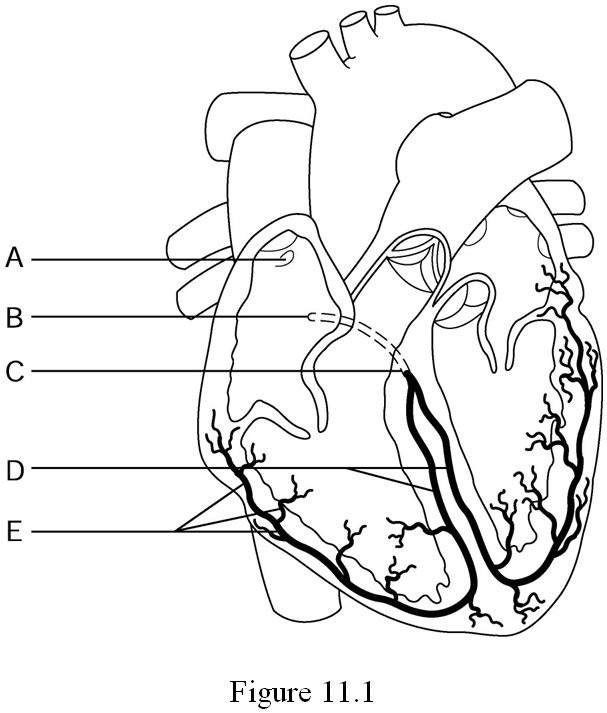
Which label is representing the Purkinje fibers?
a)
A
b)
C
c)
D
d)
E
18.

What does letter D represent?
a)
Aorta
b)
Left Atrium
c)
Left ventricle
d)
Right Atrium
19.
If there is a sudden drop in blood pressure, what happens to the heart rate?
a)
Increases
b)
Decrease
c)
Returns to Normal
d)
Stays the same
20.
Which has valves, arteries or veins?
a)
Arteries
b)
Veins
100 %

