
 Worksheets
States of Matter & Phase Changes
Total questions: 30
Worksheet time: 17mins
Name
Class
Date
1.

The drops of water that appear on the outside of a glass of cold juice on a warm day are an example of?
a)
sublimation
b)
condensation
c)
evaporation
2.

In a solid, the particles
a)
vibrate in place
b)
slide past one another
c)
overcome the strong attraction
3.

A gas
a)
has a definite shape but no definite volume
b)
has a definite volume but no definite shape
c)
has fast-moving particles
4.

The reverse of condensation is
a)
sublimation
b)
evaporatio
c)
boiling
5.
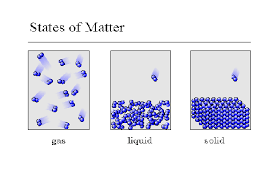
At higher temperatures
a)
particles in an object have less energy
b)
particles in an object move faster
c)
a gas contracts
6.

Balloons can be twisted into shapes because
a)
the force exerted changes the number of particles
b)
the volume of a gas is constant
c)
particles of gas can be compressed
7.

Which of the following occurs when a liquid becomes a gas?
a)
the particles slow down
b)
the particles beak away from one another
c)
the particles move closer together
8.
What term describes a solid changing to a liquid?
a)
Deposition
b)
Sublimation
c)
Freezing
d)
Melting
9.
How is a solid defined?
a)
Indefinite shape and indefinite volume
b)
Definite shape and definite volume
c)
Found in the stars
d)
Definite volume, indefinite shape
10.
How is a gas defined?
a)
Indefinite shape, indefinite volume
b)
Definite shape, definite volume
c)
Found in stars
d)
Definite volume, indefinite shape
11.
Define a liquid.
a)
Indefinite shape, indefinite volume
b)
Definite shape, definite volume
c)
Found in stars
d)
Definite volume, indefinite shape
12.
What term describes a liquid changing to a gas?
a)
Deposition
b)
Sublimation
c)
Freezing
d)
Evaporation
13.
What term describes a solid changing to a gas?
a)
Deposition
b)
Sublimation
c)
Evaporation
d)
Freezing
14.
What term describes a liquid changing to a solid?
a)
Deposition
b)
Sublimation
c)
Evaporation
d)
Freezing
15.
What term describes a gas changing to a liquid?
a)
Deposition
b)
Sublimation
c)
Evaporation
d)
Condensation
16.
What is vaporization?
a)
a gas becoming a liquid
b)
a liquid becoming a solid
c)
a gas becoming a solid
d)
a liquid becoming a gas
17.
______________________ takes place when a liquid changes to a solid.
a)
freezing
b)
melting
c)
boiling
d)
sublimation
18.
Molecules are closest together in a
a)
Solid
b)
Liquid
c)
Gas
19.
4. What type of state of matter is a gas that has electrons flowing through it?
a)
Gas
b)
Liquid
c)
Plasma
d)
Solid
20.
7. All phase changes (changing states) requires energy to be added or taken away.
a)
True
b)
False
21.
Change from Gas to Solid is called........
a)
Sublimation
b)
Deposition
c)
Fusion
d)
condensation
22.
2. A change of state from a liquid to a solid is called....
a)
Melting
b)
Freezing
c)
Evaporation
23.

The phase change from water vapor to liquid water is known as...
a)
evaporation
b)
precipitation
c)
condensation
d)
sublimation
24.
What happens to particles when they are heated?
a)
They speed up and spread out
b)
They slow down and compress
c)
They stop moving
d)
They move closer together and speed up
25.
What is deposition?
a)
Phase change from gas to solid
b)
phase change from liquid to solid
c)
Phase change from solid to gas
d)
Phase change from liquid to gas
26.
What is sublimation?
a)
phase change between solid and liquid
b)
pahse change from gas to solid
c)
phase change from solid to gas
d)
phase change from solid to solid
27.
Melting is ...
a)
liquid to solid
b)
solid to liquid
c)
solid to gas
d)
gas to liquid
28.
Freezing is...
a)
Solid to gas
b)
Liquid to solid
c)
Gas to solid
d)
Liquid to gas
29.
Boiling is ...
a)
liquid to gas
b)
gas to solid
c)
gas to liquid
d)
solid to liquid
30.
Which of the following is NOT a type of vaporization.
a)
Boiling
b)
Evaporizing
c)
sublimating
100 %

