wayground logo

Free Printable Worksheets

NEW

Font size

S
M
L
XL
Worksheets

Econ Ch 2 Free Enterprise

Total questions: 35

Worksheet time: 20mins

Name
Class
Date
1.
(5) The nation of Namibia is working hard to eliminate poverty in the country. The government has taken ownership of the factors of production, and now everyone is guaranteed a job. Which of the following most likely represents the type of economic system found in Namibia?
a)
Market
b)
Command 
c)
Mixed 
d)
Traditional 
2.
The four types of economic systems are: 
a)
Traditional, Command, Mixed, & Market
b)
Traditional, Command, Combined, & Market
c)
Communism, Capitalism, Free Market, and Macroeconomics
d)
Microeconomics, Macroeconomics, Individual, and Traditional.
3.
Type of economy that is based on trading and bartering?
a)
Socialist
b)
Traditional
c)
Free Enterprise
d)
Command
4.
This economic system is based on freedom of the individual.
a)
Socialism
b)
Communism
c)
Capitalism
5.
The Country of Korea, who has a dictator that makes most of the econmic decisions is what kind of economy?
a)
Traditional 
b)
Market 
c)
Command 
d)
Centrally Planned 
6.
The economy of the Bushmen of the Kalahari Desert the people follow the examples of their ancestors.  This is what kind of economy? 
a)
Traditional 
b)
Market 
c)
Command 
d)
Centrally planned 
7.
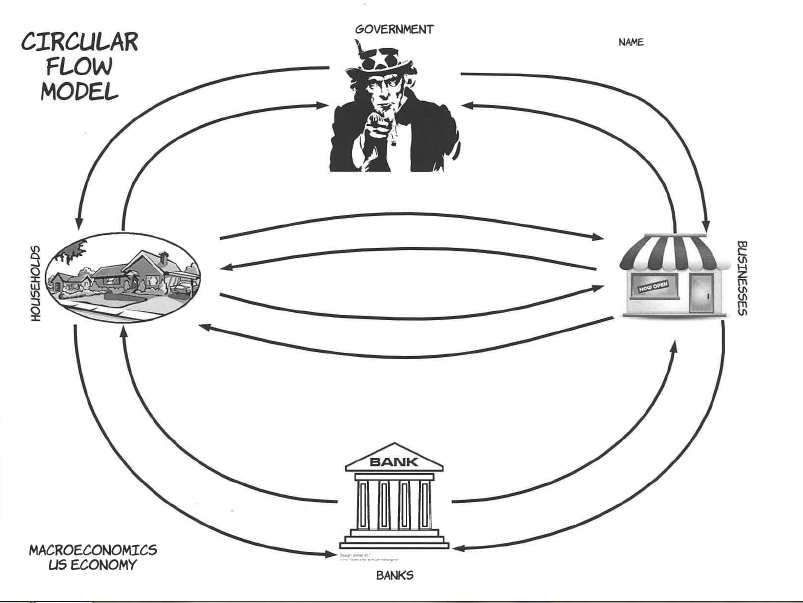
Which of the following is not a major part of the circular flow model?
a)
Government
b)
Households
c)
Goods and Service Markets
d)
Businesses
8.
What part of the circular flow model represents where you and your family live?
a)
Business markets
b)
Goods and Services Market
c)
Households
d)
Resource Market
9.
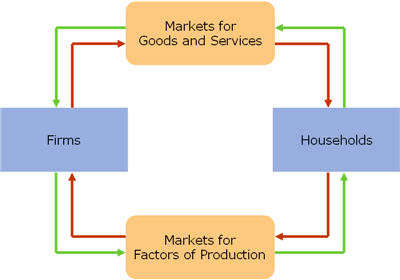
The inside loop of the circular flow model shows the exchange of
a)
Goods and services
b)
Money
c)
Human resources
d)
None of the above
10.
Which of the following is not a function of money?
a)
Medium of exchange
b)
Store of value
c)
Measure of value
d)
Measure of stock market value
11.
Which description best explains how a free market works?
a)
People trade products without money.
b)
Buying and selling is based on supply and demand.
c)
Government companies sell products that are scarce.
12.
Henry Ford is an American entrepreneur who started a company to produce-- 
a)
automobiles
b)
makeup
c)
computers
d)
cookies
13.

If dry pasta began to receive more consumer votes through increased purchases, producers likely would

a)

allocate more resources into the production of dry pasta

b)

allocate fewer resources into the production of dry pasta

c)

increase the amount of frozen pasta being produced

d)

decrease the types of dry pasta being produced

14.

Private property means that

a)

people make their own economic decisions

b)

people may own and control their possessions as they wish

c)

businesses may choose what products to sell and what to charge for them

d)

there are better goods and services

15.
A business firm must constantly try to provide the________services and create the best   products at the________possible prices.
a)
 least - lowest
b)
 best- highest
c)
best –lowest
d)
least - highest
16.
value competition and hard work 
a)
capitalism
b)
communism
c)
socialism
17.
Karl Marx
a)
capitalism
b)
communism
c)
socialism
18.
The oldest economic system, which is still in use in parts of the world, has its people living much in the manner their ancestors did
a)
traditional economy
b)
command economy
c)
market economy
d)
mixed economy
19.
The United States is an example of
a)
a traditional economy
b)
a command economy
c)
a market economy
d)
a mixed economy
20.
Which of these goals is most important in a TRADITIONAL economy?
a)
growth
b)
stability
c)
freedom
d)
efficiency
21.
Why does full employment benefit an economy?
a)
No one has to work too hard
b)
no one spends too much money
c)
unemployment offices can close
d)
all productive resources are used
22.
Which kind of economy is most common today?
a)
traditional
b)
command
c)
market
d)
mixed
23.

Money must be easy to carry.

a)

Durability

b)

Divisibility

c)

Store of Value

d)

Portability

24.

Which function of money encourages people to save money?

a)

Medium of Exchange

b)

Store of Value

c)

Unit of Account

d)

Acceptability

25.

All units of money must be identical so that people recognize it.

a)

Divisibility

b)

Unit of Account

c)

Uniformity

d)

Portability

26.

Money must be able to withstand the wear and tear of many people using it.

a)

Divisibility

b)

Durability

c)

Limited Supply

d)

Acceptability

27.

Which of the following is a function of money?

a)

acceptability

b)

medium of exchange

c)

portability

d)

relatively scarce

28.

Which function of money encourages people to save money?

a)

medium of exchange

b)

store of value

c)

unit of account

d)

acceptability

29.

Money must be easily divided into small parts so that people can purchase goods and services at any price; this meets which characteristic?

a)

portability

b)

acceptability

c)

divisibility

d)

uniformity

30.
In terms of resources, what do households provide for businesses?
a)
loans
b)
savings
c)
labor
d)
private goods
31.
T/F: Markets tend to circulate resources, goods, & money through the four sectors of the economy continuously.
a)
True
b)
False
32.
What is being represented by the "green flow lines"
a)
Flow of Money
b)
Flow of Goods and Services
c)
law
33.
What do businesses provide for consumers according to the circular flow model?
a)
goods and services
b)
only goods
c)
only services
d)
taxes
34.
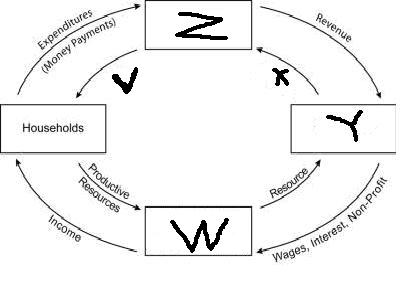
IN the picture, what should replace Z?
a)
Factor Market
b)
Firms
c)
Product Market
d)
Consumers
35.
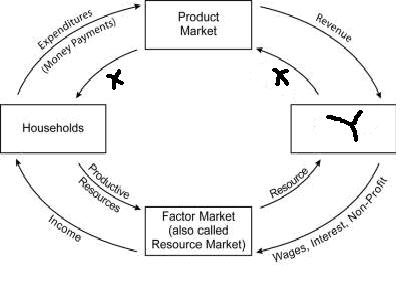
Look at the picture.  What should replace Y?
a)
Consumers
b)
Firms
c)
Factors
d)
Revenue