
 Worksheets
Nation Building
Total questions: 86
Worksheet time: 45mins
Name
Class
Date
1.

The mid18th to mid 19th century saw the emergence of a new class in society known as the
a)
Working class.
b)
Middle class.
c)
Upper Class.
d)
First Class.
2.
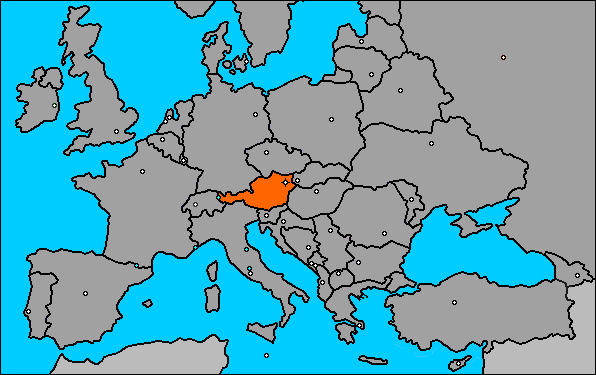
What country was in control of northern Italy for the first half of the 19th century? (Hide text for clue)
a)
Hungary
b)
Austria
c)
Czech Republic
d)
France
3.

Who was able to unite Germany using his mastery of Realpolitik?
a)
Cavour
b)
Wilhelm II
c)
Bismarck
d)
Napoleon III
4.

Which man proposed his own theory of evolution which he called natural selection, or "survival of the fittest?"
a)
Karl Marx
b)
Adolf Hitler
c)
Mark Twain
d)
Charles Darwin
5.

What kept Italy from unifying until 1870, much later than it probably could have?
a)
Poor leadership
b)
Regional differences
c)
Religious views
d)
Devastating droughts
6.

Both Germany and the U.S. were able to become leading industrial powers in the 1870's when their countries were able to ___________.
a)
Expand
b)
Gain independence
c)
Unify
d)
None of these
7.

Which of the following people contributed to the improvement of medicine in the early 1800's?
a)
Louis Pasteur
b)
Robert Koch
c)
Florence Nightingale
d)
All of these improved medicine during this time
8.

Charles Dickens is best known for his detailed portrayals & colorful characters related to slum life, like Oliver Twist.
a)
True
b)
False
9.
Because of its natural resources and the invention and improvement of the steam engine, the industrial revolution began in:
a)
France
b)
Italy
c)
England
d)
Germany
10.
The Agricultural revolution introduced the process of enclosure that tended to :
a)
increase the amount of land available for grazing
b)
increase the nutrients in th esoil
c)
increase farming efficiency
d)
increase the number of farmers
11.
When did the Industrial Revolution begin?
a)
Late 1800s
b)
Early 1600's
c)
middle 1700s
d)
middler 1600s
12.
what was a cultural and social change caused by the Industrial Revolution?
a)
decreasing relance upon the government for poverty assistance
b)
increasing class divisions between wealthy and poor
c)
decreasing difference between urban and rural life
d)
increasing power of farmers in the political world
13.
"Capitalism is destroying the lives of a huge percentage of workers. It leads to greedy people and an unhealthy society. The government should control all business." Which person might argue something like this?
a)
Karl Marx
b)
Adam Smith
c)
Harriet Beecher Stowe
d)
Nathaniel Hawthorne
14.
Karl Marx and Friedrich Engels outlined their beliefs in communism and the development of a classless society in
a)
Communist Manifesto
b)
The Wealth of Nations
c)
Principles of Political Economy and Taxes
d)
An Essay on the Principle of populaiton
15.
The Romantics believed that people could improve their world-view by …
a)
focusing on the problems and working for a solution
b)
focusing on meditation and yoga
c)
focusing on beauty, emotion and imagination as a means of escape
d)
focusing on getting the right people elected to make change
16.
Realists hoped to create a change in society by …
a)
exposing the realities of the working class and poor in order to create empathy for that group
b)
studying nature in the hopes of protecting the wilderness and a more rural lifestyle
c)
showing the reading public that the poor were lazy and inferior
17.
Prussia's final war for German unification was fought against this country in 1870.
a)
Austria
b)
Denmark
c)
France
d)
Italy
18.

Like Germany, Italy also had a shrewd and ruthless politicial to lead them. His name was
a)
Otto von Bismarck
b)
Giuseppe Mazzini
c)
Count Camillo Cavour
d)
Giuseppe Garibaldi
19.

Count Camillo Cavour provoked a war with which country in 1859 to help further Italian Unification.
a)
Italy
b)
France
c)
Austria
d)
Germany
20.
Giuseppe Garibaldi may have been able to become the first leader of a unified Italy, but instead, turned over control of Naples and Sicily to _________ who was shortly thereafter crowned king.
a)
Bismarck
b)
Mazzini
c)
Victor Emmanuel II
d)
Cavour
21.
Russian czar who freed the serfs
a)
William II
b)
Francis Joseph
c)
Alexander II
d)
Giuseppe Garibaldi
22.
What was the goal of the Zionist movement?
a)
contain spread of democracy
b)
establishment of a Jewish homeland
c)
promotion of Christianity
d)
unification of Italy
23.
Social reforms in Britain in the late 1800s helped which group the most?
a)
farmers
b)
industrial workers
c)
middle-class men
d)
women
24.
What was the result of the Franco-Prussian War?
a)
Prussia defeated France
b)
France defeated Austria
c)
France defeated Prussia
d)
Austria defeated Prussia
25.
Which of the following groups generally supported nationalist goals?
a)
church leaders
b)
noble landowners
c)
ethnic groups
d)
monarchs
26.
Which of the following represents conservative ideology in Europe in the early 1800s?
a)
tolerance for religious differences
b)
establishment of a homeland for each national group
c)
restoration of power to royal families
d)
support for freedom of the press
27.
Which of the following goals represents the ideology of nationalists?
a)
establishment of a homeland for people with a common heritage
b)
acceptance of an established church
c)
restoration of power to royal families
d)
tolerance for ethnic minorities
28.
Sigmund Freud proposed a radical theory of
a)
child behavior
b)
animal behavior
c)
human behavior
d)
adult behavior
29.
Marie and Pierre Curie pioneered what in science?
a)
Radioactivity
b)
Ecology
c)
Biology
d)
Rocket Science
30.
What government was based on the ideas of Karl Marx?
a)
Democracy
b)
Monarchy
c)
Dictatorship
d)
Communism
31.

What tragic event occurred in January of 1905 when guards at the Czar's palace shot & killed peaceful protesters?
a)
The Duma
b)
Bloody Sunday
c)
Bloody Saturday
d)
The Bolsheviks
32.
In order to calm the rebellions of 1905 after Bloody Sunday Nicholas II did this:
a)
Gave people basic civil rights and created the Duma
b)
Crushed the rebellion with force
c)
Looked to Rasputin for advice
d)
Killed Lenin
33.
The revolutions of 1848 were started by --
a)
Religion
b)
Imperialists
c)
Absolutism
d)
Nationalists
34.
What German state is most responsible for unifying all ethnic Germans?
a)
Prussia
b)
Austria
c)
Bavaria
d)
Poland
35.
What did Otto von Bismark's policy of "realpolitik" state?
a)
Candidates for office must tell the truth
b)
A leader should listen to the will of the people
c)
Justifies all means to achieve and hold power
d)
Military power should be used as a last resort
36.
Edward Jenner invented which of the following?
a)
Spinning Jenny
b)
Smallpox vaccine
c)
Steam Engine
d)
Cotton Gin
37.
In which country did the Industrial Revolution begin?
a)
The United States
b)
England
c)
France
d)
Germany
38.
Which 2 natural resources were the backbone of the Industrial Revolution?
a)
wood and peat
b)
oil and natural gas
c)
coal and iron
d)
cotton and tobacco
39.
Which innovation allowed factories to be built anywhere?
a)
flying shuttle
b)
spinning jenny
c)
cotton gin
d)
steam engine
40.
Why did "cottage industry" come to an end?
a)
Too many people moved to the city.
b)
It was replaced by the factory system.
c)
The need for textiles decreased.
d)
Women who worked in cottage industries went on strike.
41.
Which of the following would NOT be associated with mass production?
a)
Interchangeable parts
b)
division of labor
c)
unique, hand made goods
d)
assembly line
42.
Who designed the first efficient steam engine?
a)
James Hargreaves
b)
John Kay
c)
Richard Arkwright
d)
James Watt
43.
Which of the following was NOT associated with early factory working conditions?
a)
Low wages
b)
Safe working conditions
c)
Dangerous working conditions
d)
Widespread pollution
44.
The system in which the government owns and controls the means of production, such as mines and factories, is called?
a)
fascism
b)
socialism
c)
capitalism
d)
mercantilism
45.
What is the movement of people from rural to urban areas called?
a)
ruralization
b)
colonization
c)
inflation
d)
urbanization
46.
Women were paid ____ than men for doing the same work.
a)
more
b)
less
47.
How did the Industrial Revolution change the way we create goods?
a)
we made fewer products
b)
we made better quality products
c)
we made products from home
d)
mass production & cheaper goods
48.
Because children worked in factories
a)
they had less education
b)
they became sick an injured
c)
they worked for less pay
d)
all of the above
49.
What industry was the first to industrialize?
a)
electrical industry
b)
transportation industry
c)
textile industry
d)
communication industry
50.
Define industrial captialism.
a)
an economic system based on industrial production or manufacturing
b)
a type of government based on trade
c)
an economic system based on farming
51.
The harsh conditions of factories led to ________.
a)
taxes
b)
child labor
c)
schools
d)
unions
52.
At the beginning of the Industrial Revolution, European nations wanted
a)
Raw materials
b)
Land
c)
Wealth
d)
All of the Above
53.
What was the Industrial Revolution?
a)
Changes and advancements in government
b)
Changes and advancements in militarism
c)
Changes and advancements in religion
d)
Changes and advancements in the production of goods
54.
How did the Industrial Revolution affect the cities?
a)
Made the crime rate decrease
b)
Led to an increase in farm workers
c)
Make the cities cleaner and safer
d)
Led to an increase in population in the cities
55.
What was the first industry affected by the Industrial Revolution?
a)
Automobile
b)
Railroad
c)
Textile
d)
Telephone
56.
What was the purpose of labor unions?
a)
Negotiate as a group for bigger factories
b)
Negotiate as a group for better working conditions
c)
Negotiate as a group for a political revolution
d)
Negotiate as a group for a social revolution
57.
At what conference was Africa divided between European nations?
a)
Paris Peace Conference
b)
Vienna Conference
c)
Versailles Conference
d)
Berlin Conference
58.
Taking over land other than your own by force
a)
Imperialism
b)
Nationalism
c)
Industrialism
d)
Socialism
59.
What is one reason why employers would hire women instead of men?
a)
Women work harder
b)
Women can do more difficult tasks
c)
Women have more work experience than men
d)
Employers could pay women less money
60.

The theme of this image is
a)
Industrialism
b)
Communism
c)
Capitalism
d)
Imperialism
61.
Laissez-Faire Capitalism is a term that means the government is involved in all aspects of business.
a)
True
b)
False
62.
Which country is NOT a country who imperialized other nations?
a)
Switzerland
b)
France
c)
Great Britain
d)
United States
63.
What was the purpose of the Berlin conference?
a)
to promote the Trans-Atlantic Slave Trade
b)
to promote equality among African tribes
c)
to peacefully divide the African continent among Asian nations
d)
to peacefully divide the African continent among European nations
64.
Karl Marx and Friedrich Engels published a book describing a new type of Socialism. What was this book called?
a)
The Communist Manifesto
b)
Communist is King
c)
Capitalism Works
d)
Dr. Suess
65.
After the invention of the steamboat and steam locomotive, what grew across the world?
a)
Farming
b)
Industry
c)
Travel
d)
Both B & C
66.
Before the Industrial Revolution, products were made in the home by hand. This process is called the _______.
a)
Factory Industry
b)
Victorian Industry
c)
Cottage Industry
d)
Assembly Industry
67.
The cotton gin was invented by _____, which helped separate seeds from cotton fiber.
a)
Eli Whitney
b)
Henry Ford
c)
Robert Fulton
d)
Edmund Cartwright
68.

How the loss of the Opium War impact China?
a)
It allowed foreign countries to imperialize China
b)
It caused Chinese peasants to rebel against their govt.
c)
China modernized and became an imperialist power
d)
China returned to isolationism from trade with the West
69.

What was the result of the Boxer Rebellion?
a)
an alliance of imperialist nations suppressed the rebels
b)
imperialist nations were forced to withdraw from China
c)
imperialist nations fought each other over control of China
d)
China became a territory of the United States
70.
Economic motives for imperialism include _________.
a)
a desire to spread Christianity
b)
a need for military bases around the world
c)
a need for raw materials to be used in factories
d)
a desire to gain glory
71.
The Wealth of Nations was written by...
a)
Karl Marx
b)
James Watt
c)
Louis Pasteur
d)
Adam Smith
72.
Henry Bessemer can be associated with which of the following?
a)
Steam Engine
b)
Cotton Gin
c)
Steel
d)
Spinning Jenny
73.
The Industrial Revolution spread from Britain to....
a)
U.S. and Europe
b)
U.S. and Asia
c)
Asia and Europe
d)
Europe and Africa
74.

Napoleon raiding Germanic lands helped instill a sense of German nationalism among the conquered people.
a)
True
b)
False
c)
Neither
d)
Both
75.

Bismarck settled his problems with the church and the Socialists by
a)
Making them illegal
b)
Assassinating key leaders in each organization
c)
Taxing both groups until they went bankrupt
d)
Leaving the church alone & making many changes that the Socialist were hoping for.
76.

Count Camillo Cavour provoked a war with which country in 1859 to help further Italian Unification.
a)
Italy
b)
France
c)
Austria
d)
Germany
77.

British law voting qualifications and shifted representation from rural areas to industrial cities; purpose to avoid a "French-style" revolution:
a)
Corn Laws
b)
Parliamentary Change Act of 1848
c)
Reform Act of 1832
d)
Voter Qualification Statute of 1838
78.

Reform created by the British Factory Act of 1833:
a)
Outlawed child laborers under age 9.
b)
Established an 8 hour work day in factories
c)
Allowed for night time factory work for children, as long as ample light was provided.
d)
Required the establishment of public schools, paid for by an education tax.
79.

Reform movement that pushed for universal male suffrage, the secret ballot, pay for members of parliament, and annual elections:
a)
Anti-Corn Law Movement
b)
Suffragism or Suffragettes
c)
Chartism or Chartists
d)
Parliamentary Reform
80.

These individuals would have favored the repeal of the corn laws:
a)
landlords, farmers
b)
Factory owners, industrial laborers, urban shop keepers
c)
Shippers and sellers of British agricultural goods
81.

These two countries were able to successfully avoid revolutionary upheaval in 1848:
a)
Romania, Piedmon-Sardinia
b)
German States, Italian States
c)
France, Austria
d)
Russia, Great Britain
82.

The best description of the 1848 Revolution in France:
a)
Louis-Philippe abdicates, elections take place, Louis-Napoleon Bonaparte is elected, 2nd French Republic Established
b)
Louis-Philippe institutes secret police, cracks down on freedoms, and creates an autocratic state
c)
Parisians revolt and establish a permanent socialist government that guarantees employment and standards of living.
d)
Louis-Philippe abdicates, is replaced by a military dictatorship ruled by an ultra-conservative militarist. This militarist is assassinated.
83.

The biggest social change enacted in central and eastern Europe after the 1848 revolutions?
a)
Abolition of Serfdom
b)
Unified Tax Codes
c)
Creation of Strong Armies
d)
Implementation of local judiciary decisions
84.

This war ultimately destroyed the Congress system, weakened Russia, and guaranteed the survival of the Ottoman Empire in the Balkans:
a)
Danube War
b)
Black Sea War
c)
Crimean War
d)
War of Dalmatian Independence
85.

This war led to the creation of the German Empire and the seizure of the regions known as Alsace and Lorraine:
a)
German-Francophile War
b)
Western European Conflict
c)
Franco-Prussian War
d)
War of Deutsche Unification
86.

Austria attempted to strengthen its empire by giving equal status to Hungary. The creation of the Dual Monarchy was accomplished by?
a)
The Compromise of 1867.
b)
Austro-Hungarian Compromise
c)
Dual Monarchy Edict
d)
German-Magyar Alliance
100 %

