
 Worksheets
Ionic Bonding
Total questions: 19
Worksheet time: 12mins
Name
Class
Date
1.
Which is the correct name for CaBr2?
a)
Calcium Bromine
b)
Bromine Calcium
c)
Calcium Bromide
2.
What is the name for LiF?
a)
Lithium Fluoride
b)
Lithium Fluorine
c)
Fluorine Lithide
3.
What is the oxidation of C in CH4?
a)
-4
b)
-1
c)
+4
d)
+1
4.
What is the oxidation number of O in CO2?
a)
+2
b)
-1
c)
+4
d)
-2
5.
The sum of all oxidation numbers in a neutral compound is ___.
a)
0
b)
1
c)
-1
d)
depends on the compound
6.
What element always has an oxidation number of +1?
a)
Hydrogen
b)
Fluorine
c)
Chlorine
d)
Iodine
7.
Which of the following elements does NOT have an oxidation number of +2?
a)
Ca
b)
Sr
c)
K
d)
Ba
8.
How many electrons are needed in the outer energy levels of an atom to be stable?
a)
2
b)
4
c)
6
d)
8
9.
A charged particle that has gained or lost electrons is called a _____.
a)
molecule
b)
ion
c)
isotope
d)
element
10.
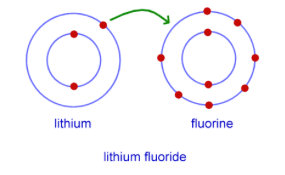
What type of bond is this?
a)
ionic
b)
covalent
11.
A cation is a ____ ion.
a)
negative
b)
positive
12.
A anion will be a ____ ion.
a)
negative
b)
positive
13.
Nitrogen will ____ valence electrons when forming an ionic bond.
a)
gain 1
b)
lose 1
c)
gain 3
d)
lose 3
14.
Beryllium will ____ valence electrons when forming an ionic bond.
a)
lose 4
b)
gain 4
c)
lose 2
d)
gain 2
15.
Boron will ____ valence electrons when forming an ionic bond.
a)
lose three
b)
gain three
c)
lose 5
d)
gain 5
16.
What will be the compound name of the following chemical formula?
NaCl
NaCl
a)
Potassium Chloride
b)
Sodium Chloride
c)
Calcium Chloride
d)
Sodium Chlorine
17.
Ionic bonds form between metals and ____.
a)
metalloids
b)
metals
c)
nonmetals
18.
What determines ionic bonds to form?
a)
Number of protons
b)
Mass of the atom
c)
Number of total electrons
d)
Number of valence electrons
19.
Ionic bonds consist of the ____ of valence electrons.
a)
sharing
b)
transfer
100 %

