
 Worksheets
AP Gov - Institutions Review
Total questions: 90
Worksheet time: 1hrs 5mins
Name
Class
Date
1.
The importance of Shay’s Rebellion to the development of the Constitution of the United States Constitution was that it
a)
revealed the necessity of both adding the Bill of Rights to the Constitution and creating a new system of checks and balances
b)
demonstrated the intensity of antiratification sentiment within the thirteen states
c)
indicated that a strong, constitutionally designed national government was needed to protect property and maintain order
d)
reinforced the idea that slavery should be outlawed in the new Constitution
2.
Which of the following is true of amicus curiae briefs?
a)
They are used by interest groups to lobby courts
b)
They are used exclusively by liberal interest groups
c)
They are used exclusively by conservative interest groups
d)
They are now unconstitutional
3.
In the Constitution as originally ratified in 1788, the provisions regarding which of the following most closely approximate popular, majoritarian democracy?
a)
Election of members of the House of Representatives
b)
Election of members of the Senate
c)
Election of the President
d)
Ratification of treaties
4.
The term “iron triangle” refers to the interrelationship of the
a)
president, Congress, and the Supreme Court
b)
electorate, Congress, and political action committees
c)
local, state, and federal governments
d)
federal bureaucracy, congressional committees, and lobbyists
5.
All of the following powers are granted to the President by the Constitution EXCEPT
a)
commissioning officers in the armed forces
b)
receiving ambassadors
c)
granting pardons for federal offenses
d)
forming new cabinet-level departments
6.
A major difference between the House of Representatives and the Senate is
a)
filibusters are possible only in the House
b)
revenue bills must originate in the Senate
c)
each state has equal representation in the House but not in the Senate
d)
there is unlimited debate in the Senate but not in the House
7.
Agreement among four justices on the Supreme Court is always sufficent to
a)
decide the outcome of the case
b)
write a majority opinion
c)
set a precedent
d)
accept a case for consideration
8.
Which of the following is true of nominees for federal judgeships?
a)
They are recruited from the current pool of United States attorneys
b)
They are nominated by the Senate
c)
They are elected in popular elections
d)
They are appointed for life by the President with the advice and consent of the Senate
9.
In selecting members of the White House staff who do not require Senate confirmation, President’s primarily seek people who
a)
are personally loyal to the President
b)
give the White House ideological balance
c)
have extensive governmental experience
d)
can bring a nonpartisan perspective to policy deliberations
10.
Those who believe that the Supreme Court in its rulings should defer to the elective institutions of government are advocating
a)
“Social Darwinism”
b)
“judicial activism”
c)
“judicial restraint”
d)
“incorporation”
11.
The minimum age of a member of the House is
a)
25
b)
30
c)
35
d)
18
12.
States are authorized to redraw congressional districts following each U.S. Census and often create districts favorable to the party in power in a process called
a)
realignment
b)
gerrymandering
c)
reapportionment
d)
logrolling
13.
Congressional committees and subcommittees exist
a)
to acquire the information needed to pass meaningful and comprehensive legislation
b)
to offer important political posts to influential representatives and senators
c)
to consolidate power in the majority party
d)
to streamline the ever-growing legislative process
14.
Which committee in the House of Representatives is an instrument of the majority party to control debate on the floor?
a)
Rules Committee
b)
Conference Committee
c)
Steering Committee
d)
Ways and Means Committee
15.
Who are the representatives in each party that form the communication network that bring each party together?
a)
Majority leaders
b)
Minority leaders
c)
Committee chairs
d)
Whips
16.
What congressional institution audits and reports on programs and agencies?
a)
Inspector generals
b)
The Office of Mandatory Reports
c)
Congressional Budget Office (CBO)
d)
Governmental Accountability Office (GBO)
17.
The actions of members of Congress receive little attention from the general public because
a)
most people don't pay attention
b)
making laws is all that matters to most citizens
c)
most people do not appreciate the talent and skills of politicians
d)
all of the above
18.
A _____ is a temporary committee established to deal with issues that either overlap or fall outside the areas of expertise of standing committees.
a)
standing
b)
conference
c)
joint
d)
select
19.
Every two years, _____ of the Senate must stand for reelection
a)
one-half
b)
three-quarters
c)
two-thirds
d)
one-third
20.
Until 1913, U.S. senators were selected by
a)
the people
b)
the House of Representatives
c)
state legislatures
d)
the Electoral College
21.
If the president neither signs nor vetoes a bill within 10 days while Congress is in session, the bill
a)
is pocket vetoed
b)
becomes law
c)
is killed
d)
is sent back to Congress
22.
A congressional committee that holds a hearing to determine whether the Department of Agriculture is administering the food stamp program as Congress intended is engaging in
a)
legislative oversight
b)
agenda setting
c)
micro-investigation
d)
pork barrel spending
23.
The most powerful person in the Senate is the
a)
Vice President
b)
President Pro Tempore
c)
Majority Leader
d)
Sergeant-At-Arms
24.
The franking privilege
a)
contributes to the incumbency advantage
b)
allows the Speaker of the House unlimited power
c)
allows the president to veto bills
d)
was abolished in 2004 by the Supreme Court
25.
The congressional system of standing committees is significant because it
a)
fosters the development of expertise by members
b)
helps Congress produces staff costs
c)
weakens Congress in its dealings with the President
d)
insulates decision-making from the influence of special interests
26.
Which of the following is empowered to create new federal courts and specify the number of judges who will sit on them?
a)
The Supreme Court
b)
Congress
c)
The President
d)
he Department of Justice
27.
Which of the following is a way Congress can influence the federal judiciary?
a)
It can prohibit judicial activism.
b)
It can change appellate jurisdiction of federal courts.
c)
It can filibuster decisions made by courts.
d)
It can exercise oversight authority over rulings of individual justices.
28.
The trading of votes between legislators so that each legislator gets what s/he wants.
a)
Logrolling
b)
Pork-barrelling
c)
Cloture
d)
Filibustering
29.
Senate bills are subject to unlimited debate unless 3/5 of the Senate (60 Senators) votes for...
a)
Filibuster
b)
Ridership
c)
Veto
d)
Cloture
30.
Which is not a major function of Congress?
a)
Enforcement
b)
Oversight
c)
Lawmaking
d)
Representation
31.
Who typically wins a Congressional election?
a)
Incumbents
b)
Former Senators
c)
Former House Representatives
d)
Political Newcomers
32.
When a version of a bill is passed in the House and different version is passed in the Senate, it goes to...
a)
The Majority Leader
b)
Servicing
c)
The President
d)
Conference Committee
33.
When a member of Congress gets a project passed that will bring jobs or other benefits to her district/state, it's called...
a)
Riding
b)
Pork-Barrel Spending
c)
Servicing
d)
Gerrymandering
34.
This is an amendment to a Senate bill that deals with an issue unrelated to the content of the bill.
a)
Cloture
b)
Rider
c)
Pork-Barrel
d)
Option
35.
A person who lives in the district or state being represented in Congress is called a/an
a)
Serviced Citizen
b)
Constituent
c)
Voter
d)
Rider
36.
Most legislation introduced in Congress
a)
is passed
b)
is vetoed
c)
never makes it out of committee
d)
gets stuck in conference committee
37.
The Framers of the Constitution assumed that most national power would be held by the
a)
executive branch.
b)
legislative branch.
c)
Department of Defense.
d)
judicial branch
38.
The necessary and proper clause
a)
has provided the basis for an expanded role of the national government.
b)
has greatly expanded the presidential powers.
c)
was in the original Constitution, but was eliminated as a consequence of the Twenty-Seventh Amendment.
d)
is located in the Constitution in the text of the Tenth Amendment.
39.
Members of Congress are granted generous franking privileges that
a)
permit them to mail letters to their constituents for free.
b)
allow them to charge items to a special expense account.
c)
allow members unlimited phone calls to their district without charge.
d)
permit them to receive four, round-trip airfares to their district.
40.
Gerrymandering is
a)
legislation passed in southern states to limit African American participation in elections.
b)
the drawing of legislative district boundary lines to give the dominant party an advantage.
c)
known to give the minority party an electoral advantage at the expense of the dominant party.
d)
a process that attempts to limit debate on a bill in the Senate.
41.
The president of the Senate is
a)
the leader of the majority party in the Senate.
b)
the senator with the most seniority, regardless of party.
c)
the fourth person in line to succeed the president.
d)
the vice president of the United States.
42.
According to the Constitution, the minimum age to be a Senator is
a)
25
b)
30
c)
35
d)
40
43.
How long must you be a U.S. citizen to serve in the House of Representatives?
a)
7 years
b)
9 years
c)
3 years
d)
5 years
44.
Which describes a standing committee of Congress?
a)
Committees on which both senators and representatives serve.
b)
Congressional committees appointed for a specific purpose, such as the Watergate investigation.
c)
Permanent committees found in both houses of Congress that are responsible for legislation and oversight within a specific policy area
d)
Small committees within another committee of Congress designed to specialize in a sub-category
45.
The necessary and proper clause is outlined in which section of Article I?
a)
section 3
b)
section 5
c)
section 8
d)
section 9
46.
Who is next in line to become President of the United States if the Vice President is unable to take over?
a)
Majority Leader of the Senate
b)
President of the Senate
c)
President pro tempore of the Senate
d)
Speaker of the House
47.
Representation in the House of Representatives is
a)
equal for each state
b)
based on each state's population
c)
constant throughout the years
d)
the same as the number of electors in the Electoral College
48.
Which of the following is NOT a formal qualification for the Presidency?
a)
Must be at least 35 years old
b)
Must be a 'natural born Citizen' of the United States
c)
Must have extensive prior political experience
d)
Must have lived in the United States for at least 14 years
49.
According to the 25th Amendment, a President can serve
a)
a maximum of 10 consecutive years
b)
three consecutive terms
c)
an unlimited number of terms
d)
only a and b above
50.
A formal duty assigned to the Vice President by the Constitution is to
a)
call Cabinet meetings
b)
choose the Secretary of State
c)
preside over the House
d)
preside over the Senate
51.
If the Presidency becomes vacant due to death or resignation
a)
the Speaker of the House becomes President
b)
the Pro-Tem of the Senate becomes President
c)
the Vice President becomes President
d)
there is an election to choose a new President
52.
In the Electoral College, each state
a)
has equal representation
b)
has the number of electors as it has in Congress
c)
gets one vote for President
d)
has the power to impeach candidates
53.
One of the major flaws in the Electoral College system is that
a)
the winner of the popular vote is not guaranteed the Presidency
b)
the incumbent President is usually reelected
c)
the majority party in Congress has an advantage when the electorate votes
d)
electors are required to vote according to the wishes of their constituency
54.
Which of the following has NOT worked to strengthen the powers of the Presidency?
a)
the influences of strong Presidents
b)
the demands of the American people for strong leadership
c)
the Constitutional system of checks and balances
d)
the need for decisive action during national emergencies
55.
Television and radio are regulated by the
a)
Federal Deposit Insurance Corporation
b)
Department of Health & Human Services
c)
Federal Communications Commission
d)
Securities & Exchange Commission
56.
The spoils system is
a)
the practice of hiring the most qualified candidates for federal jobs
b)
the practice of giving offices and other favors of government to friends and supporters
c)
completely unrelated to the practice of patronage
d)
a democratic means of filling offices
57.
Congress can declare that the President is unable to perform his duties if
a)
the President vetoes too many bills
b)
the Vice President and Cabinet inform Congress of the President's disability
c)
2/3 of the state legislature vote for change
d)
the Supreme Court rules the President is disabled
58.
Over time, the number of Executive Departments grew in large part because
a)
Presidents wanted more secretaries in the Cabinet
b)
the major political parties voted to expand the number of executive departments
c)
the regional offices were closed and Departments opened up in Washington
d)
the workload of the Federal Government expanded as the country grew
59.
The President exercises legislative power over Congress by
a)
recommending legislation
b)
preventing a bill from coming before the President
c)
routinely telling Congress when it must adjourn
d)
routinely telling Congress when it must meet
60.
The President can negotiate treaties, but
a)
treaties don't take effect until 3/4 of the states ratify it
b)
the Senate must ratify treaties
c)
the House of Representatives must ratify treaties
d)
the Supreme Court ratifies treaties
61.
The President can send troops overseas
a)
Once Congress has approved the action
b)
only after Congress has declared war
c)
pending Congress' approval after a 48 hour period
d)
at his own discretion
62.
What happens when the office of Vice President is vacant?
a)
Special election is held
b)
House of Representatives appoints new VP
c)
President appoints new VP
d)
Supreme Court appoints new VP
63.
What would be required to change the Electoral College?
a)
3/4 vote in Congress
b)
Constitutional Amendment
c)
Majority of popular vote
d)
Executive order
64.
Which of the following is NOT a role of the US President?
a)
Chief of State
b)
Chief of Judiciary
c)
Chief Executive
d)
Commander in Chief
65.
Which of the following is NOT a role of the US President?
a)
Chief Legislator
b)
Chief Administrator
c)
Chief Diplomat
d)
Chief Attorney
66.
This is a term for the group of the President’s closest advisors.
a)
faithless electors
b)
executive orders
c)
bureaucracy
d)
cabinet
67.
Ronald Reagan fires 11,000 federal air traffic controllers when they go on strike.
a)
Chief Executive
b)
Chief Legislator
c)
Chief of State
d)
Chief Administrator
68.
George W. Bush works out a trade agreement with the Japanese Prime Minister.
a)
Chief Diplomat
b)
Chief Legislator
c)
Chief Citizen
d)
Commander in Chief
69.
Which of the following is an example of checks and balances in action in the United States government?
a)
The House and Senate cannot agree on the same version of a bill to send to the president.
b)
The president issues an executive order that freezes federal government hiring.
c)
The president vetoes a bill passed by Congress.
d)
The voters reject the status quo and elect all new members of Congress.
70.

How many cabinet departments currently exist?
a)
12
b)
15
c)
10
d)
22
71.
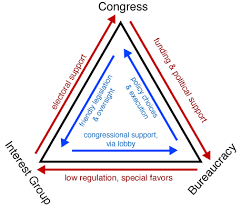
What is the name of the diagram shown in this image?
a)
Steel Union
b)
Coalition Agreement
c)
Iron Triangle
d)
Solid Partnership
72.
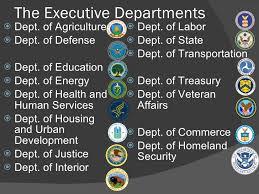
Which one of the following is an example of a regulatory agency?
a)
NASA
b)
NSA
c)
USPS
d)
EPA
73.
Giving jobs to your friends in government because they supported your election efforts is know as:
a)
merit based system
b)
Pendleton Act
c)
patronage
d)
appropriations
74.
Which of the following is a way the legislative branch can check the powers of the bureaucracy?
a)
fire civil servants
b)
defund programs
c)
impeach the president
d)
declare bureaucratic actions unconstitutional
75.
Which of the following best describes bureaucracy?
a)
the people and organizations who execute the actions of government
b)
outside groups who donate money to political campaigns
c)
committees in Congress who provide services for the American people
d)
ALL OF THE ABOVE
76.
A whistleblower is
a)
a worker who does not accomplish his or her tasks by the end of the day.
b)
someone who brings public attention to gross governmental inefficiency or illegal action.
c)
a worker hired in excess of the labor requirements of an agency.
d)
someone who leaks contents of a presidential speech to the press before it is given.
77.
A writ of certiorari by the Supreme Court orders
a)
both parties in a case to reach agreement without further litigation.
b)
state courts to abide by the decisions of the Supreme Court.
c)
a lower court to send up the record of a case for review.
d)
Congress to rewrite unconstitutional legislation.
78.
A written opinion of the Supreme Court is best defined as
a)
a press release.
b)
advice to the President.
c)
the Court's ruling on the issue presented, its reasoning, and applicable law.
d)
a ruling when it hears oral arguments.
79.
A Supreme Court justice who disagrees with the majority opinion may
a)
ask the Court to hear the case again.
b)
send the case back to a lower court.
c)
write a dissenting opinion.
d)
file an amicus curiae brief.
80.
Once appointed to a judgeship, federal judges
a)
cannot be removed from their position for any reason.
b)
must face annual performance reviews.
c)
hold that job for life.
d)
must face recall elections every 10 years.
81.
The concept of senatorial courtesy refers to the
a)
Senate approving judges only if they belong to the same party that is in control of the Senate.
b)
practice of allowing senators to have the exclusive right to nominate candidates for the federal district courts in their state.
c)
Senate's deferring to the president and routinely approving his or her nominees.
d)
practice of allowing a senator to veto a judicial appointment for federal district courts in his or her state.
82.
The power of the courts to determine whether a law or action is constitutional is called
a)
judicial review.
b)
appellate review of fact.
c)
precedent.
d)
habeas corpus.
83.
Which of the following best describes judicial activism?
a)
The Supreme Court should review as many cases as they can.
b)
The federal judiciary should actively check the activities of governmental bodies when they exceed their authority.
c)
The Supreme Court exercises judicial review.
d)
The courts should not play politics.
84.
What doctrine rests on the assumption that the courts should defer to the decisions made by the legislative and executive branches.
a)
judicial restraint.
b)
judicial activism.
c)
habeas corpus.
d)
the rule of four.
85.
What is jurisdiction?
a)
The ability to hear and appeals case.
b)
The ability to hear the original court trial.
c)
The authority to hear certain cases.
d)
The right of a judge to dictate the sentence of a criminal.
86.
Which court case gave the judicial branch the power of judicial review?
a)
McCulloch v. Maryland
b)
Brown v. Board of Education
c)
Plessy v. Ferguson
d)
Marbury v. Madison
87.
Which Supreme Court justice ruled that the Supreme Court has the power to declare laws unconstitutional?
a)
John Marshall
b)
Thurgood Marshal
c)
Sandra Day O'Connor
d)
Earl Warren
88.
What is the dissenting opinion of the Supreme Court?
a)
The winning opinion of a Supreme Court ruling.
b)
The opinion of the Supreme Court law clerks.
c)
The Supreme Court opinion that is buried underground.
d)
The losing opinion of a supreme court ruling.
89.
How does the executive branch "check" the Supreme Court?
a)
appointing members of Congress to committee
b)
appointing Supreme Court justices
c)
appointing members to The Cabinet
d)
appointing The Speaker of the House
90.
What is judicial review?
a)
judges serve for a term of "good behavior" (life)
b)
higher courts can hear the cases of lower courts
c)
the president can remove federal judges from the bench
d)
the ability of the Supreme Court to declare laws unconstitutional
100 %

