
 Worksheets
Unit 5 Exam
Total questions: 49
Worksheet time: 36mins
Name
Class
Date
1.
In the mouth, the enzyme _____ catalyzes the macromolecule _____.
a)
pepsin; protein
b)
gastrin; lipids
c)
amylase; carbohydrates
d)
cholecystokinin; carbohydrates
2.
What digestive neural system is stimulated by your senses?
a)
parasympathetic
b)
sympathetic
c)
somatic
d)
Fight or flight
3.
Olfactory receptors and taste buds are relayed to _____ to transmit through _____ nerve.
a)
pons; vagus nerve
b)
medulla oblongata; olfactory nerve
c)
medulla oblongata; vagus nerve
d)
T-1; T-1 nerve
4.
What neurotransmitter is transmitted during digestion?
a)
acetylcholine
b)
epinephrine
c)
norepinephrine
d)
pepsin
5.
What hormone is stimulated by g cells in the stomach?
a)
pepsin
b)
cholecystokinin
c)
gastrin
d)
secretin
6.
The extremely acidic environment of the gastric juice and the hormonal release activates ______.
a)
amylase
b)
gastrin
c)
pepsin
d)
chyme
7.
Small intestine cells that contain sugar and protein enzymes are called...
a)
chyme
b)
gastrin
c)
microvilli
d)
g-cells
8.
Secretin and cholecystokinin trigger _____ to enter the small intestines.
a)
gastric juice
b)
pancreatic juice
c)
chyme production
d)
rising pH
9.
Pancreatic juice and liver bile contain which of the following enzymes?
a)
starch
b)
protein and nucleic acids
c)
fat
d)
starch, protein, nucleic acids, and fat
10.
Gastric juices are _____ and pancreatic juices are _____.
a)
basic;acidic
b)
neutral; basic
c)
acidic; basic
d)
acidic; neutral
11.
Most absorption occurs in which of the following structures _____.
a)
mouth
b)
stomach
c)
small intestines
d)
large intestines
12.
The gut bacteria flora in the large intestines has which of the following functions..
a)
Digest proteins and carbohydrates
b)
Absorb most nutrients digested in the body
c)
Metabolize remaining nutrients and release gases
d)
Absorb water for hydration
13.
Catabolic steps used to break down proteins into their building blocks, amino acids, by enzymes is which digestion process?
a)
Mechanical Digestion
b)
Chemical Digestion
c)
Absorption
d)
Propulsion
14.
The passage of digested products into blood or lymph systems is called...
a)
Mechanical digestion
b)
Chemical digestion
c)
Absorption
d)
Propulsion
15.
Peristalsis involves..
a)
Physically preparing food for chemical digestion.
b)
Swallowing stimulated by receptors
c)
olfactory receptors relaying to the medulla oblongata
d)
Alternating waves of contraction and relaxation of smooth muscle wall.
16.
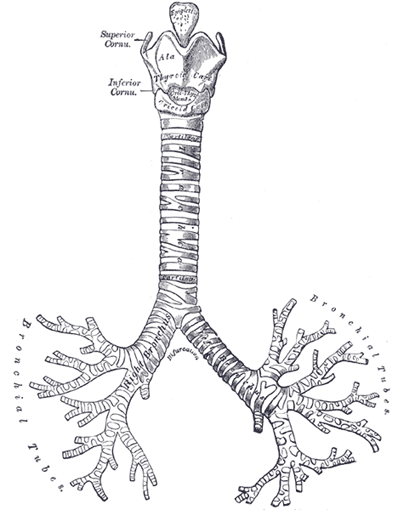
The two main branches from the trachea (one to each lung)
a)
bronchi
b)
alveoli
c)
capillaries
d)
bronchioles
17.

The air sacs that are covered with capillaries where gas exchange takes place
a)
bronchi
b)
lungs
c)
oxygen
d)
alveoli
18.

What is the function of the bronchi?
a)
Transport air from nose to lungs
b)
Transport air from trachea to lungs
c)
Transport air from lungs to alveoli
d)
Transport air from alveoli to blood
19.
Location of gas exchange
a)
alveoli
b)
myocardium
c)
raveoli
d)
pulmonary vent
20.

2?
a)
thyroid cartilage
b)
epiglottis
c)
vocal cords
d)
trachea
21.

4?
a)
Sinusis
b)
Nasal cavity
c)
Pharynx
d)
Larynx
22.

C?
a)
left lung
b)
right lung
c)
diaphragm
d)
treachea
23.

D?
a)
blood flowing to the heart
b)
blood flowing away from heart
c)
microcirculation
d)
blood filled w/ CO2
24.
Given the following structures:
1. larynx
2. nasal cavity
3. pharynx
4. trachea
Which of the following is the correct order that air would flow during inhalation.
1. larynx
2. nasal cavity
3. pharynx
4. trachea
Which of the following is the correct order that air would flow during inhalation.
a)
1,2,3,4
b)
2,3,1,4
c)
2,1,3,4
d)
4,2,3,1
25.
Given the following structures:
1. alveoli
2. bronchi
3. bronchioles
Which of the following is the correct order in which air would flow after inhalation?
1. alveoli
2. bronchi
3. bronchioles
Which of the following is the correct order in which air would flow after inhalation?
a)
1,2,3
b)
2,1,3
c)
2,3,1
d)
3,2,1
26.
The actual gas exchange with the blood occurs in the
a)
bronchi
b)
bronchioles
c)
alveoli
d)
ventricles
27.
Which of the following is not a characteristic of human lungs?
a)
Both right and left lungs are composed of three lobes.
b)
Bronchi divide to form bronchioles.
c)
Capillary supply is abundant to facilitate gas exchange with the blood.
d)
The alveoli are tiny air sacs arranged in clusters.
28.
Inhalation brings in fresh ________ and exhalation removes ________.
a)
cabon dioxide, oxygen
b)
oxygen, nitrogen
c)
oxygen, carbon dioxide
d)
nitrogen, carbon dioxide
29.
The upper section of the pharynx is called:
a)
oropharynx
b)
nasopharynx
c)
laryngopharynx
d)
hypopharynx
30.
This structure protects the superior opening of larynx.
a)
thyroid cartilage
b)
epiglottis
c)
vocal cords
d)
glottis
31.
The structure just inferior to the oropharyx .
a)
oropharynx
b)
nasopharynx
c)
laryngopharyx
d)
larynx
32.
Internal gas exchange occurs between
a)
alveoli and pulmonary capillary
b)
alveoli and body tissue
c)
body tissue and pulmonary capillary
d)
body tissue and blood vessel
33.
Exchange of oxygen and carbon dioxide through respiratory membranes is caused by
a)
osmosis
b)
simple diffusion
c)
active transport
d)
facilitated diffusion
34.
Oxygen binds to hemoglobin in the blood to form
a)
bicarbonate ion
b)
carbonic acid
c)
carbon dioxide
d)
oxyhemoglobin
35.
70% of carbon dioxide is transferred as
a)
oxyhemoglobin
b)
carbaminohemoglobin
c)
bicarbonate ion
d)
dissolved in plasma
36.
Most of carbon dioxide is transported within blood in
a)
red blood cells
b)
plasma
c)
white blood cells
d)
in alveoli
37.
Which of the following is true?
a)
CO2 concentration is higher in the capillaries than the alveoli
b)
CO2 concentration is higher in the alveoli than the capillaries
c)
O2 concentration is higher in the capillaries than the alveoli
d)
O2 concentration is lower in the alveoli than the capillaries
38.
Which of the following is true?
a)
Oxygen diffuses along the concentration gradient from the alveoli into the capillaries
b)
Oxygen diffuses against the concentration gradient from the alveoli into the capillaries
c)
Oxygen diffuses along a concentration gradient from the capillaries to the alveoli
d)
Oxygen diffuses against the concentration gradient from the capillaries to the alveoli
39.
What happens to the volume and pressure inside the thorax when the external intercostal muscles contract?
a)
Volume increases, pressure decreases
b)
Volume increases, pressure increases
c)
Volume decreases, pressure decreases
d)
Volume decreases, pressure increases
40.
What occurs first during inspiration?
a)
air flows into lungs
b)
thoracic cavity volume increases
c)
intercostal muscles contract
d)
intrapulmonary pressure increases
41.
The monomer of a protein is
a)
amino acid
b)
nucleic acid
c)
protein
d)
monosaccharide
42.
All polymers are made up of...
a)
monosaccharides
b)
monomers
c)
proteins
d)
None of these
43.
Lipids are made up of which of the following?
a)
glycerol and fatty acids
b)
glycerol and monolipids
c)
fatty acids and phosolipids
d)
amino acids and nucleotides
44.
What is the function of nucleic acids?
a)
Stores energy
b)
Stores genetic information
c)
Movement
d)
Physical structure
45.
What is the monomer of nucleic acids?
a)
Glycerol
b)
Monosaccharides
c)
Amino Acids
d)
Nucleotides
46.
Which of the following decreases the activation energy necessary to initiate the chemical change within the body?
a)
nucleotides
b)
enzymes
c)
amino acids
d)
fatty acids
47.
What are the single sugars that are the building blocks of carbohydrates?
a)
monosaccharides
b)
disaccharides
c)
polysaccharides
d)
amino acid
48.
The element _______is found in all of the organic compounds.
a)
Iron
b)
Nitrogen
c)
Carbon
d)
Oxygen
49.
Enzymes are examples of
a)
Carbohydrates
b)
Lipids
c)
Proteins
d)
Nucleic Acids
100 %

