
 Worksheets
WEEK 9 (Chapter 3-8) SB025
Total questions: 50
Worksheet time: 58mins
Where does the Calvin cycle occur in C₃ plants?
Thylakoid membrane
Cytoplasm
Stroma of chloroplast (mesophyll cell)
Matrix of mitochondria
Which of the following are products of the light-dependent reaction required for glucose synthesis in the Calvin cycle?
18 ATP, 12 NADPH
12 ATP, 18 NADPH
6 ATP, 6 NADPH
36 ATP, 24 NADPH
Why does the concentration of 3-phosphoglycerate increase during the light-independent reaction?
RuBP binds with CO₂
Carbon fixation occurs
Oxygen is used instead of CO₂
The Calvin cycle stops completely
Why can’t the Calvin cycle occur in the absence of light?
Light-dependent reactions do not occur
No ATP and NADPH are produced
CO₂ cannot enter the leaf
Glucose is directly produced in the light-dependent stage
When there is no light, glucose concentration will ______________.
increase
decrease
The first stable product formed in the Calvin cycle is (a) .
The (a) valve prevents backflow of blood from the right ventricle to the right atrium.
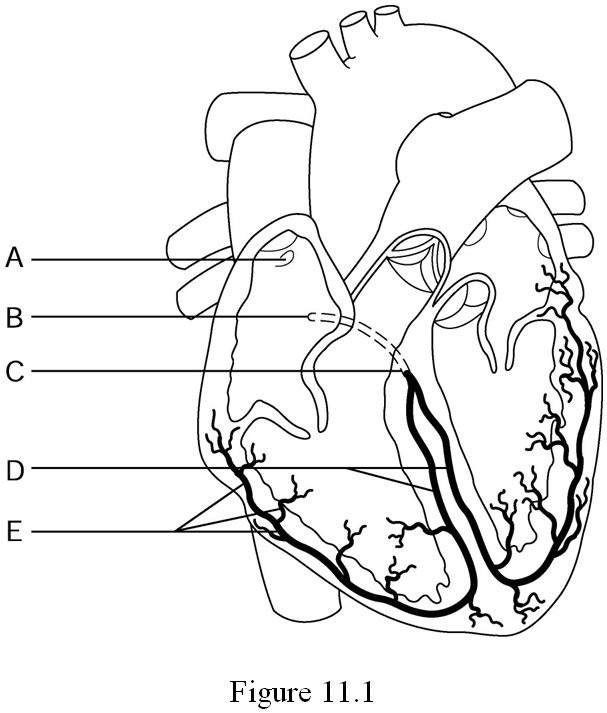
Which label is representing the Bundle of His?
A
C
D
E
The contraction of the atria is controlled by the:
SA node
AV node
Purkinje fibres
Bundle of His

#2 is pointing to the:
SA node
AV node
AV bundle branches
Purkinje fibers

#3 is pointing to the:
AV node
Bundle of His
Bundle branches
Purkinje fibers

What is happening during the T wave?
Semilunar valves close
Atria are in systole
Ventricles are in diastole
Ventricles are in systole
1. What type of natural selection is seen in oyster populations where intermediate-colored oysters are at a disadvantage?
Directional selection
Disruptive selection
Stabilizing selection
Stabilizing selection
Which enzyme catalyzes the first step of carbon fixation in C₃ plants?
PEP carboxylase
ATP synthase
Rubisco
NADP reductase
What is the function of the Bohr effect in oxygen transport?
Increases haemoglobin’s affinity for oxygen
Decreases haemoglobin’s affinity for oxygen
Prevents oxygen release to tissues
Helps CO₂ transport in plasma
Cyanide is a poison that inhibits complex D.
Which of the following describe the role of cyanide in ATP production?
Inhibits complex IV in the electron transport chain
Prevents oxygen from acting as the final electron acceptor
Enhances ATP synthesis in mitochondria
Leads to a drop in ATP production
Which conditions can trigger photorespiration in C₃ plants?
High temperature
Low CO₂ concentration
High water availability
Closed stomata

The P wave in an electrocardiogram (ECG) represents
(a)
In C₄ plants, the first stable carbon compound formed is (a)
Match the process with its function in cellular respiration.
Glycolysis
Breakdown of glucose to pyruvate
Krebs Cycle
Produces NADH & FADH₂ for ATP synthesis
Electron Transport Chain
Production of ATP through oxidative phosphorylation
Fermentation
Conversion of pyruvate to lactate
During glycolysis, glucose is converted into two molecules of ______________ (a) while generating ATP and ______________ (b) .
✅ (Correct answers: pyruvate, NADH)

Peripheral chemoreceptors detect changes in (a) and send signals to the (b) .

Reorder the following
Carbon fixation
Reduction phase
Regeneration of RuBP
Label ECG.
Draw Bohr Effect.

Label the axis.

Label.
Sort the following into “Aerobic Respiration” or “Anaerobic Respiration”.
Uses oxygen
Produces lactic acid
Yields 36-38 ATP
Occurs in cytoplasm and mitochondria
What does the P wave in an ECG represent?
Atrial depolarization
Ventricular depolarization
Ventricular repolarization
Atrial repolarization

Which of the following best explains why the T wave is longer than the QRS complex?
Ventricular contraction is faster than repolarization
The repolarization wave does not use Bundle of His, bundle branches and Purkinje fibers
The atria contract simultaneously
Ventricular repolarization occurs before depolarization
Which statements are TRUE regarding the cardiac cycle?
The QRS complex represents ventricular depolarization
The ‘lub’ sound is produced by the closure of AV valves
The ‘dup’ sound occurs when atrioventricular valves open
The sinoatrial (SA) node initiates heartbeat

The ‘lub’ sound in the cardiac cycle is produced by the closure of the (a) valves.
The ‘dup’ sound in the cardiac cycle is due to the closure of the (a) valves.
Identify the major chambers of the heart and blood vessels
What is the correct sequence of the electrical conduction system in the heart?
SA node -> AV node -> Bundle of His -> Purkinje fibers
AV node -> SA node -> Bundle of His -> Purkinje fibers
SA node -> AV node -> Purkinje fibers -> Bundle of His
SA node -> AV node -> Bundle of His -> Atria
What is happening during the QRS complex?
Atrial repolarization (atrial diastole)
Atrial depolarization (atrial systole)
Ventricular repolarization (ventricular diastole)
Ventricular depolarization (ventricular systole)
What is happening during the P wave?
Atrial repolarization (atrial diastole)
Atrial depolarization (atrial systole)
Ventricular repolarization (ventricular diastole)
Ventricular depolarization (ventricular systole)
The sinoatrial (SA) node is located in the (a) and acts as the (b) of the heart.
What are the four chambers of the heart?
Define natural selection.
The process where individuals with (a) traits (b) and (c)
Which component of the electron transport chain is the first to receive electrons from NADH?
Cytochrome C
Succinate dehydrogenase
NADH dehydrogenase
ATP Synthase
Which of the following are differences between natural selection and artificial selection?
Selective pressure is from the environment in natural selection
Artificial selection is controlled by humans
Natural selection results in immediate genetic change
Which processes occur during substrate-level phosphorylation?
ATP synthesis in glycolysis
ATP formation in Krebs cycle
ATP synthesis via ATP Synthase in mitochondria
Electron transport chain proton pumping
The selective agent in natural selection is the (a) , while in artificial selection, it is (b) .
The first stable product in the Calvin cycle is (a)
FADH₂ donates electrons to (a) instead of NADH dehydrogenase in the electron transport chain.
Match the following
Directional selection
Favors one extreme phenotype
Stabilizing selection
Favors intermediate phenotype
Disruptive selection
Favors both extreme phenotypes
Artificial selection
Traits selected by humans
In the Calvin cycle, carbon fixation is catalyzed by (a) producing an unstable 6-carbon compound that immediately breaks into ______________ (b) .

Label the components of the electron transport chain.
Label I and III.
Differentiate competitive inhibition and non-competitive inhibition.

