
 Worksheets
Basic Microbiology Lab Test (Theory base)
Total questions: 50
Worksheet time: 17mins
What is the primary purpose of practicing aseptic technique in microbiology?
To speed up experiments
To ensure accuracy in measurements
To prevent contamination
To enhance sample visibility
Which of the following is an essential step in aseptic technique when working with cultures?
Using dirty glassware
Opening culture tubes quickly
Sterilizing equipment before and after use
Leaving the laboratory door open
What should you do if the microscope slide is too bright when observing a specimen?
Increase the light intensity
Close the diaphragm
Use a higher magnification
Remove the specimen
What is the purpose of flaming the mouth of a culture tube before and after use?
To create a cool flame
To provide light in the laboratory
To kill contaminants
To melt the agar
What is the purpose of the coarse adjustment knob on a microscope?
To control the amount of light
To change the objective lens
To focus on the specimen at low power
To fine-tune the focus at high power
Which part of the microscope controls the amount of light passing through the specimen?
Condenser
Objective lens
Diaphragm
Coarse adjustment knob
At what magnification should you start focusing on a specimen using the fine adjustment knob?
4x
10x
40x
100x
What is the purpose of the oil immersion lens in a microscope?
To increase magnification
To improve resolution
To make the specimen visible
To protect the lenses
If the image appears blurry even after using the fine adjustment knob, what should you check first?
The objective lens
The eyepiece
The condenser
The microscope slide
What is the function of the mechanical stage on a microscope?
To adjust the height of the microscope
To control the light intensity
To hold and move the microscope slide
To change the objective lens
Which instrument is commonly used to sterilize microbiological tools such as inoculating loops and needles?
Microcentrifuge
Autoclave
Spectrophotometer
Petri dish
What is the purpose of a laminar flow hood in a microbiology laboratory?
To maintain a sterile environment
To amplify DNA
To refrigerate samples
To visualize bacteria
What is the purpose of a Bunsen burner in a microbiology laboratory?
Separating DNA fragments
Creating a sterile work environment
Measuring temperature
Quantifying microbial biomass
Why is it important to sterilize agar media before use in microbiological experiments?
To enhance flavor
To increase agar concentration
To eliminate contaminants
To speed up microbial growth
Which component of bacterial cells is the primary target for the Gram stain?
Capsule
Cell wall
Flagellum
Cytoplasm
What is the primary purpose of the Gram stain in microbiology?
To identify bacterial species
To determine the shape of bacteria
To assess motility
To visualize cellular structures
Which color do Gram-positive bacteria stain after the Gram staining procedure?
Pink
Purple
Red
Green
What is the decolorizing agent used in the Gram staining process?
Crystal violet
Safranin
Safranin
Alcohol or acetone
Which step of the Gram stain procedure is critical for differentiating between Gram-positive and Gram-negative bacteria?
Staining with crystal violet
Application of iodine
Decolorization
Counterstaining with safranin
What is the counterstain used in the Gram staining procedure?
Crystal violet
Iodine
Safranin
Methylene blue
If a Gram-negative bacterium is mistakenly stained as Gram-positive, which step in the procedure is likely to have been mishandled?
Application of crystal violet
Application of iodine
Decolorization
Counterstaining with safranin
Which step in the Gram stain methodology involves flooding the bacterial smear with crystal violet?
Primary staining
Decolorization
Counterstaining
Fixation
If a bacterial smear is over-decolorized during the Gram stain procedure, what is the likely outcome?
Gram-positive cells appear Gram-negative
Gram-negative cells appear Gram-positive
No impact on staining
Improved cell visualization
Which type of microscopy is commonly used to observe bacterial cells after the Gram stain procedure?
Transmission Electron Microscopy (TEM)
Scanning Electron Microscopy (SEM)
Fluorescence Microscopy
Light Microscopy

What bacterial genus is this seen in this picture?
Streptococcus
Staphylococcus
Escherichia
Enterobacteriaceae
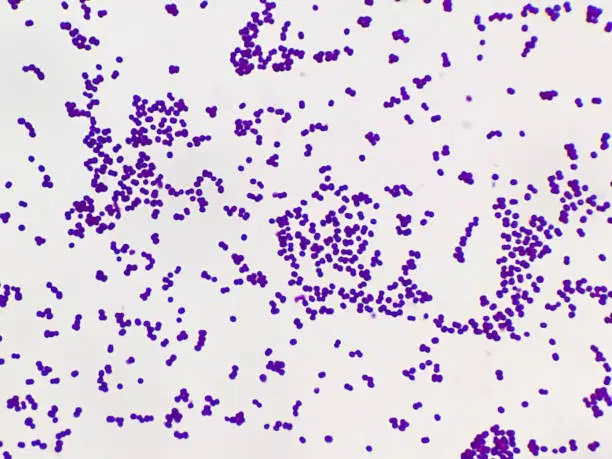
What genus of bacteria is seen in this picture?
Streptococcus
Staphylococcus
Escherichia
Enterobacteriaceae
What is the primary purpose of the Striking Plate Method in microbiology?
To visualize bacterial colonies
To sterilize equipment
To isolate DNA
To measure bacterial motility
n the Striking Plate Method, what is commonly used to spread the bacterial sample evenly on the agar surface?
Inoculating loop
Pipette
Microcentrifuge
PCR machine
What type of agar medium is often used in the Striking Plate Method for bacterial culture?
Blood agar
MacConkey agar
Nutrient agar
Selective agar
How is contamination minimized in the Striking Plate Method?
By using the loop at extreme heat while picking up the bacteria from the agar plate
By keep using the loop without re-flaming in between streaks.
By using a flame to sterilize the loop between streaks
By avoiding agar plates
In the Striking Plate Method, what is the purpose of streaking the bacterial sample in a specific pattern on the agar surface?
To create a random pattern
To promote bacterial motility
To isolate individual colonies
To increase contamination
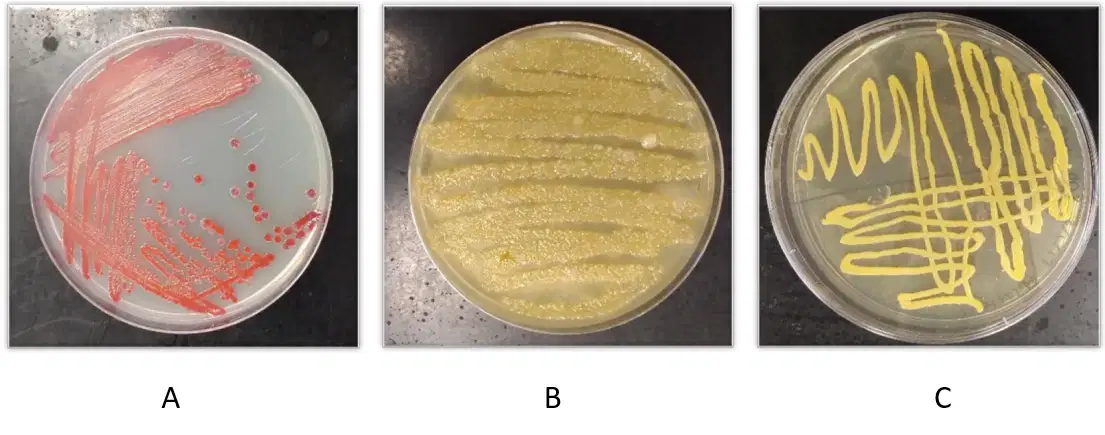
Choose the best streaking agar plate outcome.
A
B
C
Non of the above
You have been tasked with preparing Gram-stained slides for a mixed bacterial culture. Explain how you would differentiate between Gram-positive and Gram-negative bacteria under the microscope and provide reasons for your observations.
Describing the staining process
Identifying bacterial morphologies
Interpreting staining outcomes
Selecting appropriate staining reagents
Imagine you are working in a microbiology lab and need to identify a bacterial species from a patient sample. Describe the specific steps and procedures you would follow to apply the Gram stain technique in this diagnostic process.
Selecting the microscope
Preparing a bacterial smear
Applying crystal violet
Interpreting the staining results
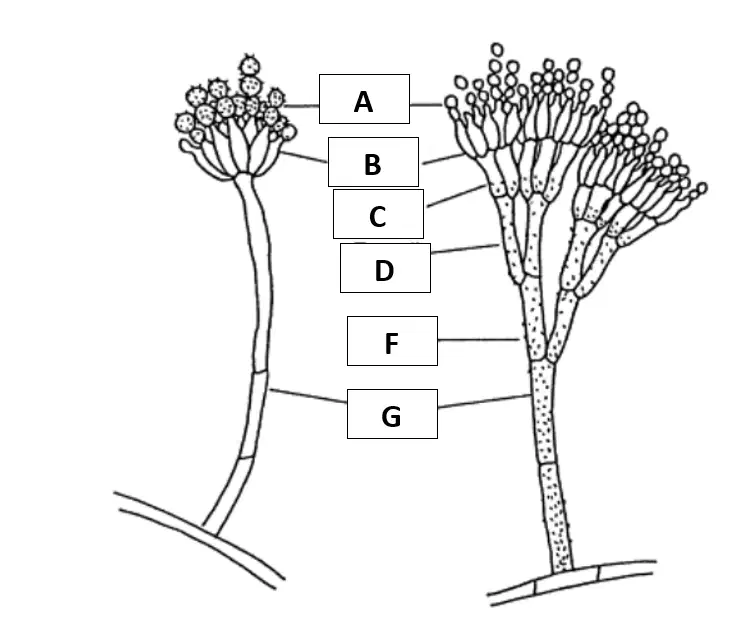
The picture show a Penicillium species. What is A label?
Phialides
Metulea
Conidia
Rami
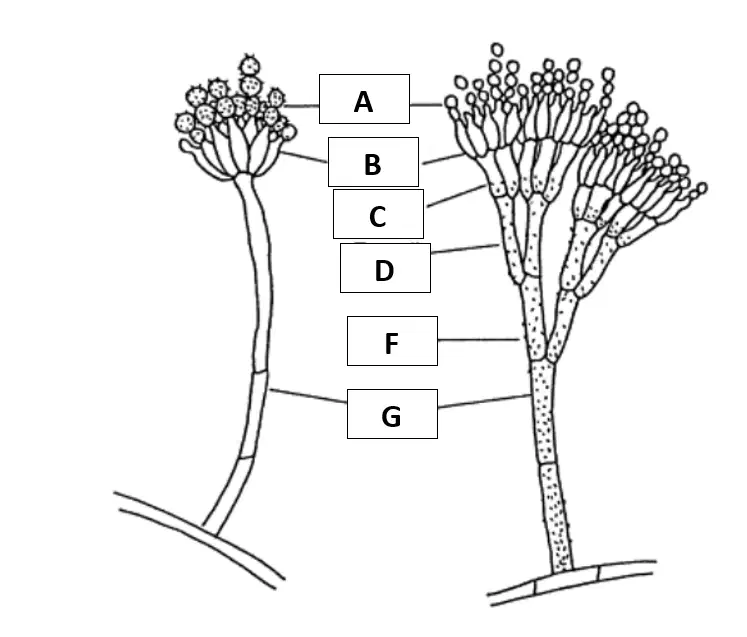
The picture show a Penicillium species. What is B label?
Phialides
Metulea
Conidia
Stipes
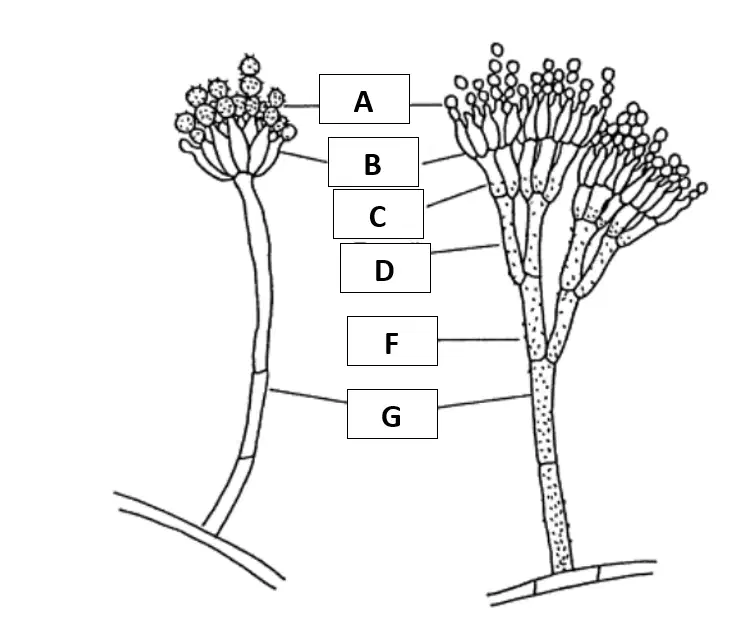
The picture show a Penicillium species. What is C label?
Phialides
Ramuli
Metulea
Stipes
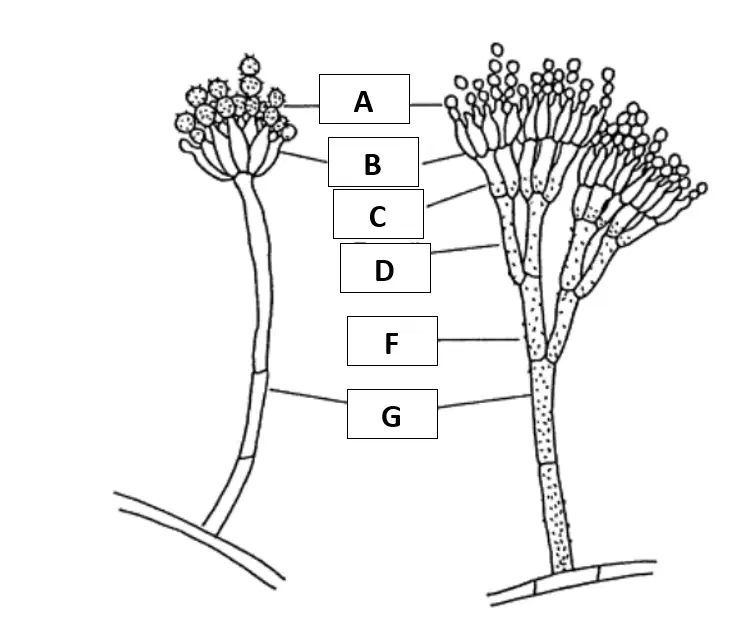
The picture show a Penicillium species. What is D label?
Phialides
Ramuli
Metulea
Stipes
The picture show a Penicillium species. What is F label?
Rami
Ramuli
Metulea
Stipes
The picture show a Penicillium species. What is G label?
Rami
Ramuli
Metulea
Stipes
Which of the following statement is TRUE regarding Gram positive bacteria?
Cell wall have high lipid content
Lipopolysacharides layer is present
crystal violet stain is retained
Have 2 layers of cytoplasmic membrane.
Which of these is a cocci occurring in pairs?
Streptococci
Diplococci
Streptococci
Staphylococci

This media selects for gram-negative organisms and isolates lactose fermenters (pink) and non-lactose fermenters (clear).
choclate agar
Mannitol salt agar
Eosin-methylene blue (EMB) agar
MacConkey agar
This is a general purpose medium that supports the growth of a wide variety of bacteria.
blood agar
nutrient agar
chocolate agar
MacConkey agar

Based on this figure, which of the alphabet is the starting point to culture bacteria and will show discrete colonies?
A : Starting point ; C : Discrete colonies
D : Starting point ; A : Discrete colonies
A : Starting point ; D : Discrete colonies
B : Starting point ; C : Discrete colonies
You are planning to start culturing bacteria. What are the apparatus that are required for the culturing and maintaining bacteria?
Inoculation loop, 37oC and agar
Inoculation loop or needle, 37oC incubator, agar or broth
Inoculation loop or needle, 37oC waterbath, broth
Forceps, 37oC incubator and agar
Mycology is the study of __________.
fungi
bacteria
algae
protozoa
Open Lid
Doesn't matter, as long as it is in the oven.
What is the concentration of alcohol used in the lab to disinfect the work bench?
30%
50%
70%
90%
Why is it important that the Petri plates are incubated upside down?
To get dense colonies
To get mat culture
To get colonies with reduced growth
To prevent moisture from condensing onto the agar surface

