
 Worksheets
MAP - Strand 3 - Cells
Total questions: 50
Worksheet time: 35mins
Name
Class
Date
1.

Directs all cell activities "Brain or Control Center of cell"
a)
Lysosomes
b)
Nucleus
c)
ribosomes
d)
Mitochondria
2.
Jelly-like substance found inside cell that acts as a medium for chemical reactions within the cell
a)
Nuclear Membrane
b)
Golgi Body
c)
Cytoplasm
d)
Ribosome
3.
"Gatekeeper" Separates the cell from the rest of the environment and helps control what passes in and out of the cell. Semi-permeable: allows some materials to pass through but not all
a)
Cell Wall
b)
Cytoplasm
c)
Mitochondria
d)
Cell Membrane
4.
All living things are made of _______.
a)
tissues
b)
organs
c)
cells
d)
chloroplasts
5.
Cell structures that perform specific functions are called
a)
tissues
b)
organs
c)
organelles
d)
organ systems
6.
A phospholipid has 2 parts. What are they called?
a)
Hydrophilic Head, Hydrophobic Tail
b)
Hydrophobic Head, Hydrophilic Tail
7.
"Water Loving"
a)
Hydrophobic
b)
Hydrophilic
c)
Hydroelectric
d)
Hydroloric
8.
"Water Fearing"
a)
Hydrophobic
b)
Hydrophilic
c)
Hydroelectric
d)
Hydroloric
9.
___________ allow cells to recognize each other and act like ID tags.
a)
Carbohydrates
b)
Proteins
c)
Phospholipids
d)
Cholesterol
10.
___________ strengthens and stabilizes the cell membrane.
a)
Carbohydrates
b)
Proteins
c)
Phospholipids
d)
Cholesterol
11.
It forms a boundary between the inside of the cell and the outside of the cell.
a)
Cell Membrane
b)
Lipid Cleric Layer
c)
Membrane Gate
d)
Protein Receptors
12.
the movement of materials through a membrane using cellular energy
a)
active transport
b)
passive transport
c)
selectively permeable
d)
diffusion
13.
The cell membrane is selectively permeable, which means...
a)
All materials can enter and leave the cell
b)
Certain things can enter while others cannot
c)
The cell manually sorts through all materials
d)
Only certain cells can interact with the cell.
14.
Most of the cell membrane is made of...
a)
Lipids
b)
Carbs
c)
Proteins
d)
Nucleic acids
15.
How does a cell maintain homeostasis?
a)
Regulates what enters and leaves the cell
b)
Flexibility
c)
Protective barrier
d)
Structure and support
16.
Another term for equilibrium is...
a)
Equality
b)
Babycakes
c)
Homeostasis
d)
Balance
17.

Against the concentration gradient
low to high
uses energy/ATP
low to high
uses energy/ATP
a)
facilitated diffusion
b)
osmosis
c)
active transport
18.

Movement of particles through the cell membrane
from high to low
from high to low
a)
diffusion
b)
photosynthesis
c)
mitochandria
19.
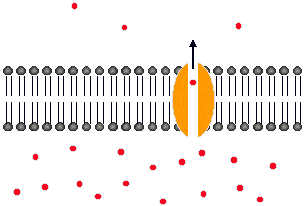
Particles are too large to enter the membrane.
Need help from channel proteins.
No energy
Need help from channel proteins.
No energy
a)
active transport
b)
passive transport
c)
facilitated diffusion
20.

Diffusion of water across a cell membrane
high to low.
high to low.
a)
osmosis
b)
active transport
c)
protein channel
21.

Engulfs large molecules inside the membrane.
uses energy
uses energy
a)
exocytosis
b)
endocytosis
c)
protein channel
22.

Movement of large substances outside of cell.
Uses energy.
Uses energy.
a)
exocytosis
b)
endocytosis
c)
photosynthesis
23.

Particles move from high to low.
Doesn't need energy
Doesn't need energy
a)
passive transport
b)
facilitated transport
c)
active transport
24.

High concentration of water.
cell will explode
cell will explode
a)
hypotonic
b)
hypertonic
c)
isotonic
25.

Low concentration of water.
Cell will shrink
Cell will shrink
a)
hypotonic
b)
hypertonic
c)
isotonic
26.

Equal concentration of water.
cell will stay the same
cell will stay the same
a)
hypotonic
b)
hypertonic
c)
isotonic
27.
Which is true about active transport?
a)
It requires energy
b)
it does not require energy
c)
It moves substances down the concentration gradient
d)
it moves material from high to low concentration
28.
The concentration of water is higher in the soil than in plant root cells. Water moves into root cells of a plant by...
a)
Facilitated Diffusion
b)
Simple Diffusion
c)
Active Transport
d)
Osmosis
29.
When a cell is placed in a hypertonic (more concentrated) solution water
a)
moves from the inside of the cell to the solution
b)
moves from the solution to the inside of the cell
c)
moves equally in and out of the cell
d)
none of these
30.
When a cell is placed in a hypotonic solution (less concentrated), water
a)
moves from the inside of the cell to the solution
b)
moves from the solution to the inside of the cell
c)
moves equally in and out of the cell
d)
none of these
31.
diffusion is the movement of
a)
water from low to high concentration
b)
particles from low to high concentration
c)
water from high to low concentration
d)
particles from high to lowconcentration
32.
which of the following terms means the movement of water from high concentration to low concentration
a)
diffusion
b)
prokaryotes
c)
osmosis
d)
concentration
33.
Which transport does not require energy?
a)
Passive
b)
Active
34.
This structure controls what can enter and leave a cell.
a)
Nucleus
b)
Cytoplasm
c)
Cell Membrane
d)
Golgi Body
35.
What are the tiny structures that carry out jobs inside cells called?
a)
membranes
b)
nucleus
c)
organelles
d)
animalicules
36.
This is the cell's "control center."
a)
Endoplasmic Reticulum
b)
Golgi Body
c)
Nucleus
d)
Cell Wall
37.
This is the "powerhouse" of the cell that converts food to energy.
a)
Mitocondria
b)
Endoplasmic Reticulum
c)
Nucleus
d)
Lysosome
38.
This structure is a storage area for the cell.
a)
Lysosome
b)
Vacuole
c)
Ribosome
d)
Golgi Body
39.
This structure packages and distributes proteins throughout the cell.
a)
Golgi Body
b)
Lysosome
c)
Ribosome
d)
Mitochondria
40.
This structure produces protein in the cell.
a)
Ribosomes
b)
Cytoplasm
c)
Nucleus
d)
Lysosomes
41.
Main producer of ATP in all eukaryotes
a)
chloroplast
b)
mitochondria
c)
lysosome
d)
smooth er
42.
Where are proteins made?
a)
Golgi body
b)
Mitoichondria
c)
Chromosomes
d)
Ribosomes
43.

The Golgi apparatus _____.
a)
packages cell products for export
b)
eliminates waste
c)
stores DNA
d)
makes energy
44.

Where is DNA stored in a cell?
a)
Lysosomes
b)
Golgi Complex
c)
Ribosomes
d)
Nucleus
45.
What are the three types of cell fibers?
a)
microfilaments, intermediate filaments, macrofilaments
b)
microfilaments, intermediate filaments, cillia
c)
microcilia, microvilli, flagella
d)
microfilaments, intermediate filaments, microtubules
46.

The image illustrates which process?
a)
Mitosis
b)
Meiosis
47.
Process that produces two daughter cells.
a)
Mitosis
b)
Meiosis
c)
Both Mitosis and Meiosis
48.
Process that produces sex cells (gametes).
a)
Mitosis
b)
Meiosis
c)
Both Mitosis and Meiosis
49.
Process used to produced new cells
a)
Mitosis
b)
Meiosis
c)
Both Mitosis and Meiosis
50.
Necessary for sexual reproduction
a)
Mitosis
b)
Meiosis
c)
Both Mitosis and Meiosis
100 %

