

wayground logo

Free Printable Worksheets

NEW

Font size

S
M
L
XL
Worksheets

Biomacromolecules

Total questions: 50

Worksheet time: 34mins
Name
Class
Date
1.
Which of the following is NOT a biomolecule?
a)
Water
b)
Nucleic Acid
c)
Protein
d)
Lipid
2.
Identify the biomolecule
a)
Lipid
b)
Protein
c)
Carbohydrate
d)
Nucleic Acid
3.
Carbohydrates are made of... 
a)
C H O
b)
C H O N
c)
C H O N P
d)
C H O N S
4.

The primary purpose the body uses carbohydrate for is?

a)

Building muscles

b)

Long term energy

c)

Immediate Energy

d)

Generating Heat

5.

Also known as simple sugars, the monomer of carbohydrates is...

a)

Maltose

b)

Dextrin

c)

Ribose

d)

Starch

6.
The type of polysaccharide which serves as a strengthening tissue in the cell wall of plants is 
a)
cellulose
b)
glucose
c)
lactose
d)
fructose
7.

Types of disaccharides include following except for?

a)

Maltose

b)

Galactose

c)

Sucrose

d)

Lactose

8.

Proteins are composed of what smaller building blocks?

a)

nucleic acids

b)

amino acids

c)

fatty acids

d)

nucleotides

9.
How many different amino acids are there?
a)
4
b)
20
c)
6
d)
46
10.
Enzymes are
a)
nucleic acids
b)
proteins
c)
lipids
d)
carbohydrates
11.
True of False. Glycogen is a starch that is found in animals. 
a)
True
b)
False
12.
What is the major component of plasma membranes?
a)
lipids
b)
carbohydrates
c)
nucleotides
d)
proteins
13.
In red blood cells, a protein called ________ binds to oxygen.
a)
hemoglobin
b)
ATP
c)
RNA
d)
DNA
14.
The building blocks of nucleic acids are called ...
a)
amino acids
b)
nucleotides
c)
carbohydrates
d)
proteins
15.
Phospholipids have a _________ head and a __________ tail.
a)
hydrophilic, hydrophobic
b)
hydrophobic, hydrophilic 
16.
RNA is an example of a ...
a)
nucleic acid
b)
phosphate group
c)
protein
d)
carbohydrate
17.
Plants store glucose in the form of
a)
starch
b)
glycogen
c)
cellulose
d)
chitin
18.

Which type of carbohydrate is this?

a)

alanin

b)

maltose

c)

linolenat acid

d)

diglyceride

19.
The percentage of our daily calories that should come from carbohydrate should be in the range of ______to_____%
a)
5-10%
b)
45-65%
c)
20-25%
d)
90-100%
20.
What happens if you eat more carbohydrates then your body needs?
a)
becomes DNA 
b)
turns to fat 
c)
creates extra energy 
d)
becomes waste
21.
what functional group is present in carbohydrates?
a)
carboxyl
b)
hydroxyl
c)
carbonyl
d)
amine
22.
What would the molecular formula of a polysaccharide with 4 glucoses be?
a)
C6H12O6
b)
C24H42O21
c)
C24H48O24
d)
C48H94O48
23.

Which of the following correctly displays the paired forms of stored energy?

a)

glycogen = liver and starch = potatoes

b)

glycogen = potatoes and starch = liver

c)

potatoes = liver and starch = glycogen

24.
Which of the following molecules make up the basic structure of a cell membrane?
a)
waxes
b)
steroids
c)
fatty acids
d)
phospholipids
25.
This molecules is a
a)
amino acid
b)
nucleic acid
c)
carbohydrate
d)
lipid
26.
Saturated fats are __________ at room temperature.
a)
liquid
b)
gases
c)
plasma
d)
solid
27.
Steroids have what kind of structure?
a)
long chain of hydrogen/carbons with a glycerol group
b)
CHO in a hexagonal shape
c)
4 fused rings
d)
polar head and two fatty acid tails
28.

What type of fat is this?

a)

saturated fatty acid

b)

triglyceride

c)

steroid

d)

wax

29.
What type of lipid is this?
a)
steroid
b)
cholesterol
c)
phospholipid
d)
triglyceride
30.
Saturated fats have _______________
a)
straight structure
b)
single bonds
c)
solidity at room temperature
d)
all of the above
31.

Triglyceride is made up of _____________ backbone.

a)

Butanol

b)

Glyceraldyhyde

c)

Glycerol

d)

Steroid

e)

Polyhidroxy

32.

_________________ is an unsaturated fatty acid.

a)

Oleic acid

b)

stearic acid

c)

Palmitic acid

d)

Butyric acid

e)

Arachidate acid

33.

Which is an omega-6 fatty acid ?

a)

Linoleic acid

b)

Butyric acid

c)

Docosahexaenoic acid

d)

Oleic acid

e)

Arachidonic acid

34.

The polypeptide in the diagram consists of;

a)

3 amino acids and 3 peptide bonds

b)

3 amino acids and 2 peptide bonds

c)

4 amino acids and 2 phosphodiester bonds

d)

3 amino acids and 2 phosphodiester bonds

35.

The diagram shows the structure of collagen. Based on the diagram, what is the structural level of collagen?

a)

Primary

b)

Secondary

c)

Tertiary

d)

Quartenary

36.

Haemoglobin is a quartenary protein because;

a)

It has more than one peptide bonds

b)

Its shape is globular

c)

It consists of more than one polypeptide chains

d)

It has iron in each heme group

37.

Based on the diagram, the side chain of amino acid alanine is;

a)

NH2

b)

COOH

c)

H

d)

CH3

38.

Protein merupakan polimer dari asam amino. Gugus fungsi yang ada di dalam asam amino adalah…

a)

–OH

b)

–COOH & –NH2

c)

–OH & –COOH

d)

NH3 & –COOH

e)

–CO– & –NH2

39.

Asam amino yang mengandung Sulfur adalah ...

a)

Metionin & Cystein

b)

Glysin & Valin

c)

Leusin & Glysin

d)

Valin & Phenylalanin

e)

Tyrosin & Phenylalanin

40.

Yang menunjukkan pembentukan ikatan peptide pada protein yang benar adalah…

a)
b)
c)
d)
e)
41.

Struktur protein yang terbentuk karena gaya non kovalent sehingga membentuk rantai polipeptida yang menggulung seperti spiral atau lipatan kertas adalah …

a)

Struktur tiga dimensi

b)

Struktur kuartener

c)

Struktur Tersier

d)

Struktur Sekunder

e)

Struktur Primer

42.

Perhatikan klasifikasi protein berikut :

1. Protein Sederhana

2. Transport Protein

3. Lipoprotein

4. Enzime

Klasifikasi protein berdasarkan komposisinya…

a)

1, 2 & 3

b)

1 & 3

c)

2 & 4

d)

2 & 3

e)

1 & 2

43.
What type of protein would the collagen be?  (Collagen keeps your skin shaped smooth and your joints elastic.)
a)
structural
b)
storage
c)
transport
d)
contractile
44.
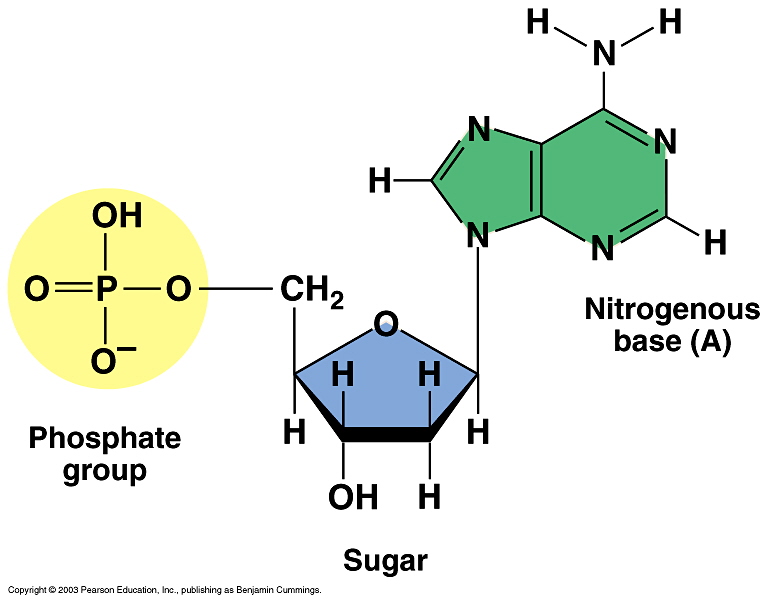
What are the components of a nucleotide?
a)
nitrogen base, phosphate group, and pentose sugar
b)
pentose sugar, purine, and pyrimidine
c)
nitrogen base and a phosphate group
d)
DNA, phosphate group, monosaccharide
45.
RNA contains the sugar...
a)
Deoxyribose
b)
Glucose
c)
Ribose
d)
Lipids
46.
From the nucleotide on the right, which part is labeled 2?
a)
Sugar
b)
Phosphate
c)
Nitrogenous Base
d)
Phosphorous
47.
What pentose sugar does DNA use?
a)
Ribose
b)
Sucrose
c)
Amylose
d)
Deoxyribose
48.
Which of the following is a purine?
a)
Cytosine
b)
Thymine
c)
Adenine
49.
Guanine is complementary to what other nitrogenous base?
a)
Cytosine
b)
Adenine
c)
Thymine
d)
Uracil
50.

Complementary Bases are held together by what type of bond?

a)

Covalent

b)

Hydrogen

c)

Ionic

d)

Mettalic

e)

Phosphodiester
