wayground logo

Free Printable Worksheets

Font size

S
M
L
XL
Worksheets

History of the Earth

Total questions: 60

Worksheet time: 31mins

Name
Class
Date
1.
An index fossil was found in Africa. The same type of index fossil was found in Asia. What does this tell us?
a)
This tells us nothing important.
b)
The rock layer in Africa and Asia were formed during the same time period.
c)
The fossils are not related.
d)
The fossils can be found all over the world.
2.
Oceanic crust is _________than continental crust
a)
more dense
b)
thicker
c)
lighter
d)
older
3.
Mountain ranges are usually found where
a)
oceanic crust converges
b)
continental crust diverges
c)
continental crust converges
d)
plates form transform boundaries
4.
According to all of the scientific evidence that we can gather; how old is the Earth?
a)
6,000 years
b)
3 years
c)
4.6 billion years
d)
3 million years
5.
What are eras divided into?
a)
eons
b)
periods
c)
epochs
d)
eras
6.
According to Wegener's hypothesis of continental drift,
a)
Earth's surface is made up of seven major landmasses
b)
the continents DO NOT move.
c)
Earth is slowly cooling and shrinking.
d)
the continents were once joined together in a single landmass
7.
What is Pangaea?
a)
The name of a German Scientist
b)
the name of the supercontinent that existed millions of years ago
c)
another name for continental drift
d)
the name of an ancient fossil
8.
Which type of evidence was NOT used by Alfred Wegener to support his continental drift hypothesis?
a)
evidence from landforms
b)
evidence from fossils
c)
evidence from human remains
d)
evidence from climate
9.
Fossils provide evidence for all of the following EXCEPT for
a)
changes in Earth's surfacde
b)
how Earth originally formed
c)
how environments on Earth have changed over time
d)
how groups of organisms have changed over time
10.
By which method have scientists determined that Earth is about 4.5 billion years old?
a)
plate tectonics
b)
relative dating
c)
radioactive dating
d)
law of superposition
11.
Which characteristic of carbon-14 dating helps scientists determine the approximate time a species became extinct?
a)
Carbon-14 is NOT present in more recent fossils
b)
Carbon-14 increases at a constant rate over time
c)
Carbon-14 decreases at a constant rate over time
d)
Carbon-14 can only be foun in fossils of a certain period
12.
Which layer contains the oldest index fossils?
a)
Layer 1
b)
Layer 2
c)
Layer 3
d)
Layer 4
13.
Which is the most accurate method scientists can use to estimate Earth's age?
a)
relativism
b)
superposition
c)
relative dating
d)
radioactive dating
14.
Which statement is true
a)
The oldest layers of rock and soil are closet to the surface of the earth
b)
The youngest layers of rock and soil are farther away from the surface of the earth
c)
Carbon-14 dating is an example of relative dating an the law of superposition is an example of absolute dating
d)
Absolute geologic dating an relative geologic dating are two methods used by scientists to determine age of geologic evidence
15.
Several different fossils were found in rock layers in a geologic column. Above these rock layers, the fossils were almost nonexistent. Which most likely explains these observations?
a)
a non conformity occurred.
b)
All the organisms migrated.
c)
A period of mass extinction occurred.
16.

The picture shows the fossilized tooth of an extinct shark called a Megalodon. Which evidence can scientist most likely gain from studying the fossilized tooth?

a)

the different types of prey eaten by the shark

b)

the differences from teeth of living sharks

c)

the events that led to how the shark died

d)

the color of the skin of the shark

17.
Which best describes a fossil that helps determine the relative age of a rock layer?
a)
index fossil
b)
unconformity fossil
18.
The length of time required for half of the radioactive atoms in a sample to decay is its...
a)
era
b)
age
c)
half-life
d)
eon
19.
The original element that undergoes radioactive decay is known as the...
a)
daughter element
b)
half-life
c)
parent element
d)
carbon-14
20.
Scientists use radioactive decay to measure...
a)
relative time
b)
absolute time
c)
half-lives
d)
time of day
21.
What element is usually used to date fossils?
a)
uranium-235
b)
carbon-14
c)
mercury-203
d)
thorium-234
22.
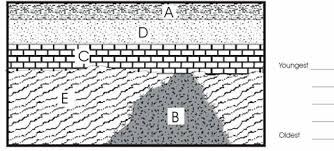
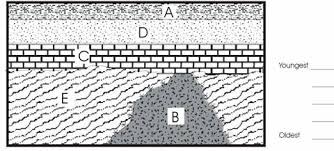
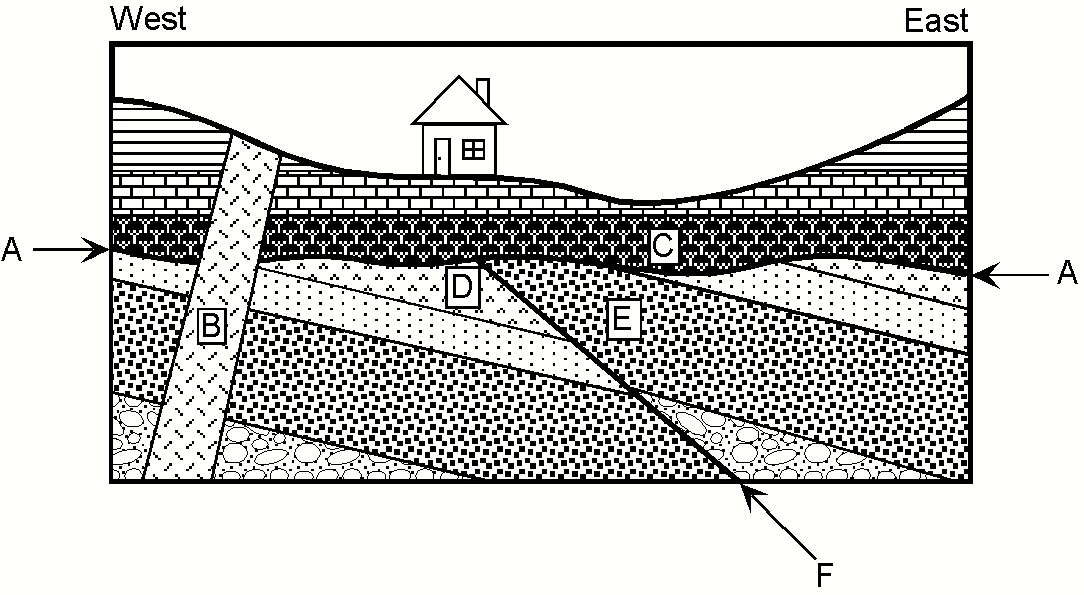
The statement "Intrusion B occurred after the deposition of layer E but after deposition of layers C, D, and A" can be determined to be correct because of which principle?
a)
Principle of Horizontality
b)
Principle of Cross-Cutting Relationships
c)
Principle of Inclusions
d)
Principle of Superposition
23.
The statement that the oldest layer will be at the bottom in an undisturbed sequence of rock layers is called the Principle of ....
a)
Inclusions
b)
Unconformities
c)
Cross-Cutting Relationships
d)
Superposition
24.
The Principle of Cross-Cutting Relationships states that an igneous intrusion is 
a)
always younger than the layers it cuts across
b)
always older than the layers it cuts across
c)
the same age as the rock it melted
d)
none of the answers are correct
25.
Relative age dating is used to determine the...
a)
actual age of an event
b)
length of time between two events
c)
age of one event in comparison with other events
d)
rate at which a gologic process occurs
26.
Older rocks contained within newer rocks are called...
a)
intrusions
b)
inclusions
c)
fossils
d)
faults
27.
Which of the following correctly lists the layers in order from oldest to youngest?
a)
A, B, C, D, E
b)
E, B, C, D, A
c)
E, D, C, B, A
d)
C, B, A, D, E
28.
What is the oldest layer in the outcrop?
a)
B
b)
C
c)
D
d)
E
29.
What is the youngest layer in the outcrop?
a)
A
b)
B
c)
C
d)
D
30.
The statement "Layer B is younger than layer E" can be determined by using which principle?
a)
Principle of Horizontality
b)
Principle of Cross-Cutting Relationships
c)
Principle of Inclusions
d)
Principle of Superposition
31.
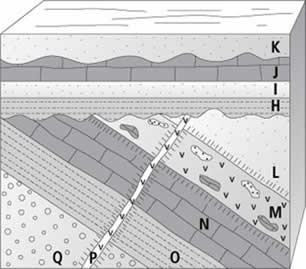
The rock formation labeled "P" is a(n)...
a)
fault
b)
intrusion
c)
inclusion
d)
unconformity
32.
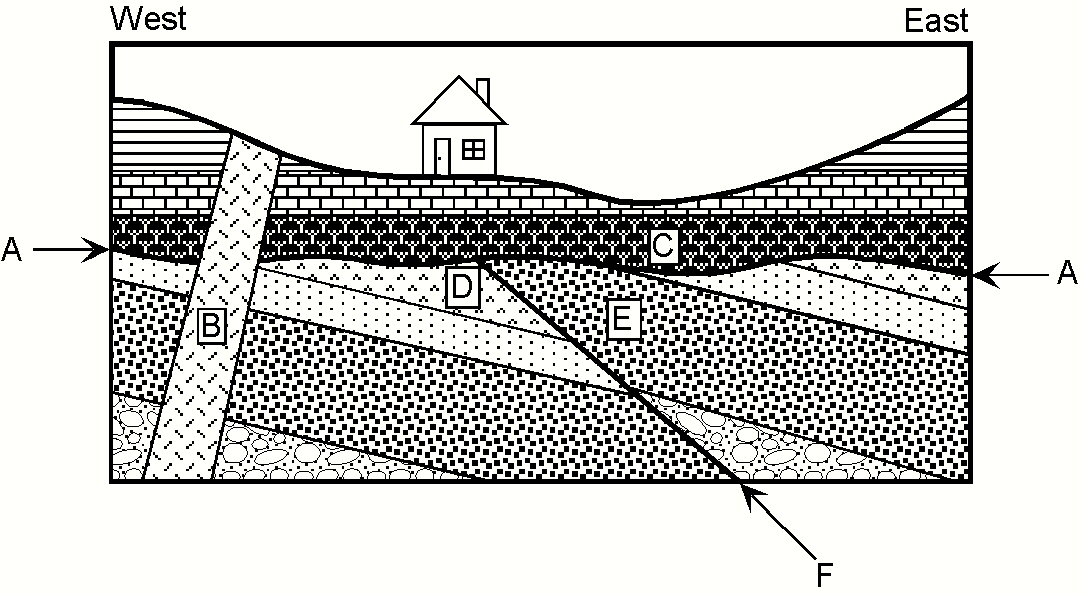
Letter "F" is a....
a)
inclusion
b)
intrusion
c)
fault
d)
unconformity 
33.
Letter "A" is an....
a)
inclusion
b)
intrusion
c)
fault
d)
unconformity 
34.
A rock formed with 1000 atoms of a radioactive parent element, but only contains 250 radioactive parent atoms today. If the half-life of the parent element is one million years, how old is the rock?
a)
250,000 years old
b)
500,000 years old
c)
1,000,000 years old
d)
2,000,000 years old
35.
What is the half life of carbon-14?
a)
5730 years
b)
4.5 billion years
c)
2000 years
d)
15 minutes
36.
What is the daughter element of carbon-14?
a)
nitrogen-14
b)
sodium-14
c)
lead-235
d)
carbon-16
37.
What percent of carbon-14 would be left after 5730 years?
a)
100%
b)
75%
c)
50%
d)
25%
38.
What percent of carbon-14 would be left after 5730 years?
a)
100%
b)
75%
c)
50%
d)
25%
39.
What percent of carbon-14 would be left after 11,460 years?
a)
100%
b)
75%
c)
50%
d)
25%
40.
How old is the fossil in layer 7?
a)
about 1 million years old
b)
about 205 million years old
c)
about 500 million years old
d)
about 300 million years old
41.

Which fossil makes a good index fossil: it is in many locations but existed for a short period of time

a)

a

b)

b

c)

c

d)

d

42.

Which fossil is the oldest?

a)

Whale

b)

Bird

c)

Dinosaur

d)

Fish

43.

The Precambrian Era accounts for (a)   % of the Earth's existence

44.

What led to the formation of water on Earth?

a)

cooling of the Earth

b)

heating of the Earth

45.

What was formed into crust and then continents?

a)

moon rock

b)

space dust

c)

molten rock

d)

fossils

46.

The formation of these two things provided a hospitable environment for life to begin on Earth

a)

oceans and atmosphere

b)

streams and rivers

c)

clouds and pollution

d)

snow and rain

47.

This gas began to accumulate by photosynthesizing cyanobacteria?

a)

oxygen

b)

nitrogen

c)

carbon

d)

helium

48.

Earth's multicellular organisms evolved at the end of this era?

a)

Hadean

b)

Archean

c)

Proterozoic

d)

Precambrian

49.

The paleozoic era spans from

a)

540 million years ago to 252 million years ago

b)

600 million years ago to 136 million years ago

c)

4.5 billion years ago to 252 million years ago

d)

252 million years ago to 66 million years ago

50.

During the _________, virtually all animal groups on Earth evolved & inhabited the oceans

a)

Cambrian explosion

b)

Silurian explosion

c)

Permian explosion

d)

Permian extinction

51.

For much of the Paleozoic era, which groups dominated the ocean?

a)

fishes, arthropods, & cephalopods

b)

sharks & whales

c)

mammals

d)

flowering plants

52.

The largest extinction event in the Earth's history is the

a)

Permian extinction

b)

Devonian extinction

c)

Silurian extinction

d)

Carboniferous extinction

53.

Which of the following animals did NOT live during the Mesozoic era?

a)

Birds

b)

Dinosaurs

c)

Fish

d)

Monkeys

e)

Reptiles

54.

Which Periods make up the Mesozoic Era?

a)

Cambrian

b)

Jurassic

c)

Tertiary

d)

Triassic

e)

Cretaceous

55.

The Mesozoic Era is also known as the...

a)

Age of Mammals

b)

Age of Fishes

c)

Age of Reptiles

d)

Age of Invertebrates

56.

What is the name of the supercontinent that breaks apart during the Jurassic period?

a)

Pangea

b)

Rhodonia

c)

Laurasia

d)

Pannotia

57.

Most early mammals are small because...

a)

They are early in their evolutionary history.

b)

The Earth was too hot for large mammals in the Mesozoic era.

c)

To better avoid dinosaurs, their predators.

58.

Why do scientists believe a meteor impact caused the KT mass extinction event? Choose two.

a)

A crater on the surface of the Earth

b)

A layer of iridium which has dinosaur fossils below it

c)

Damage seen on dinosaur fossils

d)

Based on information from previous extinction events, it is the mostly likely cause

59.

If the Paleozoic Era was the era of ______, then the Cenozoic era is the era of ______.

a)

reptiles; mammals

b)

mammals; reptiles

c)

dinosaurs; mammals

d)

mammals; dinosaurs

60.

The Cenozoic Era takes place

a)

66 mya - now

b)

252 mya - now

c)

252 mya - 66 mya

d)

10,000 ya - now