
 Worksheets
Lenses & E/M
Total questions: 44
Worksheet time: 54mins
Name
Class
Date
1.
Which of these causes the colors in a rainbow to separate?
a)
sunlight passing through raindrops
b)
strong winds
c)
Earth's gravity
d)
different colors of light going at different speeds
2.
Which of these is an example of visible light?
a)
X-rays
b)
rainbow
c)
microwaves
d)
radio waves
3.
Why does a ruler with one end in the air and one end under water appear bent?
a)
Light moves through air faster than it moves through water.
b)
The light is reflected from the ruler moves in a curved path.
c)
Light moves through water at the same speed as it moves through air.
d)
Light in the air is brighter than light in the water.
4.
Through what kind of matter does light move fastest?
a)
liquids
b)
air
c)
matter that is lighter in color
d)
matter that is in larger objects
5.
What is a property of a transparent object?
a)
Almost all of the light rays that reach it are scattered.
b)
Almost all of the light rays that reach it are absorbed.
c)
Almost all of the light rays that reach it are reflected.
d)
Almost all of the light rays that reach it pass through it.
6.
Which is translucent?
a)
tissue paper
b)
air
c)
wood
d)
clear plastic
7.
What is most likely to happen to light that hits an opaque object?
a)
All of the light passes through the object.
b)
None of the light passes through the object.
c)
Most of the light disappears.
d)
Some of the light passes through the object.
8.
If you wanted a gift to be a surprise, what kind of container would you put it in?
a)
transparent
b)
thick
c)
opaque
d)
translucent
9.
The intensity of light is related to its brightness.
a)
True
b)
False
10.
White light can be separated into different colors by using a__________.
a)
microscope
b)
prism
c)
mirror
d)
convex lens
11.

What do water droplets in a rainbow act like?
a)
prisms
b)
flashlights
c)
reflectors
d)
lasers
12.
How does light travel?
a)
in all directions
b)
in transverse waves
c)
in a zig zag line
d)
back and forth
13.
What form of energy travels faster? Light or Sound?
a)
light
b)
sound
14.

Why does light bend when it moves from one material to another?
a)
because it travels slow
b)
because it travels fast
c)
because it changes speed and bends
d)
light does not bend
15.
Light waves need matter to travel.
a)
True
b)
False
16.

You can see through water because ---
a)
it's opaque
b)
it's translucent
c)
it's transparent
d)
it's wet
17.
What happens when light hits a transparent object?
a)
The light reflects.
b)
The light is absorbed.
c)
The light is blocked.
d)
The light passes through it.
18.

The bending of light as it moves from one material to another is ---
a)
refraction
b)
reflection
c)
translucent
d)
absorbed
19.
What does it mean to reflect?
a)
bounce off
b)
bend
c)
refract
d)
energy
20.
What does it mean to refract?
a)
bounce off
b)
to bend
c)
curve outward
d)
reflect
21.
What property of light waves can be observed as light waves pass from one medium to another and change speed?
a)
Diffraction
b)
Refraction
c)
Reflection
d)
Separation
22.
All of these are transverse waves except
a)
radio waves.
b)
x-ray waves.
c)
ultraviolet waves.
d)
sound waves.
23.
Which of the following is an example of an electromagnetic wave?
a)
a radio wave
b)
a water wave
c)
the oscillation of a spring
d)
the vibration of a violin string
24.
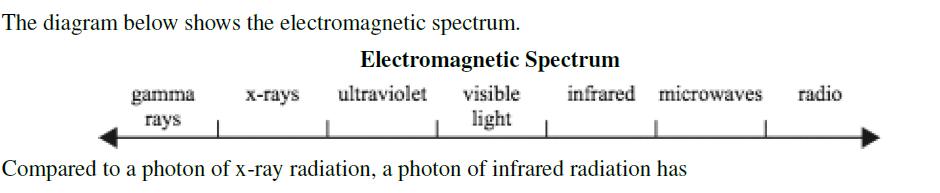
a)
a longer wavelength and less energy.
b)
a longer wavelength and more energy.
c)
a shorter wavelength and less energy.
d)
a shorter wavelength and more energy.
25.
Which of the following statements describes an advantage of total internal reflection within an optical fiber?
a)
It converts electrical signals into optical
signals.
signals.
b)
It converts optical signals into electrical
signals.
signals.
c)
It allows optical signals to be transmitted along
a curved path.
a curved path.
d)
It allows electrical signals to be transmitted
along a curved path.
along a curved path.
26.
The small part of the electromagnetic spectrum that the human eye can see including the colors red, orange, yellow, green, blue, violet
a)
prism
b)
kaleidoscope
c)
laser
d)
light spectrum
27.
A piece of clear material, such as glass or plastic, that bends light rays as they pass through, can either focus or spread light
a)
lens
b)
telescope
c)
magnify
d)
refraction
28.

Unlike mechanical waves, EM waves can travel through
a)
a vacuum
b)
water
c)
the ground
d)
air
29.

Nearsighted vision is corrected when lenses
a)
reflect light away from the eye
b)
allow light rays to focus on the retina
c)
allow light to fouca slightly past the retina
d)
help light rays relfect regularly
30.
If a candle is placed at 2f in front of a converging lens, the image
a)
will appear at f on the opposite side of the lens
b)
the image will appear at 2f on the opposite side of the lens
c)
the image will appear between f and 2f on the opposite side of the lens
d)
the image will not appear
31.
Convex lenses can produce...
a)
Real, erect images
b)
Virtual, inverted images
c)
Real, inverted images
d)
no images form
32.
A real image...
a)
is produced by virtual rays and can be projected on a screen
b)
is produced by real rays and cannot be projected on a screen
c)
is produced by virtual images and cannot be projected on a screen
d)
is produced by real rays and can be projected on a screen
33.
In order to produce an image with a convex lens that is equal in size to the object, the object distance and the image distance must be.....
a)
half of the focal length.
b)
equal.
c)
twice the focal length.
d)
inverted.
34.

Which is the angle of refraction?
a)
Angle 1
b)
Angle 2
35.

Which is the angle of incident?
a)
Angle 1
b)
Angle 2
36.
Speed of light in a vacuum is
a)
represented by the symbol "c"
b)
3.00 X10⁸ m/s
c)
both answers are correct
37.

A lens that is thicker in the center and thinner at the edges and bends light inwards is a ____________________
a)
concave lens
b)
convex lens
38.

Al lens that is thinner in the center and thicker at the edges and bends light outward is a _______________________
a)
concave lens
b)
convex lens
39.
A candle is placed on the principal axis of a convex lens at a distance of 30 cm from the lens. The focal length of the lens is 10 cm. The image formed will be
a)
Real, inverted, and reduced
b)
Real, inverted, and enlarged
c)
Real, upright, and enlarged
d)
Virtual, upright, and enlarged
40.
A converging lens has a focal length of 30 cm. A 5 cm tall candle is placed at a distance of 10 cm in front of the lens. Determine the image distance.
a)
- 45 cm
b)
-30 cm
c)
-15 cm
d)
6 cm
41.
An object is located 0.15 m from a converging lens with focal length 0.10 m.
How far from the lens is the image formed?
How far from the lens is the image formed?
a)
100/3 m
b)
3/10 m
c)
10/3
d)
3/100 m
42.
An object is located 15 m from a converging lens with focal length 10 m.If the object is 2 cm tall, find the image height if the image is located at 30 m.
a)
4 m
b)
-4m
c)
1m
d)
-1m
43.

An object of height 4 cm is placed 10 cm away from a concave lens of focal length 6 cm as shown below.Image is
a)
virtual.inverted
b)
virtual,upright
c)
real,inverted
d)
real,upright
44.
What are some uses for convex lenses?
a)
Eye glasses
b)
Camera lenses
c)
Telescopes
d)
All of the above
100 %

