
 Worksheets
Science Testing Review
Total questions: 58
Worksheet time: 33mins
Name
Class
Date
1.

What time was the temperature the highest?
a)
Between 2 and 3 in the afternoon
b)
6am
c)
Between 9 and 11 at night
d)
At 9 in the morning
2.
What is an independent variable?
a)
The variable that depends on the other variables
b)
The variable that does not ever change.
c)
The variable that DOES NOT depend on the other variables
d)
The control variable
3.
What is the first thing a scientist does in the scientific method?
a)
Make a hypothesis
b)
Choose an experiment
c)
Ask a question
d)
Record data
4.
Which of the following is a testable scientific question?
a)
Which color is the best?
b)
What flower is the prettiest
c)
Which animal is a nice pet?
d)
What amount of sunlight do plants need to grow?
5.
What part of the water cycle describes when water is running over the land and forming rivers and streams?
a)
Precipitation
b)
Runoff
c)
Condensation
d)
Evaporation
6.
What is the pH for a base?
a)
More than 7
b)
Less than 7
c)
Exactly 7
d)
Exactly 1
7.
What is the pH for an acid?
a)
More than 7
b)
Less than 7
c)
Exactly 7
d)
Exactly 14
8.
What is the pH for a neutral substance?
a)
More than 7
b)
Less than 7
c)
Exactly 7
d)
Exactly 1
9.
Which of the following is a "heat trapping gas" and contributes to the greenhouse effect?
a)
Carbon Dioxide
b)
Nitrogen
c)
Oxygen
d)
Argon
10.
What do scientists think is the impact on the atmosphere of burning fossil fuels like oil, gas and coal?
a)
It causes a colder climate
b)
It causes a warmer climate
c)
It causes less ozone
d)
It makes the water clearer
11.
What human activity contributes to acid rain by polluting the atmosphere?
a)
Fertilizing Fields
b)
Driving in a car or truck
c)
Growing food
d)
Singing in the rain
12.

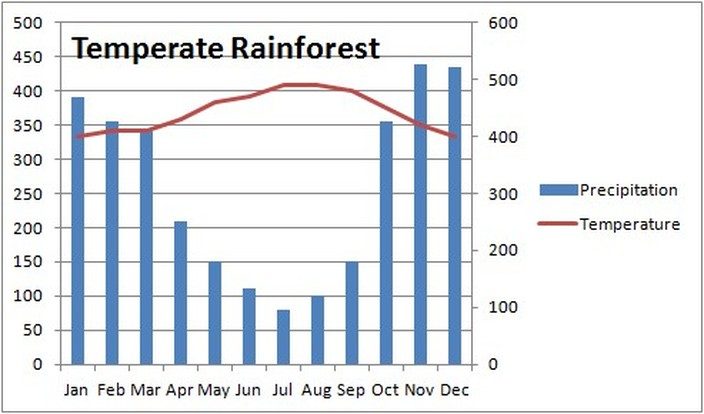
What biome is represented by the climograph ?
a)
Tropical Rainforest
b)
Desert
c)
Taiga
d)
Temperate Deciduous Forest
13.

What biome is represented by the climograph?
HINT: TEMPERATURES ARE IN CELSIUS 25 degrees is HOT!
HINT: TEMPERATURES ARE IN CELSIUS 25 degrees is HOT!
a)
The desert
b)
The rainforest
c)
The Tundra
d)
The Taiga
14.

What biome is represented by the climograph
a)
Desert
b)
Rainforest
c)
Taiga
d)
Tundra
15.
How does the ozone layer help the earth?
a)
It blocks out oxygen
b)
It keeps earth cool
c)
I blocks UV radiation
d)
It gives us Carbon Dioxide to breathe
16.
What layer is the top of the atmosphere?
a)
Troposphere
b)
Mesosphere
c)
Thermosphere
d)
Stratosphere
17.
What layer of the atmosphere is closest to the earth?
a)
Troposphere
b)
Mesosphere
c)
Thermosphere
d)
Stratosphere
18.
What tool measures temperature?
a)
Thermometer
b)
Anemometer
c)
Wind Vane
d)
Barometer
19.
What tool measures wind speed?
a)
Thermometer
b)
Wind Vane
c)
Anemometer
d)
Barometer
20.
what tool measures wind directions
a)
Thermometer
b)
Wind Vane
c)
Barometer
d)
Anemometer
21.
What tide occurs during a New Moon and Full Moon?
a)
Spring Tide
b)
Neap Tide
22.
What tide occurs during a 1st quarter moon?
a)
spring tide
b)
neap tide
23.
what is a niche in ecology?
a)
How an organism gets food and shelter
b)
How an organism hunts
c)
Where the water is
24.

what organism is the producer
a)
Plant
b)
Rat
c)
Snake
d)
Lizard
25.

What organism is a tertiary consumer?
a)
Eagle
b)
Rat
c)
Butterfly
d)
Lizard
26.
If a substance has a pH of 10 it is considered
a)
Acidic
b)
Basic
c)
Neutral
27.
Acids produce _________ ions when they break down or dissocciate.
a)
Hydroxide (OH-)
b)
Water
c)
Chlorine (Cl-)
d)
Hydrogen (H+)
28.
Bases release ____________ ions when they break down or dissociate.
a)
Hydrogen (H+)
b)
Hydroxide (OH-)
c)
Chlorine (Cl-)
d)
no
29.
Water is neutral because the number of hydrogen and hydroxide ions is _________.
a)
the same
b)
different
30.
The pH scale ranges from ____________.
a)
0-7
b)
1-100
c)
1-20
d)
0-14
31.
True or False: Your hypothesis can never be wrong.
a)
True
b)
False
32.
The summary at the end of an experiment that explains the results.
a)
conclusion
b)
procedures
c)
materials
d)
hypothesis
33.
Observations made during an experiment are considered:
a)
data
b)
problems
c)
conclusions
d)
questions
34.

What is a hypothesis?
a)
an educated guess stating what you believe will be the result of your experiement
b)
a random guess
c)
a statement of the outcome of your experiment
d)
step by step directions for your experiment
35.

What are the procedures step in the experiment?
a)
the conclusion to your experiment
b)
the materials needed to complete experiment
c)
step by step directions of how to complete your experiment
d)
an educated, best guess
36.
The independent variable is the ONE thing you _____.
a)
change on purpose
b)
control or keep constant
c)
measure
37.
The variable that is being measured or observed is called the _______________. Hint: this is the variable that is the result or effect
a)
independent variable
b)
dependent variable
c)
control variable
38.
Anything that can change in an experiment. There are three types of these in an experiment.
a)
variables
b)
constant
c)
independent
d)
dependent
39.
A possible answer to a scientific question
a)
Independent variable
b)
Hypothesis
c)
Observation
d)
Scientific inquiry
40.
A way of learning about the natural world
a)
Hypothesis
b)
Quanitative
c)
Qualitative
d)
Science
41.
Using one or more of your senses to gather information
a)
classifying
b)
observing
c)
inferring
d)
predicting
42.
The factor of an experiment that might change because of the independent variable
a)
Hypothesis
b)
independent variable
c)
Dependent variable
d)
controlled experiment
43.
The factor that is purposely changed
a)
Hypothesis
b)
independent variable
c)
Dependent variable
d)
controlled experiment
44.
Which biome is characterized by low temperatures and low amounts of rainfall?
a)
tundra
b)
desert
c)
temperate deciduous forest
d)
tropical rain forest
45.
Which type of trees is found in a temperate forest?
a)
deciduous
b)
evergreen
c)
ginko
d)
palm
46.
Which biome receives between 0 to 25 centimeters of rain per year, has a temperature range of 0 to 50 degrees Celsius, has poor soil, and is home to lizards, scorpions, and snakes?
a)
desert
b)
mountain
c)
taiga
d)
tundra
47.
The most important abiotic factors when studying biomes are...
a)
Food and Water
b)
Water and Sunlight
c)
Temperature and Oxygen
d)
Water and Temperature
48.
Day to day conditions of the atmosphere
a)
weather
b)
climate
c)
altitude
49.
The average weather conditions of an area over many years
a)
Altitude
b)
Climate
c)
Weather
50.
Which of the following removes carbon from the atmosphere?
a)
Combustion
b)
Respiration
c)
Photosynthesis
d)
Death
51.
How is the burning of fossil fuels related to global warming?
a)
Magic
b)
Fuels are hot
c)
Greenhouse effect
d)
Photosynthesis
52.

Mushroom
a)
Producer
b)
Consumer
c)
Decomposer
53.

Turtle
a)
Producer
b)
Consumer
c)
Decomposer
54.

Orange Tree
a)
Producer
b)
Consumer
c)
Decomposer
55.
What are the products of photosynthesis?
a)
water and carbon dioxide
b)
oxygen and glucose
c)
oxygen and carbon dioxide
d)
oxygen and water
56.

If there is 1000 Kcal available in the producers in trophic level 1, how much energy is available in the herbivores in trophic level 2?
a)
10 Kcal
b)
1 Kcal
c)
100 Kcal
d)
1000 Kcal
57.

The deer, grasshopper, and bird are all examples of which type of consumers on this food pyramid?
a)
decomposers
b)
omnivores
c)
carnivore
d)
herbivore
58.

In the energy pyramid here, how much of the energy in the producers gets passed to the herbivores?
a)
10%
b)
20%
c)
80%
d)
90%
100 %

