wayground logo

Free Printable Worksheets

Font size

S
M
L
XL
Worksheets

Waves

Total questions: 80

Worksheet time: 51mins

Name
Class
Date
1.
A wave that requires a medium through wave which to travel
a)
A. electromagnetic  wave
b)
B. longitudinal wave
c)
C. mechanical wave
d)
D. transverse wave
2.
A wave that does not require a medium
a)
A. electromagnetic  wave. 
b)
B. surface wave
c)
C. medium
d)
D. transverse wave
3.
A wave in which the particles of the medium move perpendicularly to the direction the wave is traveling
a)
A. surface wave
b)
B. transverse wave
c)
C. electromagnetic  wave
d)
D. longitudinal wave
4.
A wave in which the particles of the medium vibrate parallel to the direction of the wave motion
a)
A. mechanical wave
b)
B. surface wave
c)
C. longitudinal wave
d)
D. wave
5.
The number of waves produced in a given amount of time
a)
A. amplitude
b)
B. wave speed
c)
C. frequency
d)
D. wavelength
6.
The maximum distance that the particles of a wave’s medium vibrate from their rest position
a)
A. frequency
b)
B. wavelength
c)
C. wave speed
d)
D. amplitude
7.
The distance from any point on a wave to an identical point on the next wave
a)
A. frequency
b)
B. wavelength
c)
C. wave speed
d)
D. amplitude
8.
A change in the direction of a wave when the wave finds an obstacle or an edge.
a)
A. refraction
b)
B. reflection
c)
C. standing wave
d)
D. diffraction
9.
The bouncing back of a ray of light, sound, or heat when the ray hits a surface that it does not penetrate
a)
A. refraction
b)
B. reflection
c)
C. resonance
d)
D. standing wave
10.
A section of a longitudinal wave where the particles are crowded together is called a
a)
A. rarefaction.
b)
B. vibration
c)
C.compression
d)
D. surface wave.
11.

Which of the following items would work well in space?

a)

A. air horn

b)

B. radio

c)

C. guitar

d)

D. drum set

12.
A wave can make a leaf bob up and down on the water, but it cannot move the leaf toward the shore. This is because waves only transfer
a)
A. matter.   
b)
B. energy.     
c)
C. media. 
d)
D. crests.
13.
For a laboratory experiment, Antonia wants to measure the amplitude of a transverse wave. Which of the following distances is equal to the amplitude of a transverse wave?
a)
A. the distance from one crest to the next 
b)
B. the distance from the highest point to the lowest point 
c)
C. the distance from one trough to the next 
d)
D. the distance from the rest position of the wave to its highest point 
14.
Which of the following is NOT a property of a wave?
a)
A. refraction
b)
B. amplitude
c)
C. frequency
d)
D. wavelength
15.
Which of these waves do NOT require a medium?
a)
A. ocean waves       
b)
B. seismic waves
c)
C. sound waves     
d)
D. radio waves
16.
What is frequency?
a)
the number of vibrations per second
b)
how high or low a sound is
c)
the loudness or softness of a sound
d)
the back and forth movement of matter
17.
Without matter, sound waves could not travel.
a)
True
b)
False
18.
The amount of energy a wave carries corresponds with its ____.
a)
crest
b)
wavelength
c)
amplitude
d)
period
19.
The interaction of waves that meet at the same point at the same time is
a)
reflection
b)
refraction
c)
diffreaction
d)
interference
20.
What does it mean to refract?
a)
bounce off
b)
to bend
c)
curve outward
d)
reflect
21.
What does it mean to reflect?
a)
bounce off
b)
bend
c)
refract
d)
energy
22.
All of these are transverse waves except
a)
radio waves.
b)
x-ray waves.
c)
ultraviolet waves.
d)
sound waves.
23.
Which of the following is an example of an electromagnetic wave?
a)
a radio wave
b)
a water wave
c)
the oscillation of a spring
d)
the vibration of a violin string
24.

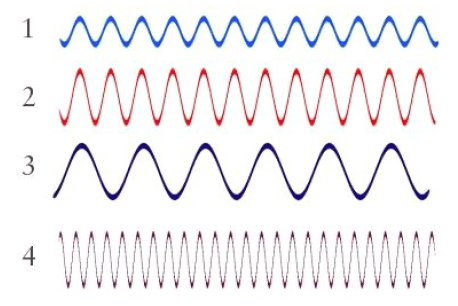
Which transverse wave has the highest frequency?

a)

1

b)

2

c)

3

d)

4

25.
The matter (solid, liquid, or gas) through which waves can travel
a)
Medium
b)
Object
c)
Transverse Wave
d)
Wavelength
26.

Which diagram shows the wavelength of a wave?

a)
b)
c)
27.

What does a wave carry from place to place?

a)

energy

b)

matter

c)

people

28.

If the wavelength of a wave increased, what would happen to the frequency?

a)

decrease

b)

increase

c)

stay the same

29.

A wave that can travel through matter and empty space is a:

a)

electromagnetic wave

b)

longitudinal wavy

c)

transverse wave

d)

mechanical

30.

What type of wave is this?

a)

Longitudinal

b)

Transverse

c)

Electromagnetic

d)

x ray

31.
How would a person measure the wavelength on this sound wave?
a)
dense to less dense
b)
trough to crest
c)
compression to compression
d)
beginning of illustration to the end
32.

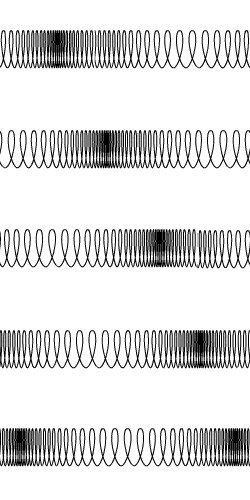
You can't hear sounds in outer space because there is no

a)

medium

b)

light

c)

energy

d)

heat

33.
Longitudinal waves are ______.
a)
Parallel
b)
Perpendicular
c)
Crazy
34.
Transverse waves are ___.
a)
Parallel
b)
Perpendicular
c)
Weird
35.
What kind of wave is pictured below?
a)
compressional wave
b)
transverse wave
c)
sound wave
d)
mechanical wave
36.
Which part of the wave is shown at letter E?
a)
trough
b)
crest
c)
resting point
d)
amplitude
37.
In longitudinal waves, the parts where the coils are spread apart are called what?
a)
rarefactions
b)
compressions
c)
mechanicals
d)
longitudes
38.
In what type of wave does the medium move perpendicular to the movement of the wave?
a)
Transverse
b)
Longitudinal
c)
Electromagnetic
d)
Radio
39.
Which type of wave does sound travel in?
a)
Transverse
b)
Longitudinal
40.
Which answer best explains what causes a wave?
a)
Shaking
b)
Potential energy
c)
Light
d)
Vibrations
41.

Which are properties of a mechanical wave?

a)

can be longitudinal or transverse

b)

can move through space

c)

must have matter to move

d)

carries energy

42.
Destructive interference is 
a)
When the two waves affect  each other in a negative way 
b)
The two waves add together and produce a single wave of greater amplitude
c)
Are in phase 
43.
What is interference?  
a)
occurs when two or more waves overlap and combine 
b)
occurs when two or more waves combine and neutralize each other 
c)
when one waves travels alone
44.
Which wave in the diagram has the greatest wavelength?
a)
1
b)
2
c)
3
d)
4
45.
Which wave behavior do noise cancelling headphones use?
a)
diffraction
b)
refraction
c)
constructive interference
d)
destructive interference
46.
Refraction causes waves to bounce back off of an object.
a)
True
b)
False
47.
Which form of Interference is occurring in this picture?
a)
Reflection
b)
Refraction
c)
Diffraction
d)
Radiation
48.
Light is the only wave that can be reflected.
a)
True
b)
False
49.
Which of the following is the bending of a wave, which changes its speed.
a)
Reflection
b)
Diffraction
c)
Refraction
d)
Frequency
50.
When a wave bends or spreads past a medium, this is referred to as
a)
Reflection
b)
Refraction
c)
Radiation
d)
Diffraction
51.
When waves meet, and form either a larger or smaller amplitude
a)
Radiation
b)
Interference
c)
Diffraction
d)
Microwaves
52.
The combination of two waves to form a larger amplitude is what type of interference?
a)
Constructive
b)
Destructive
c)
Diffractive
d)
Refractive
53.
Waves can meet and form a smaller amplitude.  If this occurs, it is called
a)
Constructive
b)
Destructive
c)
Diffractive
d)
Refractive
54.
The picture best represents
a)
Refraction
b)
Reflection
c)
Diffraction
d)
Interference
55.
These waves are experiencing
a)
Reflection
b)
Refraction
c)
Diffraction
d)
Diffusion
56.

Which type of interaction is this?

a)

reflection

b)

refraction

c)

diffraction

57.

Which type of interaction is this?

a)

reflection

b)

refraction

c)

diffraction

58.

Which type of interaction is this?

a)

reflection

b)

refraction

c)

diffraction

59.

Which type of interaction is this?

a)

reflection

b)

refraction

c)

diffraction

60.

Which type of interaction is this?

a)

reflection

b)

refraction

c)

diffraction

61.

What is a wave ?

a)

a disturbance that transfers matter

b)

a disturbance that transfers energy

c)

a disturbance that transfers both matter and energy
62.
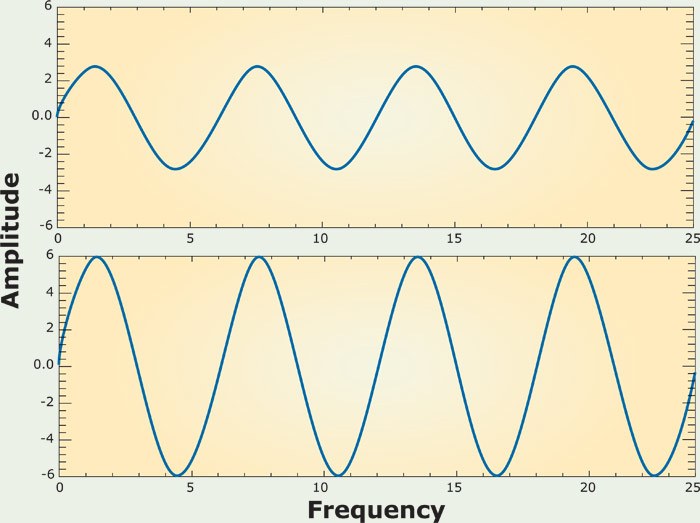
Which property of these waves differs?
a)
Frequency
b)
Wavelength
c)
Amplitude
d)
Pitch
63.
Which is the correct equation for calculating the speed of a wave?
a)
T = 1/f
b)
Speed= Wavelength x Period
c)
Speed = Wavelength/Frequency
d)
Speed= Wavelength x Frequency
64.
Velocity= ________
Wavelength= .5m
Frequency= 150 hertz
a)
.75 m/s
b)
75 m/s
c)
300 m/s
65.
Velocity= 600 m/s
Wavelength= 2.0m
Frequency= _________
a)
300 hertz
b)
.0033 hertz
c)
3000 hertz
66.
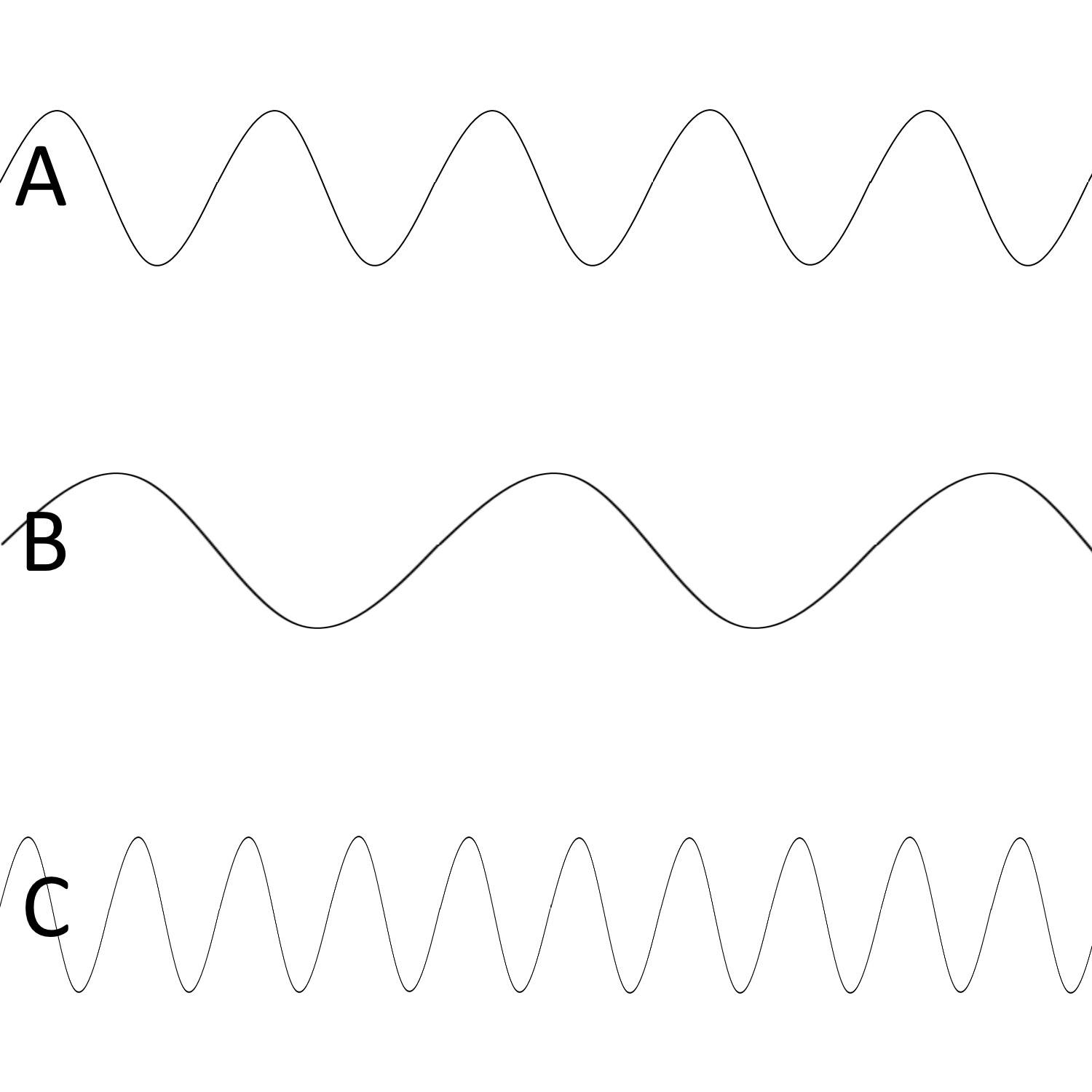
Which wave has the largest wavelength?
a)
A
b)
B
c)
C
d)
None (same wavelength)
67.
Which wave has the largest frequency?
a)
A
b)
B
c)
C
d)
None (same frequency)
68.
Velocity= _________
Wavelength= 3.0 m
Frequency= 120 hertz
a)
40 m/s
b)
360 m/s
c)
0.025 hertz
69.

20 waves go past a fixed point in 10 seconds. What is the frequency of the wave?

a)

20 seconds

b)

20 Hz

c)

2 Hz

d)

2

70.

Six waves go past a fixed point in two seconds. What is the frequency of the wave?

a)

3

b)

6 Hz

c)

3 Hz

d)

2

71.

A radio wave has a wave length of 4 m and a frequency of 4 Hz. What is the speed of the wave?

a)

16 m/s

b)

16 m

c)

4 Hz

d)

8 m/s

72.

A sound wave has a frequency of 96 Hz and a wavelength of 0.5 m. What is the speed of the wave?

a)

48 m

b)

96 m/s

c)

48 m/s

d)

96 m

73.

The length of 4 waves together is 12m. How long is the wavelength of a single wave?

a)

3 seconds

b)

3 metres

c)

12 metres

d)

3 Hz

74.

Sound waves must travel through ___________________.

a)

air

b)

a medium

c)

an outward area

d)

a short

75.

Sound waves can NOT travel through

a)

Air

b)

Water

c)

Earth

d)

space

76.

Which electromagnetic waves have the longest wavelengths and lowest frequencies?

a)

infrared waves

b)

radio waves

c)

gamma rays

d)

ultraviolet rays

77.

The range of electromagnetic waves placed in a certain order is called the

a)

electromagnetic spectrum.

b)

electromagnetic wavelength.

c)

electromagnetic frequency.

d)

electromagnetic field.

78.

Electromagnetic waves can transfer energy without a(n)

a)

medium.

b)

electric field.

c)

magnetic field.

d)

change in either a magnetic or an electric field.

79.

In a vacuum, all electromagnetic waves have the same

a)

wavelength.

b)

speed.

c)

frequency.

d)

amplitude.

80.

Which letter shows the type of wave that can be seen by the human eye?

a)

A.

b)

B.

c)

C.

d)

D.