
 Worksheets
Unit 4 Test Review
Total questions: 39
Worksheet time: 1hrs 3mins
Name
Class
Date
1.
A sled sliding on a flat, icy surface with a constant velocity is best described by
a)
Newton’s first law of motion for objects at rest.
b)
Newton’s first law of motion for objects in motion.
c)
Newton’s second law of motion.
d)
Newton’s third law of motion.
2.
Dividing the total distance traveled by the total time is how to calculate
a)
average speed.
b)
average velocity.
c)
average acceleration.
3.
A ____ force is the total force felt by an object.
a)
sum
b)
net
c)
strong
d)
balanced
4.
____ is the rubbing force that acts against motion between two touching surfaces.
a)
Acceleration
b)
Normal force
c)
Momentum
d)
Friction
5.
You hit a wall with a stick. The equal but opposite reaction is ____.
a)
the wall pushes against you
b)
the stick pushes against you
c)
you push against the stick
d)
the wall pushes against the stick
6.
A ping pong ball accelerates more than a baseball being thrown with the same force. This is an example of which Law of Motion?
a)
Newton's First Law
b)
Newton's Second Law
c)
Newton's Third Law
7.
What is the product of an objects mass and velocity?
a)
Momentum
b)
Gravity
c)
Inertia
d)
Weight
8.
What is an attractive force that acts between any two objects?
a)
electromagnetic force
b)
Inertia
c)
Gravitational Force
d)
Mass
9.
What is a force associated with charged particles, which has two aspects, electric force and magnetic force.
a)
Gravitational Force
b)
Sliding Friction
c)
Electromagnetic Force
d)
Weak nuclear force
10.

What does this graph represent?
a)
Constant speed
b)
Acceleration
c)
Not moving
d)
decceleration
11.
What is the powerful attractive force that binds protons and neutrons together in the nucleus.
a)
Gravitational Force
b)
Strong Nuclear Force
c)
Weak Nuclear Force
d)
Gravity
12.

Calculate the average speed (in meter/sec) if a cheetah runs 180 meters in 10 seconds.
a)
198 m/sec
b)
170 m/sec
c)
12 m/sec
d)
18 m/sec
13.

Which runner won the race?
a)
A
b)
B
c)
C
14.

What does this graph represent?
a)
Constant speed
b)
Acceleration
c)
At rest
d)
slowing down
15.

which line shows a negative acceleration ?
a)
A
b)
B and C
c)
D
d)
A, B, and
A, B, and D
A, B, and D
16.

What happened during A to B point?
a)
not moving
b)
increasing speed at a constant rate
c)
moving at a constant speed
d)
moving at 10 m/s2 acceleration
17.
When are you undergoing an acceleration in a car?
a)
speed up
b)
slow down
c)
make turns
d)
All of the above
18.

A roller coasters accelerates from an initial velocity of 6.0 m/s to a final velocity of 70 m/s over 4 seconds. What's the acceleration?
a)
24 m/s2
b)
18 m/s2
c)
16 m/s2
d)
16 m/s
19.

Mr. Wells drove from Georgia to New York, a distance of 1125 miles. The drive took him 25 hours. What was Mr. Wells' velocity?
a)
45 mph West
b)
45 mph North
c)
25 mph
d)
1125 miles per minute
20.
The SI unit for acceleration is
a)
mph
b)
m/s
c)
m/s2
d)
kg.m/s
21.
You and your dad are moving the couch from one side to another. Your dad pushes with a force of 35 N to the right and you push with a force of 25 N right. What is the net force on the couch?
a)
60 N right
b)
10 N left
c)
60 N left
d)
50 N left
22.
You and your friend, are playing tug of war. Your friend pulls with a force of 55 N, to the rights. You pull with a force of 65 N, to the left. What is the net force on the rope?
a)
120 N to the left
b)
20 N
c)
10 N to the left
d)
10 N to the right
23.
Jermaine runs exactly 2 laps around a 400 meter track. What is the displacement?
a)
800
b)
400
c)
0
d)
200
24.
This term describes speed and direction
a)
velocity
b)
gravity
c)
deceleration
d)
momentum
25.
A person walks 50 meters directly north, stops, and then travels 32 meters directly south. What is their distance traveled?
a)
82 meters
b)
18 meters
c)
32 meters
26.
The mass of an object _______ as it moves away from the center of Earth
a)
stays the same
b)
decreases
c)
increases
d)
doubles
27.
What is the definition of "weight"?
a)
the force in which gravity pulls on an object
b)
the amount of space an object takes up
c)
the amount of matter in an object
d)
the size of an object
28.

Which of these best describes the concept of inertia?
a)
A force that attracts objects with mass
b)
the tendency of an object to float in water
c)
a force created when surfaces are in contact
d)
The tendency of an object to resist a change in motion
29.
If a 10 kilogram object had a force of 50 newton's applied to it, what would its acceleration be?
a)
15 m/s^2
b)
5 m/s^2
c)
.5 m/s^2
d)
10 m/s^2
30.
What Unit do we Measure Force in?
a)
Newtons
b)
Joules
c)
grams
d)
pounds
31.
A car is 2000kg and accelerating at 20m/s2, what is the net force applied to it?
a)
40000 N
b)
100 N
c)
5 N
d)
200 N
32.
If a cheetah is traveling 60 m/s chasing behind a lion cub that is running 20 m/s, how fast does the cheetah appear to be running to the lion cub who looks back over his shoulder?
a)
20 m/s
b)
80 m/s
c)
40 m/s
d)
60 m/s
33.
Which of the four fundamental forces of nature is responsible for radioactive decay?
a)
Weak Nuclear Decay
b)
Strong Nuclear Decay
c)
Electromagnetic Force
d)
Gravity
34.

If the blue car is speeding at 65 mph and the police car is cruising in the opposite direction at 50 mph, then how fast does the blue car appear to be traveling when the cop looks back after passing him up?
a)
100 mph
b)
65 mph
c)
15 mph
d)
115 mph
35.
What is the unit for momentum?
a)
m/s
b)
m/s2
c)
Newtons
d)
kg.m/s
36.
A book rests on a table. The force of gravity pulls down on the book with a force of 20 newtons. What prevents the books from accelerating downward at 9.8 m/sec2
a)
The table presses back up on the book with an equal and opposite force of 20 newtons.
b)
The table presses back up on the book with a force greater than 20 newtons.
c)
The table and the book together are accelerating downwards at 9.8 m/sec2
d)
The inertia of the book holds it up
37.
With unbalanced forces, the object will move in the direction of the _______ force.
a)
larger
b)
smaller
c)
equal
38.
Inertia is the tendency of an object to resist a change in its ___________.
a)
temperature
b)
shape
c)
size
d)
motion
39.
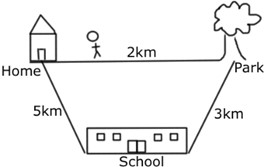
Jerry walked from home to school, then from the school to the park. What is his total displacement?
a)
2 km
b)
5 km
c)
8 km
d)
10 km
100 %

