
 Worksheets
Ch 17 Test Review
Total questions: 54
Worksheet time: 2hrs 57mins
Name
Class
Date
1.
The electric field lines around a negatively charged particle
a)
cross positively charged particle filed lines
b)
cross negatively charged particle field lines
c)
always point outward
d)
always point inward
2.
Electric field lines
a)
Point toward a negative charge
b)
Point away from a positive charge
c)
Never cross one another
d)
All of the above
3.
Electric field lines indicate
a)
Direction only
b)
Relative strength only
c)
Both Direction and Strength
d)
Neither Direction or Strength
4.
The brightness of a light bulb is determined by its filament's
a)
Voltage
b)
Current
c)
Power
d)
Resistance
5.
The resistance of an insulator is
a)
High
b)
Moderate
c)
Very Low
d)
Absent
6.
Positive charges ___________ one another
a)
Attract
b)
Cancel
c)
Repel
d)
Join
7.
The electric force between two objects _______ when the distance between them decreases
a)
Increases
b)
Decreases
c)
Remains Constant
d)
None of the Above
8.
Which of the following is a positively charged particle?
a)
Proton
b)
Electron
c)
Coloumb
d)
Neutron
9.
An electric cell is a source of electric current because of a ________ between the terminals
a)
Resistance
b)
Light Bulb
c)
Semiconductor
d)
Potential Difference
10.
Conventional current is defined as the movement of
a)
Positive Charges
b)
Negative Charges
c)
Net Charges
d)
Variable Charges
11.
A 6V battery is connected to a 24 ohm resistor. What is the current in the resistor?
a)
0.25 A
b)
4.0 A
c)
18 A
d)
144 A
12.
A circuit breaker acts as a switch creating a(n) _________ circuit when the current is too high
a)
Open
b)
Closed
c)
Series
d)
Parallel
13.
There is an attractive force between two charged objects when
a)
Their charges are of unlike signs
b)
They have the same number of protons
c)
They have the same number of electrons
d)
Their charges are of like signs
14.
Electric force varies depending on the
a)
Charge and distance between charged objects
b)
Charge and mass of charged objects
c)
Height and mass of charged objects
d)
Mass and distance between charged objects
15.
An electric current is produced when charges are accelerated by an electric field to move to a position of potential energy that is
a)
Higher
b)
Lower
c)
Equal
d)
Infinite
16.
The SI unit of resistance is the
a)
Volt
b)
Ampere
c)
Ohm
d)
Joule
17.
The SI unit for power is the
a)
Watt
b)
Ohm
c)
Volt
d)
Ampere
18.
The SI unit for current is
a)
Volt
b)
Ampere
c)
Ohm
d)
Watt
19.
What is another name for potential difference?
a)
Voltage
b)
Current
c)
Resistance
d)
Power
20.
What is the potential difference across a resistor that dissipates 15W of power and has a current of 3A?
a)
5 V
b)
45 V
c)
5 Ohms
d)
45 Ohms
21.
There is a potential difference of 6V across a resistor with 3A of current it in. What is the resistance of the resistor?
a)
0.5 Ohms
b)
2 Ohms
c)
18 Ohms
d)
32 Ohms
22.
If a lamp is measured to have a resistance of 100 ohms when it operates at a power of 120W, what is the potential difference across the lamp?
a)
120V
b)
1.2V
c)
0.83V
d)
12000V
23.
The electric force between charged objects is/are
a)
Attractive only
b)
Repulsive only
c)
Either attractive or repulsive
d)
Neither attractive or repulsive
24.
Every charged particle produces a(n)
a)
Negative Charge
b)
Positive Charge
c)
Magnetic Field
d)
Electric Field
25.
Current is the rate at which charges move through a(n)
a)
Conductor
b)
Insulator
c)
Voltage
d)
Joule
26.
A flashlight bulb with a potential difference of 8V across its filament has a power of 48W. How much current is in the bulb filament?
a)
6A
b)
0.167 A
c)
360 A
d)
12 A
27.
What has the highest resistance?
a)
Semiconductor
b)
Superconductor
c)
Insulator
d)
Conductor
28.
What has the lowest resistance?
a)
Conductor
b)
Insulator
c)
Superconductor
d)
Semiconductor
29.
An electric toaster has a power rating of 1,100W at 100V. What is the resistance of the heating coil?
a)
7.5 Ohms
b)
9.0 Ohms
c)
10 Ohms
d)
11 Ohms
30.
A 26 ohm resistor has .2 A of current in it. What is the potential difference across the resistor?
a)
5.2 V
b)
130 V
c)
.0077 V
d)
7 V
31.
What is the voltage of a standard outlet?
a)
120 V
b)
110 V
c)
60 V
d)
65 V
32.
A material that allows electrons to move easily
a)
Insulator
b)
Conductor
c)
Electric Force
d)
Electric Charge
33.
Alignment of charges at the surface of an object producing an induced charge
a)
Insulator
b)
Polarization
c)
Electric Force
d)
Electric Charge
34.
The force of attraction or repulsion between objects due to charge
a)
Insulator
b)
Polarization
c)
Electric Force
d)
Electric Charge
35.
A material that does not easily transfer electric charges
a)
Insulator
b)
Conductor
c)
Electric Force
d)
Electric Charge
36.
An electrical property of matter that creates electric charges and magnetic forces and interactions
a)
Insulator
b)
Conductor
c)
Electric Force
d)
Electric Charge
37.
SI Unit of Charge
a)
Coulomb
b)
Watt
c)
Ohm
d)
Volt
38.
A circuit in which two or more paths are connected to a voltage source
a)
Series
b)
Parallel
c)
Open
d)
Closed
39.
When a glass rod is rubbed with silk and becomes positively charged,
a)
Electrons are removed from the rod
b)
Protons are added to the silk
c)
Protons are removed from the silk
d)
The silk remains neutral
40.
A circuit in which the components form a single path
a)
Series
b)
Parallel
c)
Open
d)
Closed
41.
A device that contains a metal strip that melts when a certain current is exceeded
a)
Switch
b)
Electric Power
c)
Fuse
d)
Short Circuit
42.
A low resistance alternative pathway for current to travel in a circuit
a)
Switch
b)
Electric Power
c)
Fuse
d)
Short Circuit
43.
A device used to open or close an electric circuit
a)
Switch
b)
Electric Power
c)
Fuse
d)
Short Circuit
44.
The rate at which electrical work is done
a)
Switch
b)
Electric Power
c)
Fuse
d)
Short Circuit
45.
The rate at which charges move through a conductor is called
a)
Voltage
b)
Resitance
c)
Current
d)
Electrical Potential Energy
46.
______ is the opposition posed by a material to the flow of the current
a)
Voltage
b)
Charge
c)
Resistance
d)
Ampere
47.
______ is the opposition posed by a material to the flow of the current
a)
Voltage
b)
Charge
c)
Resistance
d)
Ampere
48.
wood is a _____?
a)
conductor
b)
insulator
49.
water is a______?
a)
conductor
b)
insulator
50.
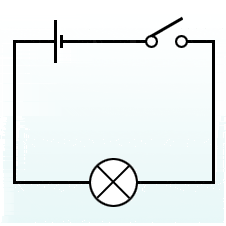
this circuit is .....?
a)
open
b)
parallel
c)
closed
d)
The cutest little circuit evah!
51.

What type of circuit is show in the image?
a)
Series Circuit
b)
Parallel Circuit
52.

What kind of circuit is this?
a)
series
b)
parallel
53.
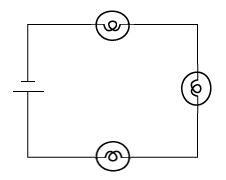
The picture shows an electrical circuit. This circuit is a series circuit because:
a)
It has 3 light bulbs.
b)
The same current flows through all three light bulbs.
c)
It uses a single battery.
d)
The electrical current has more than one path to flow through
54.
Silver is a _____?
a)
insulator
b)
conductor
100 %

