
 Worksheets
EOC REVIEW: Atomic Structure, Nuclear, Trends
Total questions: 53
Worksheet time: 45mins
Name
Class
Date
1.
What particle provides the positive charge for an atom?
a)
proton
b)
neutron
c)
electron
d)
nucleus
2.
Which particle does not contribute mass to the atom?
a)
Proton
b)
Neutron
c)
Electron
d)
Nucleus
3.
How many electrons are in an atom that has an atomic number of 34, an atomic mass of 74 and a charge of -2?
a)
34
b)
36
c)
2
d)
40
4.
How many neutrons are in an atom of P-29?
a)
29
b)
15
c)
14
d)
31
5.

What is the number of neutrons?
a)
34
b)
79
c)
45
d)
35
6.
If you have 10 protons, 8 electrons and 9 neutrons, what would the mass number be?
a)
19
b)
9
c)
18
d)
17
7.
What are the names of the horizontal rows on the periodic table?
a)
The periods
b)
The Groups
c)
The Non-Metals
d)
Ionization Energies
8.
How many neutrons does uranium-235 have?
a)
238
b)
92
c)
146
d)
143
9.
Which family would contain fluorine?
a)
Transition metals
b)
Halogens
c)
Noble Gases
d)
Inner-Transitions
10.
The _________ of a neutral element equals the number of protons in an atom of that element.
a)
mass number
b)
atomic weight
c)
atomic number
d)
isotopes
11.
The __________ of an atom is the sum of the protons and neutrons in the nucleus of that atom.
a)
mass number
b)
atomic number
c)
atomic weuight
d)
isotope weight
12.

How many protons are in this element?
a)
79
b)
196
c)
117
d)
Cannot be determined
13.
How many protons are in an atom with an atomic number of 20, an atomic mass of 45, and a charge of +2?
a)
20
b)
10
c)
2
d)
18
14.
How many neutrons are in an atom with an atomic number of 20, an atomic mass of 45, and a charge of +2?
a)
20
b)
25
c)
2
d)
18
15.
How many electrons are in an atom with an atomic number of 20, an atomic mass of 45, and a charge of +2?
a)
20
b)
45
c)
18
d)
2
16.

How many protons and neutrons does the isotope of lithium have?
a)
8 neutrons and 3 protons
b)
3 neutrons and 8 protons
c)
11 neutrons and 3 protons
d)
5 neutrons and 3 protons
17.

How many protons and electrons does this isotope of titanium have?
a)
48 electrons; 22 protons
b)
22 protons; 22 electrons
c)
26 electrons; 22 protons
d)
48 protons; 22 electrons
18.
Atoms of the same element must always have the same number of _________
a)
electrons
b)
neutrons
c)
isotopes
d)
protons
19.
Which family would contain magnesium?
a)
Alkaline Earth
b)
Halogens
c)
Noble Gases
d)
alkali metals
20.
What is true about cations?
a)
they have negative charges and gain electrons
b)
they have positive charges and gain electrons
c)
they have positive charges and lose electrons
d)
they have positive charges and lose protons
21.
What is true about anions?
a)
they have negative charges and gain electrons
b)
they have positive charges and gain electrons
c)
they have negative charges and lose electrons
d)
they have positive charges and lose protons
22.
Which element is malleable?
a)
carbon
b)
silicon
c)
phosphorus
d)
calcium
23.
Which element is brittle and an insulator?
a)
aluminum
b)
sulfur
c)
gallium (Ga)
d)
Tin (Sn)
24.
Which element could be drawn into a wire due to being ductile?
a)
zinc
b)
arsenic
c)
bromine
d)
carbon
25.
Which of the following is NOT a property of non-metals
a)
Brittle
b)
Ductile
c)
Non-conductive
d)
insulator
26.
Which of the following is NOT a property of metals?
a)
Lustrous
b)
Malleable
c)
good conductor
d)
Dull
27.
Barium-122 has a half-life of 2 minutes. A fresh sample weighing 80 g was obtained. If it takes 10 minutes to set up an experiment using barium-122, how much barium-122 will be left when the experiment begins?
a)
0.25g
b)
2.5g
c)
25g
d)
80g
28.
The half-life of strontium-90 is 25 years. How much strontium-90 will remain after 100 years if the initial amount is 4.0 g?
a)
3.0g
b)
0.25mg
c)
0.3g
d)
0.25g
29.
When nuclei decay, massive amounts of __________ is released.
a)
energy
b)
jello
c)
protons
d)
neutrons
30.
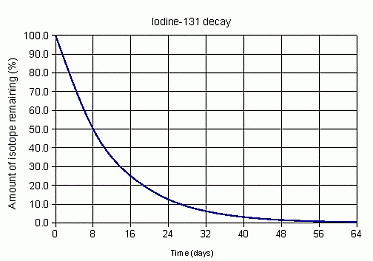
What is the half-life of iodine-131?
a)
32 days
b)
8 days
c)
16 days
d)
24 days
31.

What percent of carbon-14 would be left after 5730 years?
a)
100%
b)
75%
c)
50%
d)
25%
32.

If one-fourth of the carbon-14 is remaining then how many half-lives have passed?
a)
1
b)
2
c)
3
d)
4
33.

What particle completes this reaction?
a)
alpha particle
b)
beta particle
c)
gamma particle
d)
neutron
34.
Solve this equation for alpha decay.
20985At = ___ + 42He
20985At = ___ + 42He
a)
20583Bi
b)
20986Rn
c)
20781Tl
d)
20885At
35.
Solve this equation for alpha decay.
22688Ra = ___ + 42He
22688Ra = ___ + 42He
a)
22286Rn
b)
22689Ac
c)
22484Po
d)
22588Ra
36.
Which has the greater EN:
Cl or Al?
Cl or Al?
a)
Cl
b)
Al
37.
Which has the greater EN:
N or C?
N or C?
a)
C
b)
N
38.
Which of the following will have a larger radius than Zinc?
a)
Gallium
b)
Aluminum
c)
Magnesium
d)
Strontium
39.
Which of the following will have a lower ionization energy than Scandium (Sc)?
a)
Helium (He)
b)
Titanium (Ti)
c)
Calcium (Ca)
d)
Magnesium (Mg)
40.
As atoms of elements in group 16 are considered in order from top to bottom, the electronegativity of each successive element....
a)
decreases
b)
increases
c)
remains the same
d)
none of the above
41.
Which atom has the largest atomic radius?
a)
potassium
b)
rubidium
c)
francium
d)
cesium
42.
As you move down the periodic table atoms get bigger. This is because ____________.
a)
The atoms have more mass.
b)
The atoms have more protons.
c)
The atoms have more energy levels
d)
The atoms have more nuetrons
43.
As you move across the periodic table atoms tend to get smaller because, ______________.
a)
the atoms have more mass.
b)
the atoms have less mass
c)
the atoms have more protons.
d)
the atoms have less electrons.
44.
Atoms that have a high electronegativity, _______________.
a)
give up their electrons more easily.
b)
hold on to their electrons more tightly.
c)
have more electron shells.
45.
Electronegativity is...
a)
how good an atom is at attracting electrons
b)
the ability of an atom to lose electrons
c)
the energy required to remove an electron from a specific atom
d)
how easy it is to make friends.
46.
Ionization energy is...
a)
the energy required to add an electron to a specific atom
b)
how much energy it takes to remove an electron from an atom
c)
the energy required to shield the outer electrons from the nucleus
d)
a measure of the ability of an atom to attract electrons
47.
Metals are good conductors of heat and electricity.
a)
true
b)
false
48.
The atom with the largest atomic radius in Group 18 is -
a)
Ar
b)
He
c)
Kr
d)
Rn
49.
Which statement correctly and completely identifies a trend?
a)
Atomic radius decreases across a period and increases down a group.
b)
Electronegativity decreases across a period and decreases down a group.
c)
Ionization energy increases across a period and increases down a group.
d)
Ionic radius increases across a period and increases down a group.
50.
The element with the largest electronegativity in the halogens is -
a)
At
b)
F
c)
Cl
d)
Br
51.
The element with the lowest electronegativity in Period 3 is -
a)
Na
b)
Cl
c)
Ar
d)
Mg
52.
Atomic radius generally increases as we move __________.
a)
down a group and from right to left across a period
b)
up a group and from left to right across a period
c)
down a group and from left to right across a period
d)
up a group and from right to left across a period
53.
Electronegativity __________ from left to right within a period and __________ from top to bottom within a group.
a)
decreases, increases
b)
increases, increases
c)
increases, decreases
d)
stays the same, increases
100 %

