
 Worksheets
Chemistry Final Review
Total questions: 23
Worksheet time: 14mins
Name
Class
Date
1.

Which state of matter is represented here?
a)
Solid
b)
Liquid
c)
Gas
2.
Describe how particles in a gas behave.
a)
They don't move at all.
b)
They vibrate.
c)
They move rapidly.
d)
They move moderately and vibrate
3.
Which of these represents the bonds in order from strongest to weakest?
a)
Network covalent, dipole-dipole, electrostatic (ionic), London dispersion
b)
London dispersion, dipole-dipole, electrostatic (ionic), network covalent
c)
Network covalent, electrostatic (ionic), dipole-dipole, London dispersion
d)
Network covalent, London dispersion, electrostatic (ionic), dipole-dipole
4.

What kind of intermolecular force is shown here?
a)
hydrogen bonding
b)
London dispersion
c)
network covalent
d)
electrostatic (ionic)
5.

Which kind of intermolecular force is shown here?
a)
electrostatic (ionic)
b)
network covalent
c)
London dispersion
d)
dipole-dipole
6.

What kind of intermolecular force is shown here?
a)
hydrogen bonding
b)
network covalent
c)
London dispersion
d)
electrostatic (ionic)
7.

What kind of intermolecular force does this form?
a)
dipole-dipole
b)
London dispersion force
c)
electrostatic (ionic)
d)
network covalent
8.

Which phase of matter is represented in A?
a)
Solid
b)
Liquid
c)
Gas
9.

Which letter represents the triple point?
a)
D
b)
B
c)
C
d)
G
10.

Beyond which point are liquids and gases indistinguishable?
a)
B
b)
E
c)
A
d)
D
11.

If the substance transitions from A to G, the phase transition is called:
a)
freezing
b)
sublimation
c)
melting
d)
vaporization
12.

Which letter represents the energy needed to start the reaction?
a)
A
b)
B
c)
C
d)
D
13.

Which formula represents enthalpy?
a)
C-A
b)
A-C
c)
D-A
d)
A-D
14.
What happens when you heat a reaction?
a)
Temperature decreases
b)
Reaction time decreases
c)
Number of collisions decreases
d)
Reaction rate decreases
15.

Which of the following solutions is more concentrated?
a)
A
b)
B
c)
Cannot determine
d)
They are equal
16.

Which of the following solutions is more concentrated?
a)
A
b)
B
c)
Cannot determine
d)
They are the same
17.
What is the relationship between reaction time and reaction rate?
a)
inverse
b)
direct
c)
indirect
d)
linear
18.

Where would the level of A have to be for the reaction to be endothermic?
a)
Just where it is now
b)
Below where it is now
c)
At the same level as C
d)
Above the level of C
19.
Endothermic reactions feel
a)
hot
b)
cold
c)
nice
d)
sleepy
20.
What are the units of molarity?
a)
mol/L
b)
g/L
c)
mol/g
d)
g/mol
21.
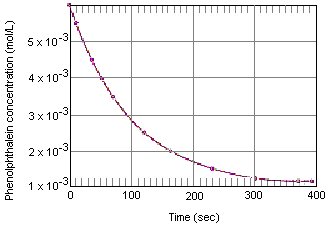
What is the relationship shown in this graph?
a)
As time increases, the phenolphthalein concentration increases.
b)
As time increases, the phenolphthalein concentration decreases.
c)
As phenolphthalein increases, the time concentration decreases.
d)
As phenolphthalein increases, the time concentration increases.
22.

What does this data show?
a)
As the [S] decreases, the rate (Vo) without inhibitor decreases.
b)
As the [S] decreases, the rate (Vo) without inhibitor increases.
c)
As the [S] decreases, the concentration (Vo) without inhibitor increases.
d)
As the [S] decreases, the concentration (Vo) without inhibitor decreases.
23.

Which bonds and how many of them are broken?
a)
1 N-N triple bond
b)
3 N-N single bonds
c)
3 H-H single bonds and 1 N-N triple bond
d)
1 N-N triple bond and 1 H-H single bond
100 %

