
 Worksheets
Plate Tectonics / Layers of the Earth Review
Total questions: 34
Worksheet time: 38mins
Name
Class
Date
1.
The San Andreas fault is located where the Pacific plate and North American plate meet, and is also a transform boundary. If it were a CONVERGENT boundary, what would form on the continent?
a)
a river
b)
a rift valley
c)
a chain of islands
d)
a volcanic mountain
2.
What type of boundary is formed when plates slide past each other?
a)
horizontal
b)
transform
c)
convergent
d)
divergent
3.
There is a difference in density between oceanic crust and continental crust. This is most likely related to differences in:
a)
porosity
b)
composition
c)
thickness
d)
the rate it cooled
4.
Which of these did NOT provide evidence for continental drift?
a)
magnetic reversals
b)
sea-floor spreading
c)
oceanic plate theory
d)
the fossil record
5.
Which process explains how new oceanic lithosphere (oceanic crust) is formed?
a)
sea-floor spreading
b)
normal polarity
c)
reverse polarity
d)
continental drift
6.
A collision between two pieces of continental crust at a convergent boundary produces a
a)
mid-ocean ridge
b)
deep-ocean trench
c)
rift valley
d)
mountain range
7.
How did fossil evidence support Wegener’s hypothesis of continental drift?
a)
Similar fossils found on far apart landmasses suggest that the continents were once a single landmass.
b)
Fossil evidence suggests that the continents have always been in their current positions.
c)
No similarities exist between fossils on different continents.
d)
Plant and animal fossils show evidence of changes in Earth’s polarity.
8.
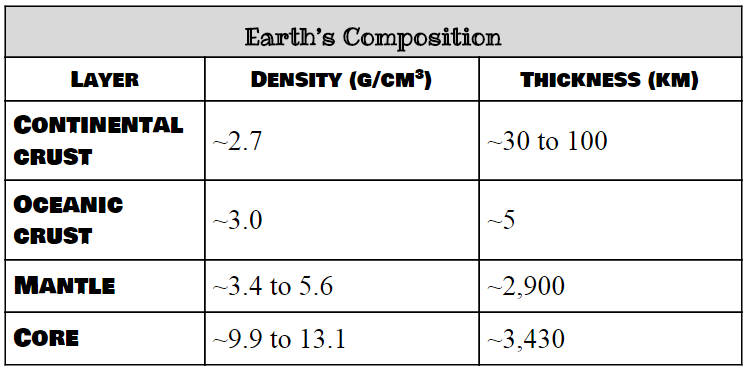
Using the table, which of the following statements is true?
a)
Oceanic crust is Earth’s thinnest and least dense compositional layer.
b)
Continental crust is Earth’s thinnest and densest compositional layer.
c)
The mantle is Earth’s thickest and densest compositional layer.
d)
The core is Earth’s thickest and densest compositional layer.
9.
What layer is more dense than the crust but less dense than the core?
a)
Continental crust
b)
Oceanic crust
c)
Mantle
d)
Core
10.
The Himalaya Mountains are currently growing taller. Which statement supports this?
a)
The Himalayas are still growing because they are at a divergent boundary that is still active.
b)
The Himalayas are still growing because they are at a convergent boundary that is still active.
c)
The Himalayas are still growing because they are at a transform boundary that is still active.
d)
The Himalayas are still growing due the processes of weathering & erosion.
11.

What layer is this?
a)
outer core
b)
mesosphere
c)
inner core
d)
asthenosphere
12.

What layer is this?
a)
outer core
b)
mesosphere
c)
inner core
d)
asthenosphere
13.

What layer is this?
a)
outer core
b)
mesosphere
c)
lithosphere
d)
asthenosphere
14.

What layer is this?
a)
outer core
b)
mesosphere
c)
lithosphere
d)
asthenosphere
15.

What layer is this?
a)
outer core
b)
mesosphere
c)
lithosphere
d)
asthenosphere
16.
The continental drift theory states that a single, huge continent once existed called
a)
Pangaea
b)
Wegener
c)
Panthalassa
d)
Eurasia
17.

Analyze the movement (indicated with arrows) and match the statement that is CORRECT within the diagram:
a)
Mountains can form on the continent at a convergent boundary.
b)
Mid-ocean ridges are not a feature associated with a divergent boundary.
c)
Convection currents are not underneath continental or oceanic crust.
d)
Coastal mountains cannot exist, only volcanoes.
18.

Analyze the movement (indicated with arrows) and match the statement that is CORRECT within the diagram:
a)
Mountains cannot form on the continent at a convergent boundary.
b)
Mid-ocean ridges are a feature associated with a divergent boundary.
c)
Convection currents are not underneath continental or oceanic crust.
d)
Coastal mountains cannot exist, only volcanoes.
19.
Analyze the movement (indicated with arrows) and match the statement that identifies what is INCORRECT within the diagram:
a)
Mountains form on the continent at a convergent boundary.
b)
Mid-ocean ridges are a feature associated with a divergent boundary.
c)
Convection currents do not move in the direction shown
d)
Convection currents are caused by hot magma sinking
20.

What geologic feature can be found on Earth's surface at number 4 on the diagram?
a)
folded mountains
b)
mid-ocean ridge
c)
subduction zone
d)
rift valley
21.
What geologic feature can be found at number 3 on the diagram?
a)
folded mountains
b)
mid-ocean ridge
c)
subduction zone
d)
rift valley
22.
The fact that similar fossils are found on both sides of the ocean is evidence of:
a)
global positioning
b)
magnetic reversal
c)
continental drift
d)
oceanic drifts
23.
In what Earth layer can convection currents that cause sea-floor spreading located?
a)
crust
b)
outer core
c)
asthenosphere
d)
inner core
24.
We can make inferences about the interior of Earth by analyzing:
a)
the behavior of seismic waves
b)
the holes dug for wells from the mantle and core
c)
chemical changes in metamorphic rocks
d)
moon rocks and Earth rock differences
25.
Earth's core mostly consists of:
a)
magnesium
b)
iron
c)
silicon
d)
oxygen
26.
Put the Earth layers in order from hottest to coolest:
a)
crust, outer core, inner core, mantle
b)
mantle, outer core, inner core, crust
c)
inner core, outer core, mantle, crust
d)
outer core, inner core, crust mantle
27.
Put the Earth layers in order from coolest to hottest:
a)
crust, outer core, inner core, mantle
b)
crust, mantle, inner core, outer core
c)
mantle, crust, inner core, outer core
d)
crust, mantle, outer core, inner core
28.
The mantle is _______ dense than the crust and ________ dense than the core.
a)
less, more
b)
more, less
c)
less, less
d)
more, more
29.
What happens when two plates of rock of a similiar density meet at a convergent boundary?
a)
the plates rub together and create fault lines
b)
the plates collide, heat up, and then melt to form a volcano
c)
the plates collide but do not subduct, instead they pile up to form a range of mountains
d)
the plates rub together and one subducts forming a trench on the boundary
30.
How could you best describe tectonic plates on Earth?
a)
they move away at the equator
b)
they move because of convection currents in the mantle
c)
they collide at mid-ocean ridges
d)
they always form subduction zones
31.

Why does the oceanic crust sink below the continental crust in this diagram?
a)
the oceanic crust is attracted to Earth's magnetic poles
b)
the continental crust is heavier than the oceanic crust
c)
the oceanic crust has a greater density than the continental crust
d)
the moon's gravity pulls continental crust upward
32.
Which of these best describes a divergent boundary?
a)
two plates collide and form a volcanic arc
b)
two plates move apart and form a rift valley
c)
two plates collide and form a mountain range
d)
two plates rub together and form a mid-ocean ridge
33.

This diagram shows that under the ocean, a volcano keeps erupting, and new mountains continue to form. Why does this happen?
a)
a new continent is forming
b)
Earth is becoming hotter
c)
the ocean floor is spreading
d)
continetal plates are colliding
34.
What type of boundary is shown in this diagram?
a)
complex
b)
divergent
c)
convergent
d)
transform
100 %

