wayground logo

Free Printable Worksheets

Font size

S
M
L
XL
Worksheets

Chapter 2 Review (8DA)

Total questions: 117

Worksheet time: 29hrs 15mins

Name
Class
Date
1.
Inductive reasoning goes from _ to _
a)
General to specific
b)
Specific to general
2.
Deductive reasoning goes from _ to _
a)
General to specific
b)
Specific to general
3.
What type of reasoning explains the next terms? 3, 9, 27, _
a)
Inductive
b)
Deductive
4.
What's the next terms in the sequence? 3, 9, 27, _
a)
81
b)
36
c)
243
d)
49
5.
What is a conjecture?
a)
An educated guess
b)
A prediction
c)
A conclusion reached from inductive reasoning
d)
A counterexample to a counterexample
6.
Circle with 1 diameter has 2 parts, 2 diameters have 4 parts, 3 diameters have 6 parts. Make a conjecture about a circle with 5 diameters. 
a)
It will have 10 parts
b)
It will have 25 parts
c)
It will have 5 parts
d)
It will have 50 parts
7.
How many counterexamples do you need to prove a conjecture false?
a)
0
b)
1
c)
3 (the minimum for scientific proof)
d)
An equal amount to the number of conjectures 
8.
Mark runs a mile in 6 mins. If your mile time is less than 8 mins, then you can be on the team. Mark is on the team. What type of reasoning is this? 
a)
Inductive reasoning
b)
Deductive reasoning
9.
All speeders are ticketed. Jim is a speeder. Jim was ticketed. 
a)
Inductive reasoning 
b)
Deductive reasoning
10.
1, 2, 6, 24, 120, _
a)
720 
b)
500
c)
480
d)
1030
11.
Conditional: If _, then _
a)
Hypothesis, Conclusion
b)
Conclusion, Hypothesis
c)
Converse, Inverse
d)
Contrapositive, Conditional
12.
If p->q, what's the converse?
a)
~p --> ~q
b)
q --> p
c)
~q --> ~p
d)
p->q
13.
If p->q, what's the inverse?
a)
~p --> ~q
b)
q --> p
c)
~q --> ~p
d)
p->q
14.
If p->q, what's the contrapositive?
a)
~p --> ~q
b)
q --> p
c)
~q --> ~p
d)
p --> q
15.
If the conditional is true, then the _ is also always true
a)
Converse
b)
Inverse
c)
Contrapositive
d)
Conditional
16.
If the converse is false, then the _ is also always false
a)
Converse
b)
Inverse
c)
Contrapositive
d)
Conditional
17.
If the contrapositive is false, then the _ is also always false
a)
Converse
b)
Inverse
c)
Contrapositive
d)
Conditional
18.
If the inverse is true, then the _ is also always true
a)
Converse
b)
Inverse
c)
Contrapositive
d)
Conditional
19.
Write a conditional for the given diagram
a)
If an integer is divisible by 8, then it is divisible by 2
b)
If an integer is divisible by 2, then it is divisible by 8
20.
Write a conditional for the given diagram
a)
p --> q
b)
q --> p
21.
T of F?
a)
T
b)
F
22.
T or F?
a)
F, F, F
b)
T, T, T
c)
T, F, T
d)
F, T, F
23.
T or F?
a)
F, F, F
b)
T, T, T
c)
T, F, T
d)
F, T, F
24.
T or F?
a)
F, T, F
b)
F, T, T
c)
T, F, T
d)
T, T, F
25.
T or F?
a)
T, T, T
b)
F, T, T
c)
T, F, T
d)
T, T, F
26.
T or F?
a)
T, T
b)
F, T
c)
F, F
d)
T, F
27.
T or F?
a)
T, T
b)
F, T
c)
F, F
d)
T, F
28.
B <--> Q is true, if 
a)
B -> Q AND Q -> B are both true
b)
B -> Q OR Q -> B are both true
c)
All B and all Q values are true
d)
~B and ~Q are false
29.
A mathematical definition is a/an _
a)
Conditional
b)
Biconditional
c)
Conclusion
d)
Conjecture
30.
The last line in a proof is always the...
a)
Given
b)
Prove
c)
Conditionals
d)
Equations
31.
The first line in a proof is always the...
a)
Given
b)
Prove
c)
Conditionals
d)
Equations
32.
Angles _ & _ are congruent
a)
1 & 2
b)
2 & 3 
c)
4 & 1
d)
2 & 4
33.
Angles _ & _ are congruent
a)
1 & 2
b)
2 & 3 
c)
4 & 1
d)
1 & 3
34.
What's the difference between = and ≅?
a)
= is for measurements, ≅ is for geometric figures
b)
= is for geometric figures, ≅ is for measurements
c)
There's no difference (they have the same meaning)
d)
= is used in standard geometry, ≅ is used in Euclidian geome
35.
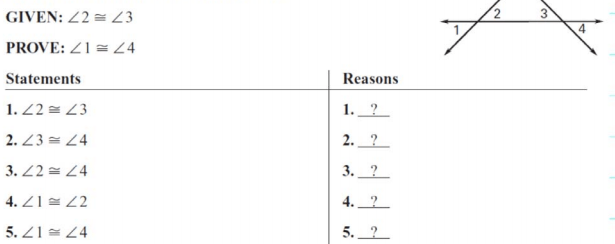
How can you prove step #2?
a)
Vertical angle theorem
b)
Subtraction property of equality
c)
Transitive property of congruence
d)
Definition of supplementary angles
36.
How can you prove step #4?
a)
Vertical angle theorem
b)
Subtraction property of equality
c)
Transitive property of congruence
d)
Definition of supplementary angles
37.
How can you prove step #5?
a)
Vertical angle theorem
b)
Subtraction property of equality
c)
Transitive property of congruence
d)
Definition of supplementary angles
38.

If two lines do not intersect then they are coplanar and parallel, or skew. Lines AB and CD do not intersect.

a)

Lines AB and CD are parallel and not coplanar.

b)

Lines AB and CD are parallel and coplanar or they are skew.

c)

Lines AB and CD are skew.

d)

No Conclusion can be made.

39.

If there is lightening, then it is not safe to be out in the open. Mary sees lightening from her home.

a)

It is not safe for the lightening

b)

No conclusion can be made.

c)

It is not safe for Marty to be out in the open.

d)

There is lightening.

40.

If we see John on Monday, then we can ask him over for lunch. We see John on Monday.

a)

John may eat with us.

b)

John saw us on Monday

c)

No conclusion can be made since the hypothesis did not occur.

d)

We asked John to have lunch with us.

41.

If two planes intersect, then their intersection is a line. If two planes are not parallel, then they intersect.

a)

No Conclusion can be made.

b)

If two planes intersect they are not parallel.

c)

If two planes are parallel, then they do not intersect.

d)

If two planes are not parallel, then their intersection is a iine.

42.

If it rains on Tuesday we will not go to the park on Tuesday.

If we do not go to the park on Tuesday we will go on Wednesday.

a)

If it rains on Tuesday, we will go Wednesday.

b)

If we go to the park on Wednesday, then it rained on Tuesday.

c)

No conclusion can be made.

d)

If we go to the park on Tuesday, then it rained on Tuesday.

43.

If you go to the swimming pool, then you will enjoy yourself. If you enjoy yourself, you will want to return.

a)

If you return to the pool you will enjoy yourself.

b)

If you enjoy yourself, then you went to the pool.

c)

If you go to the pool, you will want to return.

d)

No conclusion can be made.

44.

If the sun is shining it is a beautiful day. If it is a beautiful day then we will go go hiking.

a)

If the sun is not shining, we will not go hiking.

b)

If the sun is shining then we will go hiking.

c)

No conclusion can be made.

d)

If we go hiking, then it is a beautiful day.

45.
Use the law of syllogism to draw a conclusion from the two given statements:
Statement 1: If you exercise regularly, then you have a healthy body
Statement 2: If you have a healthy body, then you have more energy
a)
You have more energy
b)
If you exercise regularly, then you have more energy
c)
You have a healthy body
d)
If you do not have a healthy body, then you do not exercise regularly
46.
Use the Law of Detachment to draw a conclusion from the two given statements. If not possible, write not possible.
Statement 1: If I study for one hour each day, then I will score well on the exam
Statement 2: I will score well on the exam
a)
 I study for 1 hour each day.
b)
I do not study for 1 hour each day
c)
If I do well on the exam, I studied for 1 hour each day.
d)
not possible
47.
If possible, use the Law of Detachment to draw a conclusion from the two given statements. If not possible, write not possible.
Statement 1: If x = 2, then 2x – 10 = –6.
Statement 2: x = 2 
a)
2x – 10 = –6 
b)
x = 2
c)
 If 2x – 10 = –6, then x = 2
d)
not possible 
48.
Which law of deductive reasoning is being used, if any?
If a triangle is equilateral, then all three sides are congruent. 
If all the sides of a triangle are congruent, then the angles opposite them are congruent. 
Therefore, if a triangle is equilateral, then the angles opposite the sides are congruent.
a)
Law of Detachment
b)
Law of Syllogism
c)
Law of the Contrapositive
d)
Not valid
49.
Using the Law of Syllogism, which of the following completes the statement to form a valid conclusion?
If it is snowing heavily, then school will be canceled.
If school is canceled, the big test will not be given today.
It is snowing heavily, therefore
a)
look out for the snowplows while driving to school.
b)
the big test will not be given today.
c)
the roads will be hard to drive on.
d)
you should call the school to see if school is canceled.
50.
Which law of deductive reasoning is being used, if any?
If a triangle is equilateral, then all three sides are congruent. 
If all the sides of a triangle are congruent, then the angles opposite them are congruent. 
Therefore, if a triangle is equilateral, then the angles opposite the sides are congruent.
a)
Law of Detachment
b)
Law of Syllogism
c)
Law of the Contrapositive
d)
Not valid
51.
Which law of logic is this:
If I buy a dress, then I won't get chips.
I bought a dress.
Therefore, I won't get chips.
a)
Law of Detachment
b)
Law of Contrapositive
c)
Law of Syllogism
d)
Law of Biconditional
52.
p→q
q→r
∴p→r
Which law is modeled?
a)
Law of Syllogism
b)
Law of Detachment
c)
Law of Contrapositive
d)
Law of Shannon
53.
p→q
p
∴q
Which law is modeled?
a)
Law of Syllogism
b)
Law of Detachment
c)
Law of Contrapositive
d)
Law of Shannon
54.

If Mrs. Hafner walks dogs at the animal shelter, then she has a late dinner. If it is Wednesday, then Mrs. Hafner walks dogs at the animal shelter.


What can you conclude?

a)

Nothing

b)

If Mrs. Hafner has a late dinner, then she walks dogs at the animal shelter.

c)

If it is Wednesday, then Mrs. Hafner has a late dinner.

d)

If Mrs. Hafner has a late dinner, then it is Wednesday.

55.

If it is Monday, then Garfield is grumpy. If it is Monday, then John will feel Garfield lasagna.


What can you conclude?

a)

Nothing

b)

If Garfield is grumpy, then John will feed Garfield lasagna.

c)

Garfield is grumpy, if it is Monday.

d)

If John feeds Garfield lasagna, then it is Monday.

56.

If a figure is a square, then it is a rectangle. If a figure is a rectangle, then it has 4 right angles.


What can you conclude?

a)

If a figure has 4 right angles, then it is a square.

b)

If a figure is a square, then it has 4 right angles.

c)

Nothing

d)

If a figure is a rectangle, then it is a square with 4 right angles.

57.

If Bill wears a green shirt, then he will pass the test. Bill wore a green shirt.


What can you conclude?

a)

Bill wore a green shirt.

b)

Bill passed the test.

c)

Nothing

58.

If it is rainy outside, then the sun is behind clouds. The sun is behind the clouds.


What can you conclude?

a)

It is rainy outside.

b)

Nothing

c)

If it is rainy outside, then the sun is behind the clouds.

59.

If I go on vacation, I’ll spend money. If I spend money, I’ll be broke. If I’m broke, I’ll have to get another job.


What can you conclude?

a)

If I get another job, I'll spend money.

b)

If I go on vacation, I'll have to get another job.

c)

Nothing

d)

If I'm broke, I'll spend money.

60.

If Carly runs a 5k, then she will be tired. Carly is tired.


What can you conclude?

a)

Nothing

b)

Carly runs a 5k.

61.
Given, "If I have a Siberian Husky, then I have a dog." Identify the converse.
a)
If I do not have a Siberian Husky, then I do not have a dog.
b)
If I have a dog, then I have a Siberian Husky.
c)
If I do not have a dog, then I do not have a Siberian Husky.
d)
If I do not have a Siberian Husky, then I have a dog. 
62.
Given, "If I have a Siberian Husky, then I have a dog." Identify the inverse.
a)
If I do not have a Siberian Husky, then I do not have a dog.
b)
If I have a dog, then I have a Siberian Husky.
c)
If I do not have a dog, then I do not have a Siberian Husky.
d)
If I do not have a Siberian Husky, then I have a dog. 
63.
Given, "If I have a Siberian Husky, then I have a dog." Identify the contrapositive.
a)
If I do not have a Siberian Husky, then I do not have a dog.
b)
If I have a dog, then I have a Siberian Husky.
c)
If I do not have a dog, then I do not have a Siberian Husky.
d)
If I do not have a Siberian Husky, then I have a dog. 
64.
Given, "If I have a Siberian Husky, then I have a dog." Identify the conclusion.
a)
If I have a Siberian Husky.
b)
I have a Siberian Husky.
c)
Then I have a dog.
d)
I have a dog.
65.
Given, "If angles are congruent, then the measures of the angles are equal." Identify the converse.
a)
If the measures of the angles are equal, then the angles are congruent.
b)
"If angles are not congruent, then the measures of the angles are not equal."
c)
If the measures of the angles are not equal, then the angles are not congruent.
d)
If the angles are not congruent, then the measure of the angles are equal.
66.
Given, "If angles are congruent, then the measures of the angles are equal." Identify the inverse.
a)
If the measures of the angles are equal, then the angles are congruent.
b)
"If angles are not congruent, then the measures of the angles are not equal."
c)
If the measures of the angles are not equal, then the angles are not congruent.
d)
If the angles are not congruent, then the measure of the angles are equal.
67.
Given, "If angles are congruent, then the measures of the angles are equal." Identify the contrapositive.
a)
If the measures of the angles are equal, then the angles are congruent.
b)
If angles are not congruent, then the measures of the angles are not equal.
c)
If the measures of the angles are not equal, then the angles are not congruent.
d)
If the angles are not congruent, then the measure of the angles are equal.
68.
Given, "If angles are congruent, then the measures of the angles are equal." Identify the hypothesis.
a)
If angles are congruent.
b)
Angles are congruent.
c)
Then the measures of the angles are equal.
d)
The measures of the angles are equal.
69.
Given, "If angles are congruent, then the measures of the angles are equal." Identify the conclusion.
a)
If the angles are congruent.
b)
The angles are congruent.
c)
Then the measures of the angles are equal.
d)
The measures of the angles are equal.
70.
What is the hypothesis of the following statement: "If Johnny is late to school, then his mom will have to drive him."
a)
His mom will have to drive him
b)
If Johnny is late to school
c)
Johnny is late to school
d)
Then his mom will have to drive him
71.
What is the conclusion of the following statement: "The angles are supplementary, if they add up to 180 degrees."
a)
if they add up to 180 degrees
b)
the angles are supplementary
c)
they add up to 180 degrees
d)
there is no conclusion
72.
Conditional: If it does not rain today, then we will have practice.
What is this statement called: If it rains today, then we will not have practice.
a)
Converse
b)
Inverse
c)
Contrapositive
d)
Negation
73.
Conditional: If Maria gets married, then the reception will be at the country club.
What is this statement: If the reception is at the country club, then Maria will be getting married.
a)
Converse
b)
Inverse
c)
Contrapositive
d)
Negation
74.
Original: If Emily is not late to class, then she will not be marked tardy.
What is this? If Emily is late to class, then she will be marked tardy.
a)
Converse
b)
Inverse
c)
Contrapositive
d)
Negation
75.
Original: If Jenny buys a guitar, then she will not buy a keyboard.
What is this? If Jenny does buy a keyboard, then she will not buy a guitar.
a)
Converse
b)
Inverse
c)
Contrapositive
d)
Negation
76.
If an animal is furry, then it is a hamster. What would be an appropriate counterexample?
a)
goldfish
b)
frog
c)
elephant
d)
cat
77.
The product of two negative numbers is greater than the sum of the two numbers. What is an appropriate counterexample?
a)
-3 and -3
b)
True. There is no counterexample
c)
-1 and -1
d)
4 and 6
78.
If it is a fraction, then it is a number between zero and one. What is an appropriate counterexample?
a)
2/3
b)
4/5
c)
1/2
d)
3/2
79.
If it is an angle, then it is acute. What is an appropriate counterexample?
a)
70⁰
b)
45⁰
c)
120⁰
d)
True. There is no counterexample.
80.
True or False: a counterexample is an example that makes a definition or conjecture incorrect
a)
True
b)
False
81.
If it is a number, then it is either positive or negative. What is an appropriate counterexample?
a)
10
b)
-2
c)
0
d)
True. There is no counterexample.
82.
Identify the hypothesis and conclusion of the conditional statement:
If you give me twenty dollars, then I will be your best friend.
a)
Hypothesis: I will be your best friend
Conclusion: you give me twenty dollars
b)
Hypothesis: you give me twenty dollars
Conclusion: I will be your best friend
c)
Hypothesis: if you have to pay for friends
Conclusion: then you probably should reevaluate your life
d)
Hypothesis: you will not have to pay twenty dollars
Conclusion: if you have lots of friends
83.
What is the next number in this pattern?
a)
49
b)
55
c)
57
d)
63
84.
Find the next item in the pattern:
-3, 6, -12, 24, ...
a)
36
b)
-36
c)
48
d)
-48
85.

Write a definition of congruent angles as a biconditional statement.

a)

Angles are congruent if they have the same size and shape.

b)

If angles are congruent, then they have the same size and shape.

c)

Congruent angles are the same.

d)

Angles are congruent if and only if they have the same size and shape.

86.

Write a definition of a right angle as a biconditional statement.

a)

An angle is a right angle if and only if it has a measure of 90 degrees.

b)

An angle has a measure of 90 degrees if and only if it is a right angle.

c)

Right angles are 90 degrees.

d)

If an angle is a right angle, then it has a measure of 90 degrees.

87.

Select the conditional statement(s) of the biconditional statement.


Points are collinear if and only if they all lie in one line.

a)

If collinear points lie in one line, then they are a line.

b)

If points all lie in one line, then they are collinear.

c)

Collinear points lie in one line.

d)

If points are collinear, then they all lie in one line.

88.

Select the conditional statement(s) of the biconditional statement:


Points lie in one plane if and only if they are coplanar.

a)

Coplanar points lie in one plane.

b)

If points lie in one plane, then they are coplanar.

c)

If points are coplanar, then they lie in one plane.

d)

Planes have coplanar points.

89.

Write the conditional statements as a biconditional statement:


1) If B is between A and C, then AB+BC=AC.

2) If AB+BC=AC, then B is between A and C.

a)

Segment Addition Postulate

b)

B is between A and C when AB+BC=AC if and only if Segment Addition Postulate.

c)

B is between A and C if and only if AB+BC=AC.

90.
1. Find X 
a)
28
b)
5
c)
55
d)
40
91.
1. Find ∠ AOC 
a)
130
b)
50 
c)
40
92.
2. Find X
a)
9
b)
27
c)
45
93.
2. FIND ∠SOR
a)
45
b)
135
c)
90
d)
180
94.
3. Find X
a)
59
b)
31
c)
177
95.
3. Find ∠NOQ
a)
31
b)
59
c)
180
d)
149
96.
4. Find X
a)
1
b)
30
c)
53
d)
10
97.
4. FInd ∠ JOM
a)
10
b)
170
c)
80
d)
100
98.
Vertical angles are always
a)
acute
b)
total 180 degrees
c)
congruent (equal measures)
d)
adjacent angles
99.
What is the justification (reason)?
a)
Reflexive Property
b)
Symmetric Property
c)
Transitive Property
d)
Substitution
100.
What is the justification (reason)?
a)
reflexive property
b)
definition of segment bisect
c)
definition of a midpoint
d)
substitution property
101.
Given that angles A and B form a linear pair what is the next step we can conclude by definition of a linear pair?
a)
m∠A + m∠B = 90
b)
A and B are both acute angles
c)
m∠A + m∠B = 180
d)
A and B are both obtuse angles
102.
Which is the correct reason for statement 1 in the proof?
a)
Definition of Congruent Angles
b)
Substitution
c)
Transitive Property
d)
Given
103.
What reason do we have to use to put the statement that AB = AB in our proof?
a)
Reflexive Property of Equality
b)
Transitive Property of Equality
c)
Symmetric Property of Equality
d)
Distributive Property of Equality
104.
If <M = <L then <L = <M
a)
Transitive Property of Equality
b)
Substitution Property of Equality
c)
Symmetric Property of Equality
d)
Reflexive Property of Equality
105.
What is the "reason" for step 2 of the proof?
a)
Reflexive property
b)
They are congruent
c)
Congruent through the Side Angle Side Postulate
d)
Given
106.
If ∠A and ∠B are complementary,
then m∠A + m∠B = 90°.
a)
Definition of Supplementary Angles
b)
Angle Addition Postulate
c)
Definition of Right Angle
d)
Definition of Complementary Angles
107.
If ∠BAT and ∠MAN are vertical angles,
then ∠BAT ≅ ∠MAN.
a)
Vertical Angles Theorem
b)
Definition of Congruent Angles
c)
Angle Addition Postulate
d)
Batman
108.
Which is given in the diagram?
a)
BD ≅ BD
b)
AB ≅ BC
c)
D is the midpoint of AC
d)
ΔABD ≅ ΔCBD
109.
Which is NOT given in the diagram?
a)
AC ≅ EC
b)
BC ≅ DC
c)
AB ≅ ED
d)
All of these are given
110.

Given: B is the midpoint of AC. What should you conclude?

a)

AB + BC = AC

b)

AB = BC

c)

A is the segment bisector of BC

d)

ABC is a straight angle

111.

Given: OR \perp QP.  What should you conclude by definition of perpendicular?

a)

<ORP is a right angle

b)

QR + RP = QP

c)

<ORQ and <ORP are complementary

d)

<QRP = 180 °\degree  

112.

Given: <1 and <3 are vertical angles. What should you conclude by the vertical angles theorem?

a)

<1 and <2 are a linear pair

b)

<1 and <3 are right angles

c)

<2 and <4 are vertical angles

d)

 <1<3<1\cong<3  

113.

Given: <1 and <2 are supplementary. What can you conclude?

a)

m<1 + m<2 = 180

b)

m<1 + m<2 = 90

c)

m<1 = m<2

d)

nothing

114.

Given: <1 and <2 are a linear pair. Conclusion: m<1 + m<2 = 180. What is the reason that allows you to draw that conclusion?

a)

Angle addition postulate

b)

Definition of straight angle

c)

Linear Pair Postulate

d)

Definition of supplementary

115.

Which of the following is an example of the transitive property?

a)

If x = 5 and and x = y, then y = 5.

b)

If x = y then y = x

c)

x = x

d)

If 2x + 4 = 2, then x = -1

116.

Which of the following conclusions CANNOT be drawn just by looking at the diagram?

a)

GH and AB intersect at D

b)

<GDA and <HDB are vertical angles

c)

D is the midpoint of GH

d)

G, D, and H are collinear

117.

When trying to prove two angles are supplementary, what must you show in your proof?

a)

that the angles are equal

b)

that the angles add up to 180 degrees

c)

that the angles are a linear pair

d)

that the angles are right angles