
 Worksheets
The Colonies Emerge
Total questions: 78
Worksheet time: 2hrs 42mins
Name
Class
Date
1.

Where was the lost colony?
a)
Plymouth
b)
Roanoke
c)
Jamestown
d)
Charlestine
2.

Where was the Mayflower taking people from England to?
a)
Jamestown
b)
Roanoke
c)
Williamsburg
d)
Plymouth
3.

Why did the Pilgrims come to a new land and form a settlement?
a)
They wanted to be ruled by a king in Great Britain
b)
They wanted freedom to practice their own religion
c)
They wanted to start plantations and earn money
d)
They wanted to learn from the Native Americans
4.

What agreement did the pilgrims sign on their way to North America?
a)
The Declaration of Independence
b)
The Constitution
c)
The Mayflower Compact
d)
The Girl Scouts' Oath
5.

Who Disapproved the use of Tobacco?
a)
King James II
b)
King James III
c)
King James I
d)
King Tut
6.

When did they settle in the new world?
a)
1618
b)
1631
c)
1607
d)
1683
7.

The Jamestown settlers found a way to make a profit for their investors by growing and harvesting
a)
maize
b)
cotton
c)
tobacco
d)
wheat
8.

Pilgrims’ and Puritans started the colony of ___.
a)
Carolina
b)
Georgia
c)
New York
d)
Massachusetts
9.
What motivated the Puritans to leave England in the first place?
a)
freedom of religion
b)
freedom to raise children
c)
freedom to have multiple spouses
d)
freedom to cook their favorites meals
10.
In what year was Jamestown settled?
a)
1492
b)
1607
c)
1776
d)
2007
11.
Which of the following choices was not a reason that England started a colony in Jamestown?
a)
Increase wealth and power
b)
Find raw materials
c)
Trade with other countries
d)
To get a new King
12.
Which of the following is not a reason that the settlers chose the site for the Jamestown settlement?
a)
It had swamps
b)
Fresh supply of water
c)
Deep harbor to dock ships
d)
Easy to defend against attack
13.
Which of the following was not a hardship the settlers faced?
a)
Not enough safe drinking water
b)
Not enough survival skills
c)
The indians were nice to them.
d)
A harsh winter with little food
14.
Who said, "If you don't work, then you don't eat!"?
a)
Chief Powhatan
b)
Christopher Newport
c)
Lord De La Warr
d)
Captain John Smith
15.
What was the name of the indian girl who told the indians they should get along with settlers and help them survive?
a)
Belle
b)
Ariel
c)
Pocahontas
d)
Rapunzel
16.
Jamestown was located on a peninsula in ...
a)
Virginia
b)
North Carolina
c)
Florida
d)
New York
17.
What did the settlers build to protect themselves?
a)
adobe apartments
b)
tee pees
c)
longhouses
d)
a fort
18.
What is one thing the Powhatan Indians traded to the settlers?
a)
Corn, beans, and squash
b)
money
c)
guns
d)
armor
19.
What is something the settlers traded to the indians?
a)
bear skins
b)
metal tools
c)
pumpkins
d)
coffee
20.
What resource did the French and Dutch want to trade with Native Americans?
a)
furs
b)
tobacco
c)
corn
d)
gold
21.

What brought the original colonists from England to Jamestown?
a)
the search for food
b)
the search for gold and silver
c)
the search for tobacco
d)
the search for religious freedom
22.
Which of the following choices was NOT a reason that England started a colony in Jamestown?
a)
Increase wealth and power
b)
Find raw materials
c)
Trade with other countries
d)
To get a new King
23.
Which of the following is NOT a reason that the settlers chose the site for the Jamestown settlement?
a)
It had swamps
b)
Fresh supply of water
c)
Deep harbor to dock ships
d)
Easy to defend against attack
24.

Which colony started the traditional Thanksgiving holiday by having a feast with Native Americans?
a)
Jamestown
b)
Plymouth
25.

What was the document that the men signed aboard the ship in the New World which intended to be an agreement for a democratic set of laws?
a)
The Jamestown Compact
b)
The Mayflower Compact
c)
The Jamestown Agreement
d)
The Mayflower Agreement
26.
The Virginia House of Burgesses:
a)
Provided an example of representative government.
b)
Established the first army in the New World.
c)
Regulated what the people were allowed to eat.
d)
Determined who could leave the colony.
27.
Someone who agreed to work without pay for 3-7 years in exchange for paid passage to the New World was called a(n)...
a)
slave
b)
indentured servant
c)
pilgrim
d)
governor
28.

Which mountain chain created the western boarder of the British North American Colonies?
a)
Appalachian
b)
Smokey
c)
Rocky
d)
Himalayan
29.
Which of the following nations developed the most peaceful relationship with Native Americans?
a)
Dutch
b)
French
c)
Spanish
d)
English
30.
Which group served as the first form of forced labor in the Spanish colonies in the New World?
a)
Indentured Servants
b)
Africans
c)
Native Americans
d)
Creoles
31.
The House of Burgesses in Virginia Colony represents which of the following?
a)
colonial rebellion against Great Britain
b)
royal rule over the North American colonies
c)
royal indifference towards the colonies
d)
colonial self-government in North America
32.
Which Native American tribe inhabited the Chesapeake Area during the development of Jamestown?
a)
Cheyenne
b)
Cherokee
c)
Creek
d)
Powhatan
33.
What was the name of the system of incentive that offered 50 acres of land to anyone who brought an indentured servant to the new world?
a)
Bacon's Rebellion
b)
Headright System
c)
Middle Passage
d)
House of Burgesses
34.
Which term is used to describe the journey of Africans across the Atlantic during the trans-Atlantic slave trade?
a)
Headright System
b)
Starving Time
c)
Middle Passage
d)
Indentured Servitude
35.
How did John Rolfe help Jamestown generate income for the Virginia Company?
a)
Introduction tobacco in the colonies
b)
Beginning the Headright System
c)
Starting the Middle Passage
d)
Marrying Pocahontas
36.
This Powhatan princess married John Rolfe and became a celebrity in England.
a)
Pocahontas
b)
Sacajawea
c)
Elizabeth I
d)
Kokoum
37.
Which of the following best describes the Virginia Colony?
a)
Corporation
b)
Joint-Stock Company
c)
Partnership
d)
Proprietorship
38.
Which of the following is most likely a result of the Columbian Exchange?
a)
Increase in Native American Population
b)
Introduction of horses and cattle to Europe
c)
Decrease in the Native American population
d)
Introduction of tobacco to the New World
39.
What is the name of the transfer of flora, fauna, pathogens and ideas between the Old World and New World?
a)
Columbian Exchange
b)
Middle Passage
c)
Headright System
d)
House of Burgesses
40.
What is the name of the transfer of flora, fauna, pathogens and ideas between the Old World and New World?
a)
Columbian Exchange
b)
Middle Passage
c)
Headright System
d)
House of Burgesses
41.
What do you call "Factors the drive people away from a place"?
a)
pull factors
b)
push factors
c)
leading factors
d)
common factors
42.
What do you call "Factors that drive people to a place"?
a)
pull factors
b)
push factors
c)
leading factors
d)
common factors
43.
Freedom, economic opportunity, and abundant land are three _______ factors of ________.
a)
push, immigration
b)
push, coastal areas
c)
pull, immigration
d)
pull, coastal areas
44.
Which of the following groups in the colonies in the late 17th century would be most critical of John Locke's ideas as well as others of the Enlightenment?
a)
slave owners
b)
church leaders
c)
merchants
d)
women
45.
Which of the following is NOT a characteristic of indentured servitutde?
a)
poor workers, convicted criminals, and debtors received immigration passage and fees in return for work in the New World
b)
servants entered into their contracts voluntarily and kept some of their legal rights
c)
servitude was so valuable that there was no need for slaves until the 19th century
d)
servants had little control over their work and were sometimes a part of harsh and brutal treatment
46.
Which of the following groups were the authors of the Maryland Act of Toleration trying to protect?
a)
Jews
b)
Puritans
c)
Quakers
d)
Roman Catholics
47.

The trade routes established by colonists and merchants across the Atlantic Ocean can be defined as
a)
Triangular Trade
b)
Headright System
c)
Mercantilism
d)
Economic Domination
48.

The Middle Passage was
a)
Route that transported slaves from Africa to America
b)
Route that transported rum and molasses from Caribbean to Africa
c)
Route that transported manufactured goods from Europe to America
d)
Route that transported materials from colonial America to Africa
49.
Which group are the New England colonies?
a)
Connecticut
New Hampshire
Rhode Island
Massachusetts
New Hampshire
Rhode Island
Massachusetts
b)
North Carolina
South Carolina
Virginia
Maryland
Georgia
South Carolina
Virginia
Maryland
Georgia
c)
Pennsylvania
Deleware
New York
New Jersey
Deleware
New York
New Jersey
d)
Illinois
Indiana
Ohio
Wisconsin
Indiana
Ohio
Wisconsin
50.
The Mayflower Compact helped to establish what?
a)
A government for the people
b)
A treaty with the Natives
c)
Directions on how to best fish
d)
Who was the best colonist
51.
Which group are the Middle colonies?
a)
Connecticut
New Hampshire
Rhode Island
Massachuttes
New Hampshire
Rhode Island
Massachuttes
b)
North Carolina
South Carolina
Virginia
Maryland
Georgia
South Carolina
Virginia
Maryland
Georgia
c)
Pennsylvania
Delaware
New York
New Jersey
Delaware
New York
New Jersey
d)
California
Arizona
New Mexico
Washington
Arizona
New Mexico
Washington
52.
Which group are the Southern colonies?
a)
Connecticut
New Hampshire
Rhode Island
Massachuttes
New Hampshire
Rhode Island
Massachuttes
b)
North Carolina
South Carolina
Virginia
Maryland
Georgia
South Carolina
Virginia
Maryland
Georgia
c)
Pennsylvania
Delaware
New York
New Jersey
Delaware
New York
New Jersey
d)
Florida
Georgia
Louisiana
Alabama
Georgia
Louisiana
Alabama
53.
Which colonies have large plantations?
a)
Middle
b)
Southern
c)
New England
d)
Northeast
54.
Quakers are a key religious group in the Middle colonies
a)
True
b)
False
55.
The most important export from the Virginia colony was
a)
Cotton
b)
Tobacco
c)
Rice
d)
Corn
56.
Bacon's Rebellion was initiated by a group of farmers who felt most directly threatened by
a)
an increase in royal taxes
b)
the power of large planters
c)
conflicts with American Indians
d)
the growth of the slave trade
57.
a large estate on which commercial crops are cultivated by resident labor
a)
plantation
b)
persecution
c)
tobacco
d)
Protestant
58.
an agreement written in 1620 for ruling the Plymouth Colony
a)
Mayflower Compact
b)
Makeup Compact
c)
Jamestown Pact
d)
Bill of Rights
59.
The French and Indian War included
a)
French, British, Native Americans
b)
French, British, African Americans
c)
Ohio, Spain, Canada
d)
Ohio, Native Americans, French
60.
The land fought over was the
a)
Ohio River Valley
b)
Appalachian Mountains
c)
Florida
d)
Canada
61.
Both French & British wanted this land because of it's rich soil. It led to conflict and the French & Indian War.
a)
Ohio River Valley
b)
Appalachian Mountains
c)
Florida
d)
Gulf of Mexico
62.
George Washington was a leader for for which country during the French & Indian War.
a)
Great Britain
b)
France
c)
America
d)
Confederate Army
63.
George Washington was from which Colony?
a)
Virginia
b)
Massachusettes
c)
New York
d)
Washington DC
64.
Who won the War?
a)
French
b)
British
c)
Native Americans
d)
Colonists
65.
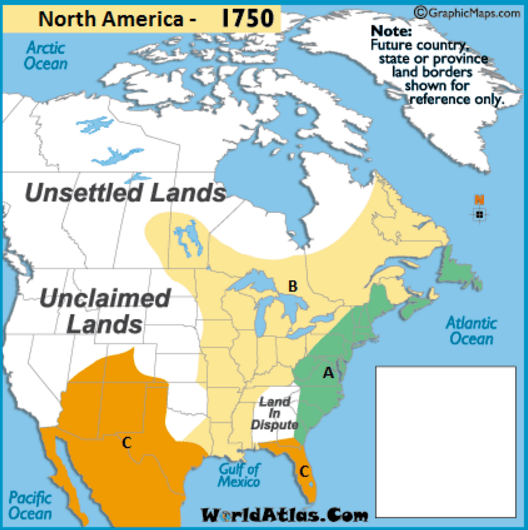
Which European power controlled territory A?
a)
England
b)
France
c)
Spain
66.
a willingness to let others practice their own beliefs
a)
religious tolerance
b)
pilgrimages
c)
charters
d)
Puritanism
67.
Which European power controlled territory C?
a)
England
b)
France
c)
Spain
68.
Which European power controlled territory B?
a)
England
b)
France
c)
Spain
69.
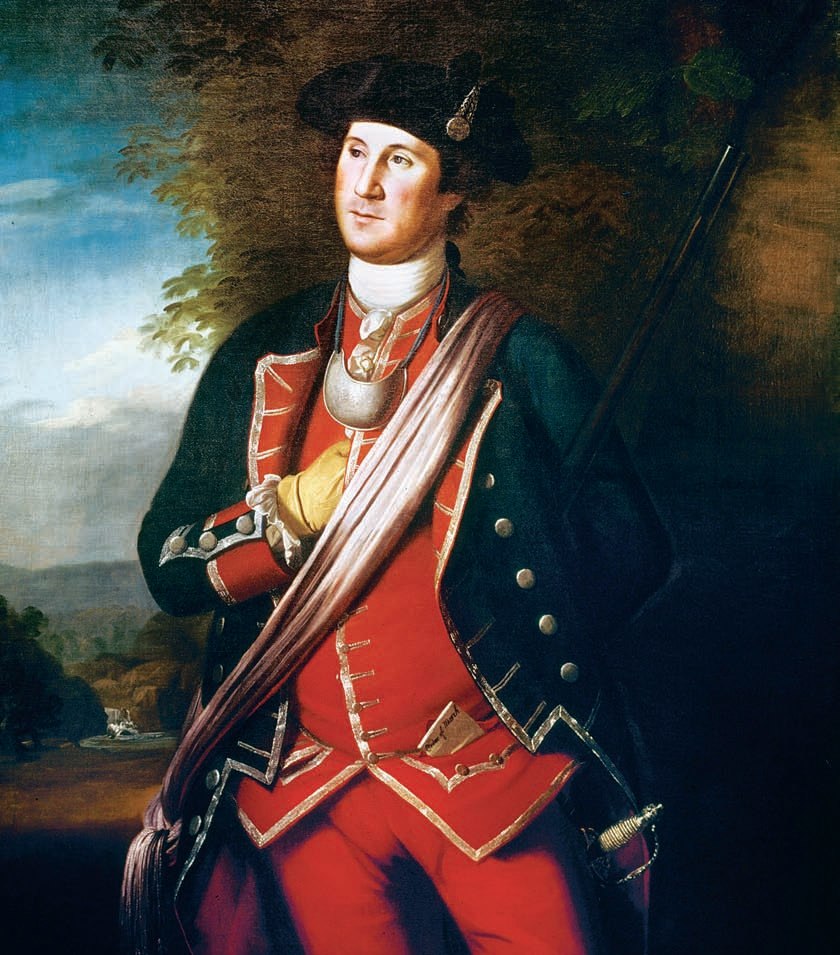
Who was the young military leader from Virginia who was sent to western Pennsylvania to fight the French?
a)
William Pitt
b)
Edward Braddock
c)
King George II
d)
George Washington
70.
Where did the French and Indian War take place?
a)
England
b)
France
c)
North America
d)
Africa
71.
What the result of the French and Indian War
a)
France lost its territory in North America to the British
b)
France took over all of Canada
c)
Native-Americans succesfully kicked out the British and French from North America
d)
France defeated the British
72.
Which significant outcome of the French and Indian War eventually led to the American Revolution?
a)
Britain placed its colonies under strict control and began taxing them to help pay for the war.
b)
Britain expected colonists to fight the war at their own expense and offered no reimbursement.
c)
The loss of colonial territory to the French made colonists lose faith in the British government.
d)
Britain did not offer aid to colonists during the war but still declared sovereignty over them.
73.
Which of the following was not a result of the British victory in the French and Indian War?
a)
colonists' growing dissatisfaction with the English government by colonists over settlement of western territory
b)
organized rebellions by Native Americans that captured British forts west of the Appalachian Mountains
c)
the British gaining control over the port of New Orleans and the Mississippi River from the Spanish
d)
the gradual weakening of the French influence throughout North America and Canada
74.
Why was it expected that the Native Americans would support the French in the war?
a)
Most French were traders and trappers, like the Native Amiercans
b)
The French did not destroy Native American land for farming
c)
The French respected and adopted Native American cultures
d)
All of the listed answers are correct
75.

Why was France's territory in North America (New France) a bigger threat to the British colonies than Spain?
a)
New France surrounds most of the British colonies, limiting westward expansion.
b)
New France had a larger population than the British
c)
New France controlled all the major trading ports along the Atlantic Coast.
76.

Who benefits the most from mercantilism?
a)
The colony
b)
The mother country
c)
Native Americans
d)
Allies of the mother country
77.

Benjamin Franklin's famous "Join, or Die" political cartoon was drawn to do what?
a)
to get the colonies to support the Albany Plan of the Union and unite the colonists against France
b)
to get colonists to join the French and fight Britain
c)
to tell the French to get out of North America
d)
to get colonists to join the Boston Tea Party
78.
The Albany Congress met and agreed to the Albany Plan of Union which did what?
a)
raised taxes on the colonies for Britain
b)
declared war on the Iroquois
c)
negotiated a peace treaty to end war with France
d)
united the colonies to help fight against the French
100 %

