
 Worksheets
Chapter 5 Plate Tectonics Review
Total questions: 70
Worksheet time: 48mins
Name
Class
Date
1.
Which of the following causes Earth's tectonic plates to move?
a)
Energy from the Sun
b)
Magnetic Pole Reversal
c)
Convection currents in the mantle
d)
Faults in Mountain Ranges
2.
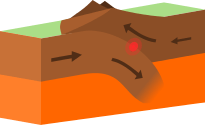
What type of plate boundary is this?
a)
Plate
b)
Divergent
c)
Convergent
d)
Transform
3.

What type of event will occur at this boundary?
a)
Earthquake
b)
Volcano Eruption
c)
Tornado
d)
Mountain Building
4.
Which of the following is NOT evidence to support the theory of plate tectonics?
a)
Fossils
b)
Mountains
c)
Glaciers
d)
Sand Erosion
5.
Deep Ocean Trenches are formed by _______ plate boundaries
a)
Convergent
b)
Transform
c)
Plate
d)
Divergent
6.
Islands can from from magma which is pushed up at a __________ plate boundary
a)
Divergent
b)
Convergent
c)
Transform
7.
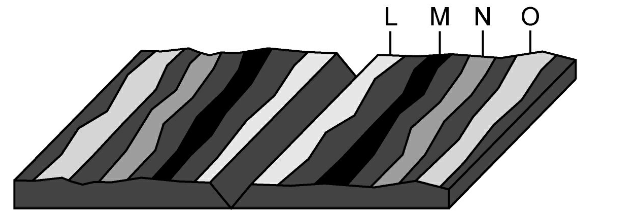
Where would the oldest rock be found?
a)
L
b)
M
c)
N
d)
O
8.
How is it possible for new crust to be formed without increasing the surface area of the Earth?
a)
Crust is destroyed at the same time it is created
b)
New crust is underwater where it sinks
c)
New crust breaks more easily than old crust
9.
Mountains are created when....
a)
Two continental plates collide
b)
Two oceanic plates pull apart
c)
An Oceanic plate subducts under a Continental Plate
d)
Two continental plates pull apart
10.
Whenever a subduction zone is formed a ______ is formed.
a)
Mountain
b)
Island Arc
c)
Rift
d)
Volcano
11.
What does the theory of continental drift state?
a)
The continents were once joined in a super-continent and have moved over time
b)
Continents are stationary and do not move
c)
The Earth is broken into lithospheric plates that move due to convection currents
d)
none of the above
12.

What type of boundary creates an island arc?
a)
convergent ocean ocean
b)
convergent ocean continental
c)
convergent continental continental
d)
divergent
13.
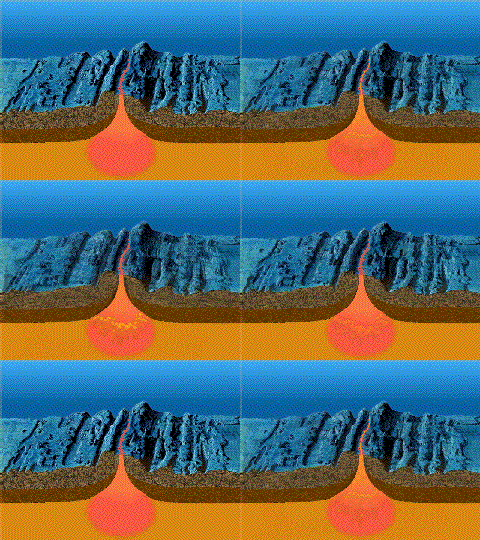
What type of boundary creates new seafloor?
a)
convergent ocean ocean
b)
convergent ocean continental
c)
convergent continental continental
d)
divergent
14.

What type of boundary creates a volcano?
a)
Transform
b)
convergent ocean continental
c)
convergent continental continental
d)
divergent
15.
Plates of the lithosphere float on the ____.
a)
crust
b)
asthenosphere
c)
core
d)
atmosphere
16.
What geologic feature is most likely to form at a divergent boundary?
a)
delta
b)
rift valley
c)
trench
d)
plateau
17.

Earthquakes and volcanoes are most likely found in which locations?
a)
at plate boundaries
b)
in oceans
c)
in the middle of continents
d)
in the middle of plates
18.
What forms at a subduction zone?
a)
Trench
b)
Rift Valley
c)
Volcano
d)
Uplifted Mountains
19.
This layer of Earth is solid Iron and Nickel
a)
Outer Core
b)
Mantle
c)
Inner Core
d)
Crust
20.
Who suggested the Continental Drift theory?
a)
Aldrin Weiner
b)
Alfred Wegener
c)
George Williams
d)
Dr Drift
21.

This fault boundary has two plates moving past each other.
a)
divergent
b)
transform
c)
convergent
22.

This fault boundary is has two plate moving away from each other.
a)
divergent
b)
convergent
c)
transform
23.

The crust and the rigid upper part of the mantle form the part of Earth called the ______________.
a)
lithosphere
b)
mid-ocean ridge
c)
rift
d)
core
24.

_______________ is a chain of mountains that runs about 41,600 miles through the world's oceans.
a)
Rift
b)
Mid-Ocean Ridge
c)
Valley
d)
Rocky Mountains
25.

The lithosphere moves only a few _______ a year.
a)
centimeters
b)
feet
c)
yards
d)
miles
26.

____________ is the theory that the lithosphere is divided into plates that are always moving.
a)
Plate tectonics
b)
Mid-Ocean ridge
c)
Divergent
d)
Fault
27.

_____________ is the process, which takes place along the mid-ocean ridge, in which liquid rock rises and becomes solid as two tectonic plates move farther apart.
a)
sea-floor spreading
b)
mid-ocean ridge
c)
rift
d)
transform fault
28.
The San Andreas Fault in California is an example of a ___________ fault.
a)
transform
b)
divergent
c)
convergent
d)
rift
29.
What is one clue/evidence that scientists have used to conclude that the continents once were together?
a)
fossils
b)
water levels
c)
elevation above sea level
30.
What type of plate is thicker? Continental or Oceanic
a)
continental
b)
oceanic
31.
Which of the following did not support Alfred Wegener's idea of continental drift?
a)
magnetic striping on the ocean floor
b)
identical fossils on continents
c)
mountain ranges
d)
coastlines fit like a puzzle
32.
Which of the following occurs because of convection currents?
a)
Tectonic plates on the crust move.
b)
The mantle increases in size.
c)
Pressure in the crust increases.
d)
Pressure in the crust decreases.
33.

Scientists think that convection currents that move the plates flow in Earth's
a)
Continental crust
b)
Oceanic crust
c)
Mantle/Asthenosphere
d)
Lithosphere
34.
Where does the heat come from that drives this convection current in the mantle?
a)
The sun
b)
The crust
c)
the mantle
d)
the core
35.
What does the theory of continental drift state?
a)
The continents were once joined in a super-continent and have moved over time
b)
Continents are stationary and do not move
c)
The Earth is broken into lithospheric plates that move due to convection currents
d)
none of the above
36.
Oceanic crust is
a)
Younger and less dense than continental crust
b)
Thinner, younger and more dense than continental crust
c)
Older, thicker and less dense that continental crust
d)
Bigger and younger than continental crust
37.
What evidence did Wegener use in his theory?
a)
Continents and fossils fitting together/matching-up like puzzle pieces
b)
glacier scars and other climate evidence from temperature
c)
mountain ranges and rocks line up across continents
d)
all of the above
38.
What two specific continents fit together most noticeably?
a)
Africa and North America
b)
South America and Europe
c)
South America and Africa
d)
Antartica and Africa
39.
Why did no one believe Wegener's theory?
a)
He could not explain HOW the continents moved.
b)
He didn't have any evidence to support his idea.
c)
His evidence was not supporting the hypothesis.
d)
He didn't use the right technology to gather data.
40.

Who is the person credited with developing the theory of continental drift?
a)
Harry Hess
b)
Alfredo Sauce
c)
Alfred Wegener
d)
Alfred the Butler
41.
Was continental drift accepted in Wegener's lifetime?
a)
Yes
b)
No
c)
Yes, but only by his mother.
d)
No, but scientists told him to never give up.
42.
What year did Alfred Wegener create his theory?
a)
1912
b)
1960
c)
1945
d)
1512
43.
What does Pangaea mean?
a)
together
b)
all earth
c)
all over Marlboro
d)
all around the world
44.
Which ocean is expanding due to a mid-ocean ridge?
a)
Indian
b)
Dead Sea
c)
Atlantic
d)
Artic
45.
Created by a divergent boundary.
a)
Rocky Mountains
b)
Mariana Trench
c)
Mid Atlantic ridge
46.

Name the boundary
a)
convergent boundary
b)
divergent boundary
c)
transform boundary
d)
sergent boundary
47.

Name the boundary
a)
convergent boundary
b)
divergent boundary
c)
transform boundary
d)
sergent boundary
48.
During sea floor spreading, molten material rises up from the mantle...
a)
along the continents
b)
at the mid ocean ridges
c)
deep ocean trenches
d)
at north and south poles
49.
Which of the following is where one plate slides under another plate?
a)
submarine zone
b)
divergence zone
c)
subduction zone
d)
lower zone
50.
Mountains form from ...
a)
plates sliding past one another
b)
collision of plates
c)
plates moving away from each other
51.
Earth's plates are...
a)
constantly moving and changing the face of the earth
b)
Never moves
c)
Moves seldom and very fast
d)
Moves when it feels like it
52.
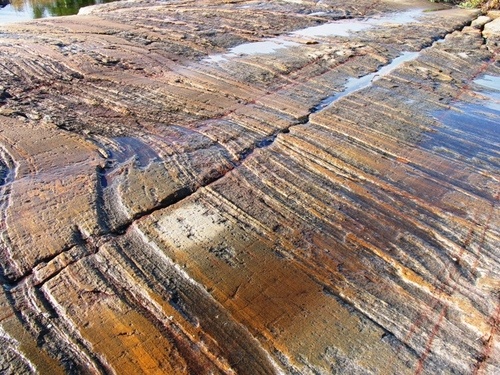
This is a picture of glacier scars found in Africa. What are these evidence for?
a)
Africa has always been near the equator
b)
Africa was once in an area of the Earth that had a very cold climate
c)
The continents have not moved
d)
sea floor spreading
53.
What specific technology did Wegener use in his study?
a)
GPS
b)
Sonar
c)
Radar
d)
Maps
54.
____ is a fossil fern that helped support Wegener’s hypothesis of continental drift.
a)
Gondwanaland
b)
Kannemeyerid
c)
Mesosaurus
d)
Glossopteris
55.
Scientists at the time rejected Wegener’s hypothesis of continental drift because he could not explain how or why Earth's continents move.
a)
True
b)
False
56.
Wegener's theory was rejected due to his lack of evidence.
a)
True
b)
False
57.
Who hypothesized that the plates were spreading?
a)
Harry Ness
b)
Harry Hess
c)
Alfred Wegener
d)
Alfred Wagner
58.
What is the driving force of the movement of plates?
a)
Convergent
b)
Divergent
c)
Transform
d)
Convection
59.
Igneous rock at the center of the mid- ocean ridge is younger than the rock that is being recycled at the ends.
a)
True
b)
False
60.
Alfred Wegener hypothesized that plates drifted apart over millions of years.
a)
True
b)
False
61.
Is the sea floor old or young, compared with the rest of the earth's crust?
a)
old
b)
young
62.
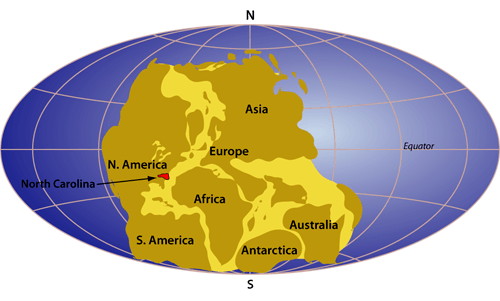
What is this a picture of?
a)
plate tectonics
b)
continental drift
c)
pangea
d)
glacier scaring
63.
What is the force that moves the continents?
a)
Conduction
b)
Convection
c)
Radiation
d)
Conveyor belts
64.
The area around the pacific plate where boundaries form is called...
a)
death ring
b)
fire zone
c)
ring of fire
d)
zone of fire
65.

In this experiment, the WARM red dye and the COLD blue dye was placed in the water at the same time. The warm red dye rose to the top while the cold blue dye sank to the bottom.
a)
conduction
b)
convection
c)
radiation
66.
The type of heat transfer that happens through direct contact of molecules or particles with each other is ___________________.
a)
Convection
b)
Conduction
c)
Radiation
d)
insulation.
67.
Which statement is true?
a)
The quicker a molecule moves, the colder it is.
b)
The slower a molecule moves, the warmer it is.
c)
The quicker a molecule moves, the warmer it is
d)
The movement on molecule don�t affect its temperature
68.
Which of the following is an example of convection?
a)
A hair dryer is drying up your hair.
b)
When the AC or heater changes the temperature.
c)
When a car engine turns hot after being turned on.
d)
When you are making soup and the water is rising and lowering.
69.
Hot matter is _________ dense and ___________
a)
less, sinks
b)
less, rises
c)
more, sinks
d)
more, rises
70.
Molecules that are less dense than the surrounding particles will...
a)
rise up
b)
sink down
c)
stay put
100 %

