wayground logo

Free Printable Worksheets

NEW

Font size

S
M
L
XL
Worksheets

Unit 5 Quizziz

Total questions: 72

Worksheet time: 2hrs 54mins

Name
Class
Date
1.
This boundary is described by two plates moving away from eachother along the edges and separating. The resulting gap allows magma to rise and create new crust, forming new lithosphere. 
a)
Convergent Boundary 
b)
Divergent Boundary  
c)
Transform Boundary
2.
This boundary is described as two plates moving past eachother ALONG THE EDGES horizontally.  These boundaries will get stuck or lock against eachother causing earthquakes when they slip and release. 
a)
Convergent Boundary
b)
Divergent Boundary
c)
Transform Boundary
3.
This boundary is described as moving toward one another  When the plates are both continental plates the will crumple up and form a mountains. When they are continental and oceanic plates, subduction occurs  and earthquakes and volcanoes form. 
a)
Convergent Boundary
b)
Divergent Boundary
c)
Transform Boundary
4.
Trenches, deep underwater canyons on the sea floor are created at this type of boundary 
a)
Divergent
b)
Convergent, Subduction Zone
c)
Transform 
5.
New crust is created at this type of  boundary.
a)
Divergent
b)
Convergent, Subduction Zone
c)
Transform 
6.
Mountains are created at this type of  boundary.
a)
Divergent 
b)
Convergent
c)
Transform 
7.
Mid Ocean Ridge Formation  is created at this type of  boundary.
a)
Divergent 
b)
Convergent
c)
Transform 
8.

The movement of the tectonic plates is caused by

a)

the rotation of the Earth.

b)

convection currents in the Asthenosphere

c)

the gravity of the iron-nickel core.

d)

the Moho discontinuity.

9.
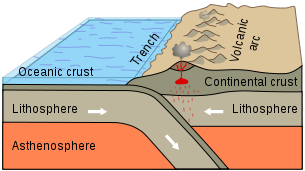
Subduction zones occur on Earth where dense oceanic crust dives under more buoyant continental crust. These boundaries are characterized by a deep ocean trench next to a high continental mountain range, large numbers of earthquakes and volcanoes. All of this is further evidence for the
a)
big bang theory.
b)
theory of plate tectonics.
c)
origin of the species.
d)
theory of natural selection.
10.
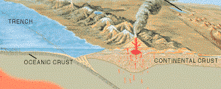
What geological forces might be responsible for this range of mountains?
a)
diverging tectonic plates
b)
erosion of the land by the ocean
c)
converging tectonic plates
d)
deposition of sediments by the ocean
11.

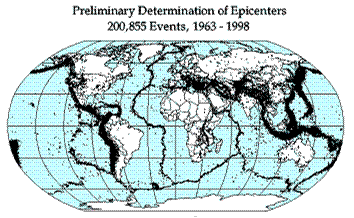
Earthquake epicenters (center of where the earthquakes started) were mapped for a 35 year period in the diagram above. The black dots indicate these epicenters. The black dots appear along what feature on Earth?

a)

hot spots

b)

plate boundaries

c)

rift zones

d)

sea floor spreading

12.

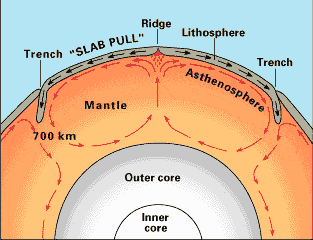
___________ currents in the Earth's asthenosphere cause plate to shift at their boundaries. This movement also causes earthquakes and volcanic activity.

a)

conduction

b)

convection

c)

radiation

d)

ocean

13.

What is the source of energy that drives plate movement?

a)

the subducton of the sea floor

b)

the different densities of the oceanic and crustal plates

c)

convection currents in the asthenosphere

d)

the friction force between the plates that move past each other
14.
Which type of wave arrives first during an earthquake?
a)
Primary (p-wave) waves
b)
Secondary (s-wave) waves
c)
Rayleigh Waves
d)
Love Waves
15.
An s-wave is an example of what type of wave?
a)
Longitudinal
b)
Converse
c)
Transverse
d)
Ocean
16.
A p-wave is an example of
a)
Longitudinal
b)
Transverse
c)
Converse
d)
Ocean
17.
A primary wave moves
a)
parallel
b)
perpendicular
c)
in circles
18.
A secondary wave moves
a)
parallel
b)
perpendicular
c)
in circles
19.
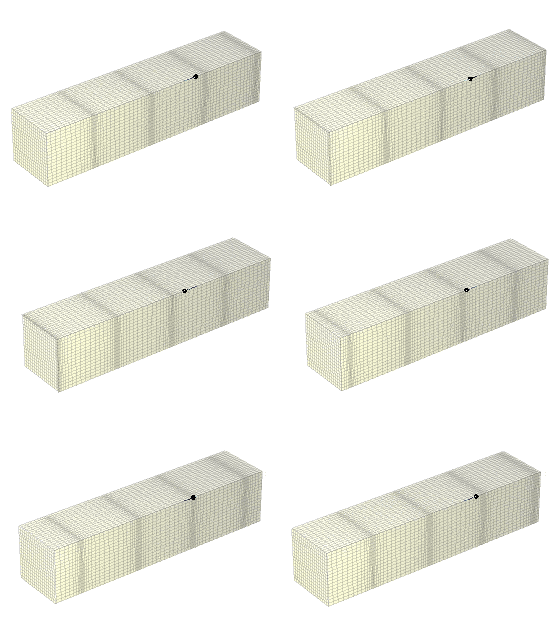
Which body wave is pictured?
a)
P-Wave
b)
S-Wave
c)
Rayleigh Wave
d)
Love Wave
20.

It can travel through solids only

a)

Love waves

b)

Rayleigh waves

c)

Primary waves

d)

Secondary waves

21.

This is considered as the fastest kind of seismic waves.

a)

Love waves

b)

Body waves

c)

Primary waves

d)

Secondary waves

22.

Main type of seismic waves that can only travel through the surface of the Earth.

a)

seismic waves

b)

surface waves

c)

body waves

d)

primary waves

23.

Primary (P) Waves can pass through...

a)

solids only

b)

liquids only

c)

gases only

d)

solids, liquids, and gases

24.

Rank the seismic waves in order of appearance when an earthquake first occurs as measured by a seismograph.

a)

S waves, P waves, then surface waves

b)

P waves, S waves, then surface waves

c)

S and P waves at the same time, then surface waves

d)

Surface waves, then S and P waves at the same time

25.
An instrument that detects and measures earthquakes is a 
a)
seismogram
b)
focus seismic map
c)
focus
d)
seismograph 
26.
What are the two classifications of waves?
a)
Body and Legs
b)
Rayleigh and Love
c)
Body and Surface
d)
Inner and Outer
27.

These waves travel slowly. They are the most destructive.

a)

Seismic Waves

b)

Primary Waves

c)

Secondary Waves

d)

Surface Waves

28.
A seismic wave that compresses and expands rock.  It is the fastest wave.  It arrives "on scene" first.
a)
Secondary Wave
b)
Aftershock
c)
Primary Wave
d)
Seismic Wave
29.
A rock formed from fragments of other rocks is a(n)
a)
Metamorphic Rock
b)
Sedimentary Rock
c)
Extrusive Rock
d)
Igneous Rock
30.
An igneous rock containing large crystals is most likely a(n)
a)
Chemical Rock
b)
Foliated Rock
c)
Extrusive Rock
d)
Intrusive Rock
31.
If heat and pressure inside the Earth cause a rock to melt, the material that formed would be
a)
Metamorphic
b)
Magma
c)
Sedimentary
d)
Igneous
32.
As lava cools and crystallizes, what type of rock will form?
a)
Sedimentary
b)
Metamorphic
c)
Extrusive Igneous
d)
Intrusive Igneous
33.
Fossils are only found in
a)
Sedimentary rocks
b)
Foliated Metamorphic rocks
c)
Igneous Rocks
d)
Nonfoliated Metamorphic rocks
34.
The three groups of rocks are classified by
a)
How they form
b)
Color
c)
Grain size
d)
Chemical Composition
35.
This rock was another type of rock that was heated and compressed over time. What type of rock is this?
a)
Sedimentary
b)
Igneous
c)
Metamorphic
36.
This rock started as molten magma. What type of rock is this?
a)
Sedimentary
b)
Igneous
c)
Metamorphic
37.
This rock was formed by smaller pieces of rock that settled at the bottom of a lake millions of years ago. What type of rock is this?
a)
Sedimentary
b)
Igneous
c)
Metamorphic
38.
Cooling & crystalization produce
a)
igneous rocks
b)
metamorphic rocks
c)
sedimentary rocks
39.
True or False: Once a rock is sedimentary, it cannot become an igneous rock.
a)
True
b)
False
40.
The process when rocks break into smaller pieces due to exposure to natural elements is called
a)
erosion
b)
weathering
c)
sediments
41.
What are the 3 major types of rocks?
a)
Igneous, Metamorphic, Sedimentary
b)
Metamorphic, Igneous, Cementation
c)
magma, lava, crystals
42.
The process by which igneous rocks are formed...
a)
heat and pressure
b)
melting and cooling
c)
weathering and erosion
43.
The process by which metamorphic rocks are formed...
a)
heat and pressure
b)
erosion and deposition
c)
melting and cooling
44.
The name rock is given when it is broken down into smaller pieces.
a)
texture
b)
weathering
c)
sediment
d)
erosion
45.

Which rock is formed form the cooling of volcanic ash on Earth's surface?

a)

intrusive igneous

b)

foliated metamorphic

c)

extrusive igneous

d)

organic sedimentary

46.

Rocks that form from colling magma inside Earth?

a)

Igneous intrusive

b)

Igneous extrusive

c)

Metamorphic foliated

d)

Metamorphic nonfoliated

47.
True/False: Igneous rocks can only turn into metamorphic rocks.
a)
True
b)
False
48.
The process in which dissolved minerals crystallize and glue sediment together.
a)
compaction
b)
deposition
c)
organic rock
d)
cementation
49.
What is the outermost layer of earth?
a)
inner core
b)
outer core
c)
mantle
d)
crust
50.

This layer of Earth is solid iron and nickel

a)

Outer Core

b)

Mantle

c)

Inner Core

d)

Crust

51.
The liquid portion at the center of the Earth.
a)
Asthenosphere
b)
Inner Core
c)
Outer Core
d)
Lithosphere
52.
The core is different from the other layers of the Earth because it is made of ______________.
a)
Metal
b)
Solid Rock
c)
Magma
d)
Melted Rock
53.
The lithosphere is made up of which two layers?
a)
Upper and Lower Mantle
b)
Upper Mantle and Crust
c)
Core and Mantle
d)
Crust and Uppermost Mantle
54.
Which layer is the thinnest, least dense and most brittle?
a)
Mantle
b)
Inner Core
c)
Crust
d)
Outer Core
55.
What is the name of the layer that contains the uppermost mantle and crust
a)
Asthenosphere
b)
Mesosphere
c)
Lithosphere
d)
Transosphere
56.
This layer of Earth is the thickest part
a)
crust
b)
outer core
c)
mantle
d)
inner core
57.

Is the outer core solid or liquid?

a)

solid

b)

liquid

58.
_________ is the thickest layer of the Earth. 
a)
Inner Core
b)
Outer Core
c)
Crust 
d)
Mantle
59.

Which statement is correct?

a)

As you move up through the layers, the pressure increases.

b)

As you move down through the layers density increases.

c)

As you move down through the layers, pressure decreases.

d)

As you move up down through the layers, pressure remains the same.

60.

Which zone is larger?

a)

S wave shadow

b)

P waves shadow

c)

shadow zones are equal

61.

Which location is farther from the epicenter?

a)

Seismogram B (top)

b)

Seismogram C (bottom)

62.

Which location would experience a more intense earthquake?

a)

Seismogram A (top)

b)

Seismogram B (bottom)

63.

Which letter represents surface waves?

a)

A

b)

B

c)

C

d)

All are surface waves

64.

Which station was closest to the earthquake's epicenter?

a)

Station A

b)

Station B

c)

Station C

65.

This model demonstrates a

a)

P wave shadow zone

b)

S wave shadow zone

c)

Surface wave shadow zone

d)

Convection currents

66.

This model represents a

a)

P wave shadow zone

b)

S wave shadow zone

c)

Surface wave shadow zone

d)

Convection currents

67.

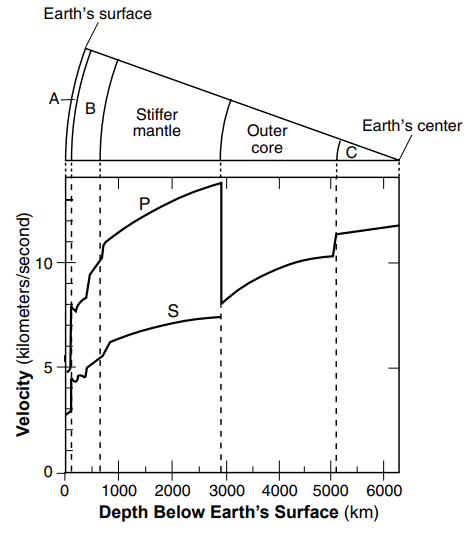
When S waves leave the Mantle and enter the outer core, they...

a)

speed up

b)

slow down

c)

get absorbed

68.

When P waves leave the inner core and enter the outer core, they...

a)

speed up

b)

slow down

c)

get absorbed

69.

Which shadow zone is larger?

a)

S wave shadow

b)

P waves shadow

c)

P and S shadow zones are equal in size

70.

If the Earth did NOT have a liquid outer core, how would earthquake waves travel differently.

a)

P and S waves would both be absorbed.

b)

Only S waves would travel through the Earth's core.

c)

s wave Shadow zones would not be bigger than P-wave.

d)

S waves would travel faster than P waves.

71.

Plate tectonics impact the rock cycle

a)

true

b)

false

72.

All of the below supports plate tectonic theory EXCEPT

a)

sea floor spreading

b)

convection cells in the mantle

c)

fossils of finches being found in one country

d)

new crust being created at mid ocean ridge