wayground logo

Free Printable Worksheets

Font size

S
M
L
XL
Worksheets

Physical and Chemical Properties and Changes

Total questions: 70

Worksheet time: 52mins

Name
Class
Date
1.
What kind of properties can only be observed when a substance changes into a different substance?
a)
physical properties
b)
chemical properties
2.
Which type of property is the ability to conduct electricity?
a)
physical property
b)
chemical property
3.
Properties that can be observed without changing the identity of the substance.
a)
Physical
b)
Chemical
4.
Example for physical property
a)
odor
b)
burns in air
c)
reacts with water to create hydrogen gas
d)
rust
5.
Which of the following is a sign that a chemical reaction has occurred?
a)
change in shape
b)
melting
c)
formation of a gas
d)
dissolving
6.
Which of the following is NOT an example of a physical change?
a)
crumpled paper
b)
pencil sharpening
c)
shrunken clothing
d)
rust
7.
A change where one or more new substances are created.
a)
Physical Change 
b)
Chemical Change 
8.
Fizzing, foaming, and burning are all examples of
a)
Chemical change
b)
Physical change
9.
Change in density is a physical change.
a)
True
b)
False
10.
Rust on an iron bar is an example of chemical change.
a)
True 
b)
False
11.
Flammability is an example of what property?
a)
Chemical property
b)
Physical property
12.
Physical properties are
a)
properties that can be observed without changing the identity of the substance
b)
properties that describe how a substance changes into a completely different substance
13.
Properties that can be measured or observed only when matter undergoes a change to become an entirely different kind of matter.
a)
Evaporation
b)
Density
c)
Physical Properties Of Matter
d)
Chemical Properties of Matter
14.
Properties that can be measured or observed without matter changing to an entirely different substance.
a)
Chemical Properties of Matter
b)
Physical Properties of Matter
c)
Physical Change
d)
Chemical Change
15.
Silver is a white metal that is an excellent conductor. Silver tarnishes when exposed to air and light. The density of silver is 10.49 g/cm3 The melting point is 962oC and the boiling point is 2000oC. A chemical property of silver is
a)
melting point
b)
boiling point
c)
density
d)
tarnishing
16.
temperature at which a substance changes from solid to liquid
a)
Conductivity
b)
Melting Point
c)
Hardness
d)
Boiling Point
17.
An attractive force for some metals.
a)
Conductivity
b)
Solubility
c)
Magnetism
d)
Mass 
18.
This is an example of a
a)
physical change
b)
chemical change
19.
Ability to rust is this type of property:
a)
Physical property
b)
Chemical property
20.
What is anything that has mass and takes up space?
a)
matter
b)
substance
c)
chemistry
d)
property
21.
The formation of gas bubbles is evidence that a _________________ has taken place.
a)
physical property
b)
chemical property
c)
physical change
d)
chemical change
22.
What is the formula for density?
a)
density = mass x volume
b)
density = mass / volume
c)
density = mass + volume
d)
density = mass - volume
23.
Jack has a rock. The rock has a mass of 14g and a volume of 2cm3. What is the density of the rock?
a)
7 mL
b)
7 g/cm3
c)
28 g/cm3
d)
1/7 g/cm3
24.
Frank has an eraser. It has a mass of 4g, and a volume of 2cm3. What is its density?
a)
8 g/cm3
b)
2 g/cm3
c)
1/2 g/cm3
d)
24 g/cm3
25.

A student was working with 50 mL of water in an experiment. Which of the following statements can be concluded from the picture?

a)

The volume of a liquid changes when the shape of its container changes.

b)

The mass of a liquid changes when the shape of its container changes.

c)

The volume of a liquid stays the same when poured from one container to another container.

d)

The temperature of the liquid changes as the shape of the container changes.

26.

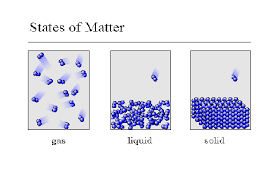
Which of the following best represents the three states of matter?

a)

Picture A

b)

Picture B

c)

Picture C

d)

Picture D

27.
What is matter?
a)
Anything that has mass and occupies space
b)
Anything that has mass
c)
Anything that is made of air
d)
ALL of them 
28.
A pure substance that cannot be broken down into other substances by chemical or physical means. 
a)
compound          
b)
atom
c)
mixture 
d)
element
29.
a)

Pure Substance

b)

Mixture

30.

Which classification of matter is composed of two or more substances which are physically combined?

a)

atoms

b)

pure substances

c)

mixtures

d)

elements

31.

Oxygen

a)

Pure Substance

b)

Mixture

32.
The amount of matter in an object is a measure of the object's ________________.
a)
volume
b)
density
c)
mass
d)
solubility
33.
What is the volume of the rock? The water level is displaced from 20 mL to 23 mL with the rock.
a)
3 mL
b)
23 mL
c)
20 mL
d)
43 mL
34.
What would be the best way to measure the volume of a small rock?
a)
L x W x H with a ruler
b)
Put on triple beam balance
c)
Mass ÷ Volume
d)
Displacement method using graduated cylinder
35.
What is the formula for calculating density?
a)
Mass ∗ Volume
b)
Volume ∗ Mass
c)
Mass ÷ Volume
d)
Volume ÷ Mass
36.
What is the density of water?
a)
1 mL
b)
1 gram
c)
1 g/cm3
d)
All of the above
37.
Which statement is true?
a)
Oil is the most dense substance.
b)
Corn syrup is less dense than water.
c)
Oil is less dense than water.
d)
Oil and corn syrup have the same density but different masses.
38.
In which state does matter completely fill its closed container?
a)
Gas
b)
Liquid
c)
Solid
d)
Ice
39.
Which state of matter has a fixed shape and volume and it's molecules move very slowly?
a)
Liquid
b)
Gas
c)
Solid
d)
Plasma
40.
The volume of water in a beaker was 215 mL. After 5 days, the volume of the water was 200 mL. What best explains the change in volume?
a)
Some of the water absorbed the air. 
b)
Some of the water evaporated and escaped into the air as water vapor.
c)
Some of the water disappeared.
d)
Some of the water was released due to condensation.
41.

What state of matter is water in?

a)

soild

b)

liquid

c)

gas

d)

thermo

42.
What state of matter is ice in? 
a)
Solid
b)
Liquid
c)
Gas
d)
Thermo
43.
Steam is an example of what state of matter?
a)
Solid
b)
Liquid
c)
Gas
d)
Thermo
44.
Which is an example of a physical property?
a)
ability to react with acid
b)
 color
c)
flammability
d)
ability to react with oxygen
45.
Which is NOT a physical property?
a)
odor
b)
reacts with bleach
c)
sinks in water
d)
density
46.
Physical properties are
a)
properties that can be observed without changing the identity of the substance
b)
properties that describe how a substance changes into a completely different substance
c)
properties that we can only observe with our eyes
d)
properties that we need special tools to observe
47.
Alka-Seltzer gives off carbon dioxide when added to water
a)
physical change
b)
chemical change
48.
Which of the following is a sign that a chemical reaction has occurred?
a)
change in shape
b)
melting
c)
formation of a gas
d)
dissolving
49.
What kind of properties can only be observed when a substance changes into a different substance?
a)
physical properties
b)
chemical properties
c)
liquid properties
d)
real properties
50.
What is burning an example of?
a)
physical change
b)
physical property
c)
chemical change
d)
chemical property
51.
When you break a cracker into pieces it is a 
a)
Chemical change
b)
Physical change
c)
Chemical Weathering
d)
Physical Weathering
52.
Milk sours (goes bad)
a)
physical change
b)
chemical change
c)
physical property
d)
chemical property
53.
Salt dissolving in water is an example of what?
a)
A physical change
b)
A chemical change
c)
A physical property
d)
A chemical property
54.
Which is an example of a physical property?
a)
rusting
b)
boiling point
c)
combustion
d)
reactivity with water
55.

Change in density is a physical change.

a)

True

b)

False

56.
The amount of matter in an object is a measure of the object's ________________.
a)
volume
b)
density
c)
mass
d)
solubility
57.
What are the states of matter?
a)
solid, liquid, and juice
b)
solid and liquid
c)
solid and gas
d)
solid, liquid, and gas
58.
Matter that has its own shape and takes up space.
a)
solid
b)
liquid
c)
gas
59.
Matter that always fills the shape in a container, such as air.
a)
solid
b)
liquid
c)
gas
60.
Which object is a solid that keeps it's shape when it changes containers? 
a)
Chocolate milk
b)
Gravel
c)
Oxygen
61.
Molecules are closest together in a 
a)
Solid
b)
Liquid
c)
Gas
d)
plasma
62.
A gas
a)
has a definite shape but no definite volume
b)
has a definite volume but no definite shape
c)
has fast-moving particles
63.

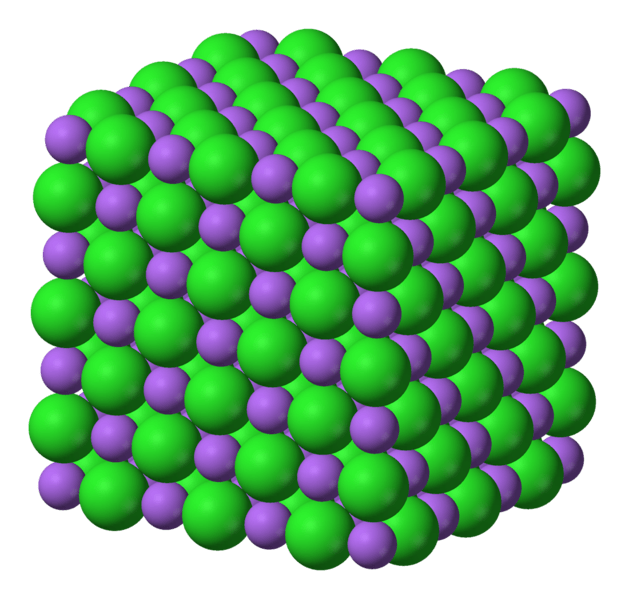
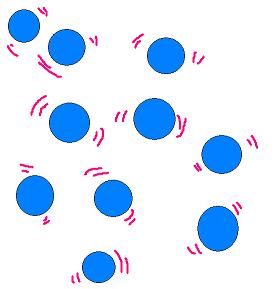
Which state of matter does this picture show?

a)

Solid

b)

Liquid

c)

Gas

64.

What state of matter does this picture show?

a)

Solid

b)

Liquid

c)

Gas

65.

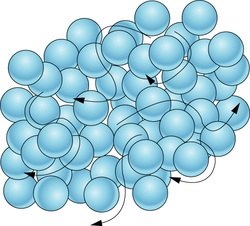
Which state of matter does this picture show?

a)

Solid

b)

Liquid

c)

Gas

66.
Particles (molecules) in a ______________________ have more energy than the other states of matter.
a)
gas
b)
solid
c)
liquid
67.
If the tops were removed from the cylinders, the following would happen:
a)
The solid would fly out of the container
b)
The liquid would fly out of the container.
c)
The gas would fly out of the container.
d)
They ALL would fly out of the container.
68.

As temperature increases, what happens to particles?

a)

They speed up

b)

They slow down

69.

As temperature decreases, what happens to particles?

a)

They speed up

b)

They slow down

70.

Particles (molecules) in a ______________________ have more energy than the other states of matter.

a)

gas

b)

solid

c)

liquid