
 Worksheets
Chapter 2: The Laws of Motion
Total questions: 45
Worksheet time: 44mins
Name
Class
Date
1.
What is the unit called that measures force?
a)
Isaac
b)
Yee
c)
Newton
d)
kilogram
2.
The term inertia means an object's resistance to motion; which of Newton's laws involves inertia?
a)
first
b)
second
c)
third
d)
fourth
3.
Which of Newton's laws is illustrated when a magician pulls a tablecloth out from under the dishes without disturbing them?
a)
first
b)
second
c)
third
d)
fourth
4.
A(n) __________ is a push or pull.
a)
newton
b)
acceleration
c)
force
d)
momentum
5.

What is the force applied to all objects on Earth?
a)
Earthquakes
b)
Gravity
6.
A ____ force is the total force felt by an object.
a)
sum
b)
net
c)
strong
d)
balanced
7.
____ is the rubbing force that acts against motion between two touching surfaces.
a)
Acceleration
b)
Normal force
c)
Momentum
d)
Friction
8.
When the net force is zero, the forces on an object are balanced. True or false.
a)
true
b)
false
9.
Any time the forces are unbalanced, an object will remain at rest. True or false?
a)
true
b)
false
10.
The moon and other satellites rotate around the earth. Identify the force that keeps these satellites in orbit.
a)
gravity
b)
friction
c)
a strong force
d)
electromagnetic force
11.
The upward force on an object falling through the air is _________.
a)
air force
b)
weight
c)
air resistance
d)
upheaval
12.
According to Newton's First Law, an object's velocity will not change unless _____ acts upon it.
a)
a balanced force
b)
an unbalanced force
c)
zero force
13.
If you travel to Mars, where gravity is 38% of Earth's gravity, what will happen to your mass and weight?
a)
Your mass and weight will both be greater than on Earth.
b)
Your mass and weight will both be less than on Earth.
c)
Your mass will be the same, but your weight will be less than on Earth.
d)
Your mass will be less than on Earth, but your weight will be the same.
14.
The scientist who is most famous for developing the Laws of Motion is _____.
a)
Albert Einstein
b)
Stephen Hawking
c)
Sir Isaac Newton
d)
Galileo Galilei
15.
A ball thrown at the ground bounces back up.
a)
Law of Inertia (1st Law)
b)
Law of Mass and Acceleration (2nd law)
c)
Law of Action Reaction (3rd Law)
16.

A soccer ball accelerates more than a bowling ball when thrown with the same force.
a)
1st Law
b)
2nd Law
c)
3rd Law
17.
F=MA
An object of mass 10 kg is accelerated upward at 2 m/s2. What force is required?
An object of mass 10 kg is accelerated upward at 2 m/s2. What force is required?
a)
20 N
b)
2 N
c)
5 N
d)
0 N
18.

Which car is accelerating?
a)
A car that is not moving
b)
A ar that rounds a curve at a constant speed
c)
A car traveling at a constant speed
d)
A car that has a set speed of 60mph
19.
If a baseball and a cannonball are dropped from the same height at the same time, which ball will hit the ground first?
a)
the cannonball
b)
the baseball
c)
The balls land at the same time.
d)
the ball with the larger volume
20.
According to Newton’s third law, when an object applies a force on a second object, the second object applies a weaker reaction force in response.
a)
True
b)
False
21.
Which type of collision occurs when a baseball bat hits a baseball?
a)
Elastic
b)
Inelastic
c)
accelerated
22.
The law of conservation of momentum states that the total momentum of a group of objects
a)
Increases after a collision
b)
Decreases after a collision
c)
Remains the same after a collision
23.
Which type of force involves two objects touching?
a)
Contact
b)
Noncontact
c)
Magnetic
24.
______________________acts perpendicular to the direction of motion when an object moves in a circle
a)
Centripetal Force
b)
Momentum
c)
Circular Motion
d)
Force Pair
25.
Force pairs act in opposite directions and are the same strength
a)
True
b)
False
26.
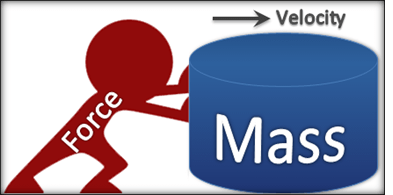
a)
1st
b)
2nd
c)
3rd
27.
What law is best described by inertia?
a)
1st
b)
2nd
c)
3rd
28.
F = MxA
a)
1st
b)
2nd
c)
3rd
29.

"For every action, there is an equal and opposite reaction."
a)
Newton's 1st Law
b)
Newton's 2nd Law
c)
Newton's 3rd Law
d)
Newton's 4th Law
30.

"An object in motion (or at rest) will to stay in motion (or at rest) until an outside force acts upon it."
a)
Newton's 1st Law
b)
Newton's 2nd Law
c)
Newton's 3rd Law
d)
Newton's 4th Law
31.

The tendency of an object to resist changes in its motion is...
a)
inertia
b)
force
c)
acceleration
d)
velocity
32.

Any push or pull on an object.
a)
force
b)
velocity
c)
inertia
d)
momentum
33.

A force that opposes motion between a surface in contact with the atmosphere.
a)
air resistance
b)
gravity
c)
momentum
d)
terminal velocity
34.

Which of the following is the same as a Newton?
a)
kg*m/sec/sec
b)
kg*m/sec
c)
m/sec/sec
d)
m/sec
35.

Which of the following is the units for acceleration?
a)
kg*m/sec/sec
b)
kg*m/sec
c)
m/sec/sec
d)
m/sec
36.

Which of the following is the units for velocity?
a)
kg*m/sec/sec
b)
kg*m/sec
c)
m/sec/sec
d)
m/sec
37.
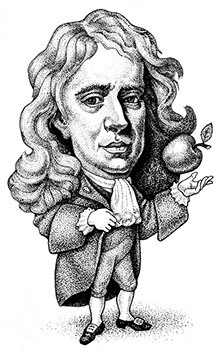
A Newton is a unit of...
a)
force
b)
inertia
c)
acceleration
d)
velocity
38.

When all the forces on an object are equal and opposite, & the net force is zero, that's...
a)
balanced forces
b)
unbalanced forces
c)
terminal velocity
d)
reaction forces
39.

The combination of all the forces acting on an object is the...
a)
net force
b)
action force
c)
reaction force
d)
balance force
40.

An archer pulls the bowstring back, then releases the string and the arrow flies forward. Pulling the string back is the...
a)
action force
b)
reaction force
c)
net force
d)
inertia
41.

An archer pulls the bowstring back, then releases the string and the arrow flies forward. The arrow flying forward is the...
a)
action force
b)
reaction force
c)
net force
d)
inertia
42.

A cannonball with a mass of 0.5 kg is flying at an acceleration of 10 m/sec/sec. What is it's force?
a)
50 Newtons
b)
5 Newtons
c)
20 Newtons
d)
9.5 Newtons
43.

The net force on a ball thrown in outer space is... (you are no longer touching the ball)
a)
there is none
b)
forward
c)
down and backward
d)
forward and down
44.

The net force on a ball thrown on Earth is... (you are no longer touching the ball)
a)
there is none
b)
forward
c)
down and backward
d)
forward and down
45.

To compare the two pictures would require...
a)
Newton's 1st Law
b)
Newton's 2nd Law
c)
Newton's 3rd Law
d)
Newton's 11th Law
100 %

