
 Worksheets
Unit 3 LT 1
Total questions: 41
Worksheet time: 29mins
Name
Class
Date
1.
Matter is made of
a)
atoms
b)
space
c)
light
d)
sound
2.
Something that takes up space and has mass.
a)
volume
b)
matter
c)
mass
d)
density
3.
A measure of how much mass is contained in a given unit of volume.
a)
mass
b)
density
c)
volume
d)
matter
4.
You can measure ______ with grams.
a)
mass
b)
volume
c)
conductivity
d)
melting point
5.
Which thing is not and example of matter?
a)
light
b)
book
c)
person
d)
air
6.
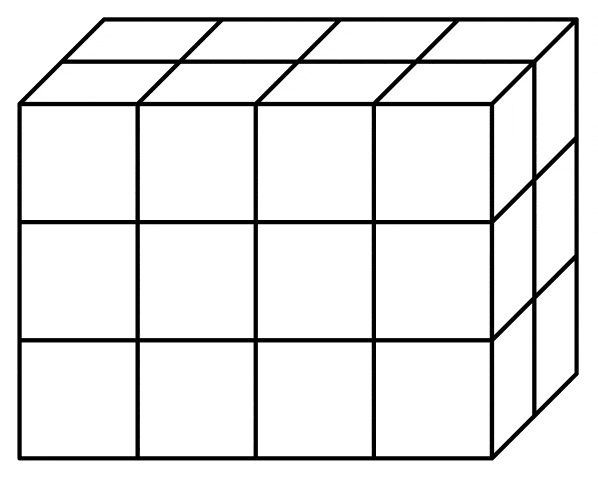
What is the volume of this rectangular prism?
a)
26 cubic units
b)
24 cubic units
c)
24 square units
d)
26 square units
7.
Which formula can be used to find the volume of a rectangular prism?
a)
length x width
b)
length x width x height
c)
height x length
d)
length + width + height
8.

What is the volume of this rectangular prism?
a)
60 cubic centimeters
b)
15 cubic centimeters
c)
20 cubic centimeters
d)
6 cubic centimeters
9.

What is the volume of the screw?
a)
10 cm3
b)
13 cm3
c)
16 cm3
d)
3 cm3
10.
the amount of space an object takes up
a)
liter
b)
mass
c)
volume
d)
gram
11.
used to find the volume of liquids and other objects
a)
graduated cylinders
b)
formula
c)
bleeker
12.
formula for density
a)
D=M/V
b)
g/cm3
c)
length x width x height
13.
the relationship between the mass of a material and its volume, it is the mass of 1 cm3 of a substance
a)
mass
b)
volume
c)
density
d)
meter
14.
unit of density is
a)
D=M/V
b)
g/cm3
c)
length x width x height
15.
What is the name for the method of calculating the volume of irregular objects?
a)
measuring
b)
weighing
c)
water polo
d)
water displacement
16.

At which point should your eyes be when you read a graduated cylinder? (Hint: see the letter next to the eye)
a)
A
b)
B
c)
C
17.

What is the volume of the fish?
a)
18.0 cm3
b)
6.0 cm3
c)
38.0 cm3
18.
Jack has a rock. The rock has a mass of 14g and a volume of 2cm3. What is the density of the rock?
a)
7 mL
b)
7 g/cm3
c)
28 g/cm3
d)
1/7 g/cm3
19.
Which lab tool might you use to measure the volume of a liquid?
a)
electric scale
b)
bunsen burner
c)
test tube
d)
graduated cylinder
20.
True or False: The density of a specific type of material never changes.
a)
True
b)
False
21.

I have two objects with the same volume but different masses. Which object will be more dense?
a)
The object with less weight.
b)
The object with more weight.
c)
The object with more mass.
d)
The object with less mass.
22.
What is the formula for density?
a)
density = mass x volume
b)
density = mass / volume
c)
density = mass + volume
d)
density = mass - volume
23.
Frank has an eraser. It has a mass of 4g, and a volume of 2cm3. What is its density?
a)
8 g/cm3
b)
2 g/cm3
c)
1/2 g/cm3
d)
24 g/cm3
24.
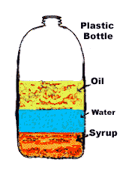
Which liquid is the least dense?
a)
oil
b)
water
c)
syrup
d)
plastic bottle
25.

Which box has a higher density?
a)
Box A
b)
Box B
c)
cannot be determined
d)
they are the same
26.

Calculate the density of the cube.
a)
2 g/cm3
b)
4 g/cm3
c)
6 g/cm3
d)
8 g/cm3
27.
An object with which of the following densities will float on water?
a)
0.7 g/cm3
b)
1.2 g/cm3
c)
3.5 g/cm3
d)
11.4 g/cm3
28.
Which property of matter is determined by dividing its mass by its volume?
a)
elasticity
b)
buoyancy
c)
density
d)
viscosity
29.
A brick sinks in water while a wooden block of the same size floats. This is because the brick has a
a)
lower volume than the wooden block
b)
lower density than the wooden block
c)
higher volume than the wooden block
d)
higher density than the wooden block
30.
A scientist has four different liquids and pours them all into a bottle. The silver liquid sinks to the bottom, the red liquid settles on top of the silver one, and the pink liquid stays at the surface. Which liquid has the smallest density?
a)
the pink liquid
b)
the silver liquid
c)
the red liquid
d)
the water
31.
Why do some substances float on water?
a)
they are warmer than water
b)
they are cooler than water
c)
they are more dense than water
d)
they are less dense than water
32.
What units are used to measure Density?
a)
cm3/g
b)
g
c)
g/cm3
d)
cm3
33.
Define the term "mass".
a)
Mass/Volume
b)
Anything that has mass and takes up space
c)
The amount of space an object occupies.
d)
The amount of matter in an object.
34.
Volume is ...
a)
Mass/Volume
b)
The amount of matter in an object.
c)
The amount of space an object occupies.
d)
Anything that has mass and occupies space.
35.
Density is...
a)
the amount of mass in an object
b)
the amount of space an object takes up
c)
the amount of mass in a given space
d)
the weight of an object
36.

What is the mass of this pear when each cube stands for 50 grams?
a)
200 grams
b)
150 grams
c)
100 grams
d)
50 grams
37.
If you added or removed matter from an object, what would change?
a)
the color
b)
the melting point
c)
the mass
d)
the texture
38.
Which of these would you use to measure mass?
a)
a barometer
b)
a thermometer
c)
a balance scale
d)
a ruler
39.
Anything made of matter must _____________________.
a)
take up space and have mass
b)
have mass and be a solid
c)
be a solid and not move
d)
take up space and be a liquid
40.
Which of these things contains matter?
a)
rocks
b)
x-rays
c)
light
d)
heat
41.
Suppose an astronaut were to visit a planet where the gravity is half that of Earth. His MASS on that planet would be ______________.
a)
half his Earth mass
b)
the same as his Earth mass
c)
twice his Earth mass
d)
zero
100 %

