wayground logo

Free Printable Worksheets

Font size

S
M
L
XL
Worksheets

Decoding the Peroidic Table

Total questions: 41

Worksheet time: 40mins

Name
Class
Date
1.

Label the box from the Periodic Table correctly by moving the labels from below to the correct locations on the picture.

2.

Move the labels to the correct location on the box from the Periodic Table.

3.
He discovered the neutron in the nucleus and completed the current atomic model.
a)
J.J. Thomson
b)
Ernest Rutherford
c)
Niels Bohr
d)
James CHadwick
4.
He found that atoms have smaller parts and found negative electrons that he theorized were surrounded in a sphere of positive charges
a)
J.J. Thomson
b)
Ernest Rutherford
c)
Niels Bohr
d)
James Chadwick
5.
He found the positively charged protons in the nucleus and said that electrons moved around the nucleus
a)
J.J. Thomson
b)
Ernest Rutherford
c)
Niels Bohr
d)
James Chadwick
6.
He found that electrons have specific amounts of energy and move in specific orbits around the nucleus, like planets orbiting the sun. 
a)
J.J. Thomson
b)
Ernest Rutherford
c)
Niels Bohr
d)
James Chadwick
7.
Which of the following was not part of John Dalton's theory of an atom?
a)
Matter can be created and destroyed
b)
All atoms of the same element are exactly alike
c)
Every compound is composed of atoms of different elements in a specific ratio
d)
All elements are composed of atoms that can not be divided
8.
According to Ernest Rutherford, an atom is made of mostly....
a)
empty space
b)
electrons
c)
the nucleus
d)
protons
9.
The atomic particle with no charge is the...
a)
proton
b)
neutron
c)
electron
d)
nucleus
10.
The atomic particle with a positive charge is the...
a)
proton
b)
neutron
c)
electron
d)
nucleus
11.
The atomic particle with a negative charge is the...
a)
proton
b)
neutron
c)
electron
d)
nucleus
12.
The smallest part of the element with the properties of the element is the...
a)
electron
b)
quark
c)
atom
d)
proton
13.
Hydrogen (H2), Oxygen (O2), water (H2O) are examples of ____________________ because they contain more than one atom.
a)
Molecule
b)
Compound
c)
Mixture
d)
Atom
14.
A combination of elements and compounds that is not chemically combined is known as a ______________________. 
a)
Molecule
b)
Compound
c)
Mixture
d)
Atom
15.

What is true of the electrons in this diagram?

a)

They are the 3 blue dots

b)

They are the 3 red dots

c)

They are the 3 white dots

d)

There are 9 elecrton dots

16.

Which dot represents the protons in the diagram?

a)

the white circles

b)

the grey circles

c)

the black circle

d)

you do not have enough information

17.
What is the atomic number of this atom?
a)
1
b)
3
c)
4
d)
7
18.
What is the mass number of this atom?
a)
1
b)
3
c)
4
d)
7
19.

What is the electron configuration of this atom?

a)

3-4

b)

3-4-3

c)

2-1

d)

3

20.

What element of the periodic table does this atom represent?

a)

Li

b)

Sc

c)

Na

d)

N

21.
Which element has an Atomic Number of 10?
a)
Neon (Ne)
b)
Calcium (Ca)
c)
Gold (Au)
d)
Potassium (K)
22.

Which element has the HIGHEST atomic number out of the following?

a)
Hydrogen (H)
b)
Lithium (Li)
c)
Sodium (Na)
d)
Potassium (K)
23.

Which element has the LOWEST Atomic Number out of the following?

a)
Bromine (Br)
b)
Chlorine (Cl)
c)
Iodine (I)
d)
Astatine (At)
24.

How many protons does an atom of Fluorine have?

a)
4
b)
9
c)
12
d)
0
25.

How many protons does each atom of Menganese have?

a)
4
b)
25
c)
6
d)
12
26.

Using your periodic table, How many neutrons does Carbon have?

a)
12
b)
0
c)
2
d)
6
27.

Using your Periodic Table, How many Protons and Neutrons does Sulfur have?

a)
P = 18, N = 14
b)
P = 16, N = 14
c)
P = 16, N = 16
d)
P = 30, N = 2
28.

What is the chemical symbol for the element Silicon

a)

S

b)

Si

c)

si

d)

Sl

29.

Name this element.

a)

Neon

b)

Magnesium

c)

Sodium

d)

Manganese

30.

Looking at the Bohr models below, Which is showing the correct electron configuration for Beryllium ?

a)

b)

c)

d)

31.

What is the chemical symbol for magnesium?

a)
12
b)
Mg
c)
24.31
d)
Magnesium
32.
Which of these is the proton.
a)
A
b)
B
c)
C
d)
None
33.
Which of these is the electron?
a)
A
b)
B
c)
C
d)
D
34.
B and C are found in the ______ of an atom.
a)
Energy levels
b)
Space
c)
Nucleus
d)
Outside
35.
Which number here is my atomic number?
a)
5
b)
10.811
36.
In order for me to find the number of neutrons, I must round the atomic mass and then do what?
a)
atomic number-atomic mass
b)
atomic number x atomic mass
c)
atomic mass + atomic number
d)
atomic mass - atomic number
37.

How many neutrons does this atom have?

a)
2.5
b)
5
c)
6
d)
10.81
38.
Identify the element in the picture
a)
Boron
b)
Carbon
c)
Nitrogen
d)
Lithium
39.

This Bohr diagram shows an element from the periodic table, which statement is true?

a)

This atoms is of Chlorine

b)

This atom has an atomic mass of 34

c)

There are 17 nuetrons

d)

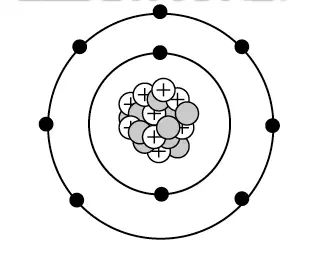
The electron configuration is 7-8-2

40.

How many electrons total?

a)

5

b)

6

c)

7

d)

8

41.
What is the name of this element?
a)
Lithium
b)
Boron
c)
Carbon
d)
Neon