wayground logo

Free Printable Worksheets

Font size

S
M
L
XL
Worksheets

Atomic Structure Review

Total questions: 45

Worksheet time: 50mins

Name
Class
Date
1.

Subatomic particles with a negative charge

a)

Electrons

b)

Neutrons

c)

Protons

d)

Quarks

2.
Subatomic particles with a positive charge
a)
neutrons
b)
atomic mass
c)
protons
d)
isotopes
3.
Value representing the number of protons in an element
a)
Atomic Mass
b)
Mass Number
c)
Valence Electrons
d)
Atomic Number
4.
Subatomic particles that are neutral in charge
a)
Neutrons
b)
Protons
c)
Nucleus 
d)
Electrons
5.
Atoms of the same element with a different number of neutrons
a)
Ion
b)
Gluons
c)
Isotope
d)
Quarks
6.
A charged atom
a)
Ion
b)
Isotope
c)
Electron Cloud
d)
Quark
7.
The smallest particle of an element that shows all the properties of that element.
a)
Subatomic Particles
b)
Atom
c)
Quarks
d)
Gluons
8.

Where electrons are likely to be found as they travel within the atom

a)

Nucleus

b)

Electron Cloud

c)

Within a Proton

d)

Within a Neutron

9.
A tiny but very dense, positively charged portion of the atom that holds most of the atomic mass
a)
Electron Shells
b)
Orbitals
c)
Electron Cloud
d)
Nucleus
10.

Calculation used to find the number of neutrons in an atom

a)

Mass number - Atomic Number

b)

Atomic Number - Atomic Mass

c)

Atomic number - Atomic mass

d)

Atomic mass - mass number

e)

none of these

11.

Choose all that apply.

Which subatomic particles have a mass of 1 amu?

a)

protons

b)

electrons

c)

neutrons

d)

nucleus

12.
A particle that orbits around the nucleus is a(n)...
a)
Proton
b)
Neutron
c)
Electron
d)
Quark
13.

What does the nucleus of an atom contain?

a)

Electrons and neutrons

b)

Protons and neutrons

c)

Neutrinos and positrons

d)

Electrons and megatrons

14.

This subatomic particle has very, very little mass

a)

protons

b)

neutrons

c)

electrons

d)

protons and neutrons

15.
The atomic number of an atom is the number of 
a)
protons in its electron cloud
b)
protons in its nucleus
c)
neutrons in its nucleus
d)
electrons and neutrons in the nucleus
16.
An atom with atomic number 6 would have how many protons?
a)
6
b)
12
c)
3
d)
cannot be determined 
17.
The mass of one proton is greater than the mass of one...
a)
neutron
b)
electron
18.
Which letter represents a proton?
a)
A
b)
B
c)
C
d)
D
19.
Which letter represents a neutron?
a)
A
b)
B
c)
C
d)
D
20.
Which letter represents an electron?
a)
A
b)
B
c)
C
d)
D
21.
Which letter represents the nucleus?
a)
A
b)
B
c)
D
d)
E
22.
What is an atom mostly made up of?
a)
protons
b)
electrons
c)
empty space
d)
neutrons
23.
What is the number of protons that the element in this image contain?
a)
14
b)
7
c)
15
d)
18
24.
If an atom has 12 positively charged subatomic particles, which of the following must it also have to be considered a neutral atom?
a)
12 neutrons
b)
12 electrons
c)
12 protons
d)
24 protons and neutrons
25.

An atom has 10 protons, 15 neutrons and 10 electrons. What is its mass number?

a)

20

b)

10

c)

5

d)

25

26.

What is the mass number of the atom pictured?

a)

9

b)

10

c)

18

d)

19

27.
What is the atomic number of the atom pictured? 
a)
9
b)
10
c)
18
d)
19
28.

The number 16 for the atomic element sulfur is the

a)

ionic number

b)

isotope

c)

atomic mass

d)

atomic number

29.
How many electrons are in an atom of Lithium?
a)
3
b)
6
c)
7
d)
6.941
30.
What charge does the nucleus have and why?
a)
positive - the neutrons do not have a charge
b)
positive - the neutrons and protons are positively charged particles
c)
neutral - the neutral charge dominates the positive charge
d)
neutral - electrons cancel out the positive charge of the atom
31.

This causes the charge of the atom to increase.

a)

Increasing the number of electrons

b)

decreasing the number of electrons

c)

Increasing the number of protons

d)

Decreasing the number of protons

32.

What does the 1.00794 stand for?

a)

Hydrogen

b)

atomic number

c)

atomic mass

d)

atomic explosion

e)

mass number

33.
Isotopes are atoms of the same element that have the same number of __________ but different number of __________ . Therefore, isotopes of the same element have different masses. 
a)
protons, neutrons
b)
protons, electrons
c)
neutrons, protons
d)
electrons, protons
34.
What is true about a neutral atom?
a)
The number of protons equal the number of neutrons
b)
The number of protons equal the number of electrons
c)
The number of neutrons equal the number of electrons
d)
The number of protons, neutrons, and electrons are all different
35.

Anions are formed when a neutral element (a)   electrons.

36.
Do the following atoms belong to the same element? Explain
       Aluminum-27
       An atom with 14 protons and 13 neutrons
a)
Yes because they have the same number of protons
b)
Yes because they have the same mass
c)
No because they have different number of protons
d)
No because they have different number of neutrons
37.
An element with a mass number of 11 and an atomic number of 5 has how many neutrons?
a)
11
b)
5
c)
6
d)
16
38.

An atom has 10 protons, 15 neutrons and 10 electrons. What is its mass number?

a)

20

b)

10

c)

5

d)

25

e)

20.180

39.

How would 5B form a cation?

a)

losing electrons

b)

gaining electrons

c)

losing neutrons

d)

gaining neutrons

40.

Choose all that apply.

How would 35Br become an anion?

a)

if it has more than 35 electrons

b)

if it loses electrons

c)

if it gains electrons

d)

if the number of neutrons changes

41.

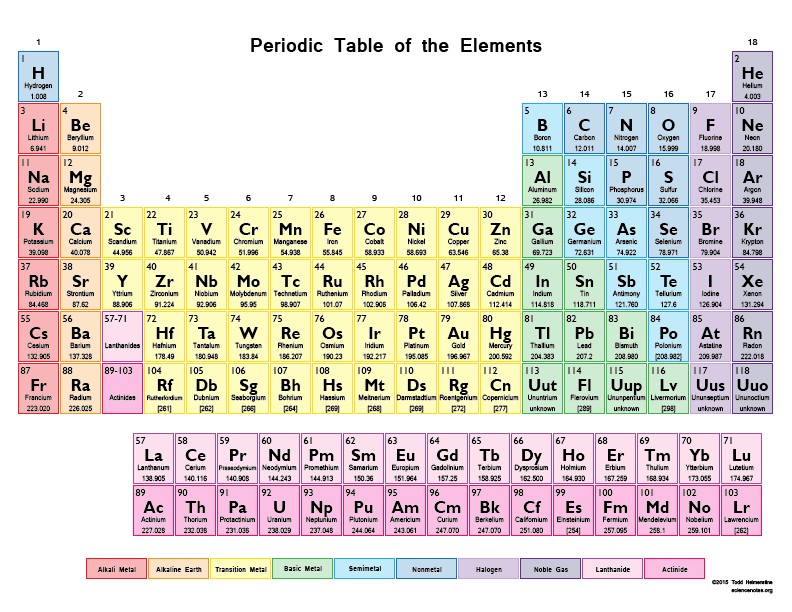
How many protons are in a sodium atom? (tap to enlarge the periodic table)

(a)  

42.

 13756Ba\frac{137}{56}Ba  How many neutrons does this barium isotope have?


(a)  
43.
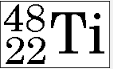
How many protons does this isotope of titanium have?
a)
48
b)
22
c)
26
d)
70
44.

What do these isotopes of carbon all have in common? 126C\frac{12}{6}C     146C  \frac{14}{6}C\ \       166C\frac{16}{6}C  

a)

neutrons & mass number

b)

atomic number and neutrons

c)

atomic number and electrons

d)

protons, atomic number, and mass number
45.

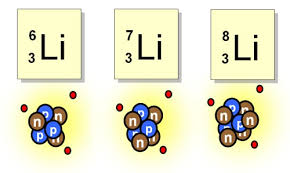
Which atom has 4 neutrons?

a)

lithium-6

b)

lithium-7

c)

lithium-8

d)

they have the same # of neutrons