
 Worksheets
8.9AB Practice
Total questions: 41
Worksheet time: 22mins
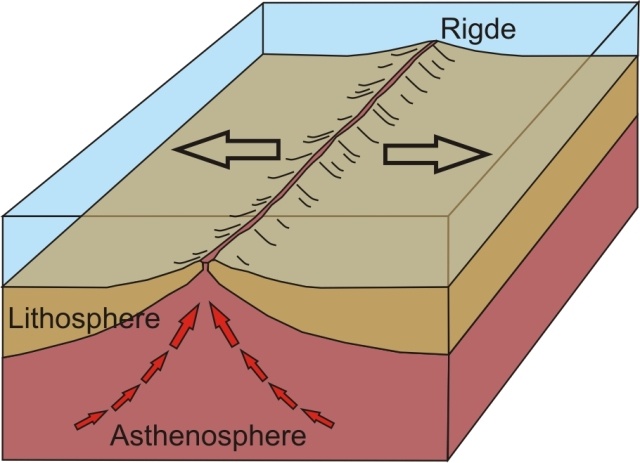
A mid-ocean RIDGE is located at the boundary of two tectonic plates. Which diagram correctly models the relative plate motion on each side of a mid ocean ridge?


The San Andreas fault is a transform fault. The map below shows a student's approximation of where the fault line crosses through the United States. Students were asked to make maps predicting which way land would most likely move over thousands of years.


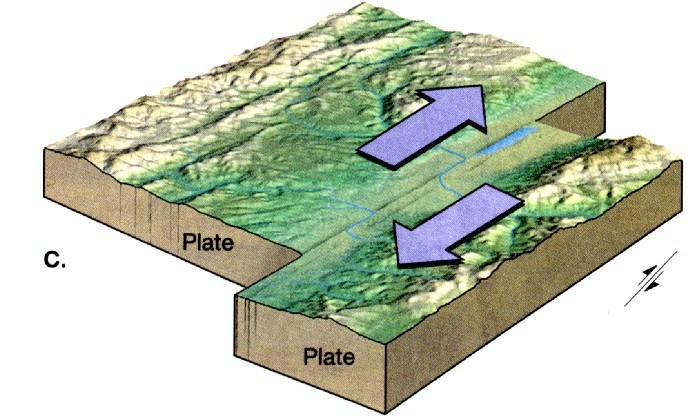
The image shows a plate boundary. Arrows have been added to indicate the movement of the plates.What plate boundary feature is also shown?
A ridge formed by an inactive convergent boundary
A valley forming at an active divergent boundary
A fault forming at an active transform boundary
A volcano formed by an active transform boundary

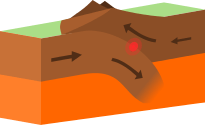
The diagram shows a model of the movement of two tectonic plates. When the plates collide, on plate often moves below the other plate. The rising magma that can result from this type of plate movement may produce-
fossil layers
volcanic islands
deep-sea sediment
seafloor spreading

The model below shows two continental plates. The folded mountains in this model form at which type of plate boundary?
Transform boundary
Divergent boundary
Subduction boundary
Convergent boundary
Scientists theorized that the continents were once joined together even before they had modern evidence from rocks and fossils. Using only maps, they observed that -
continents with the most temperate climates were found near the Equator.
the oceans have become smaller throughout the history of Earth.
the shapes of continents appeared to allow them to fit together.
most of the larger land masses are in the Northern Hemisphere.
The earthquakes experienced in California are related to tectonic plates because these catastrophic events are the result of -
two tectonic plates sliding past each other.
tectonic plates melting as they slide into the mantle.
tectonic plates being weathered over time.
two tectonic plates pulling away from each other.
One piece of evidence that supports the Theory of Plate Tectonics is the discovery of what in both South America and Africa?
The ancient atmosphere in both places was identical.
The rates of weathering of rock are similar.
Fossil remains of the same land-dwelling animal.
Plants on both continents have similar flowers.
Which of the following features is likely to form where two tectonic plates push toward each other?
Ocean shoreline
Mountain range
Mid-ocean ridge
Rift valley

Which student correctly identified the geologic process that formed the Himalayan mountains?
1
2
3
4


Fossil records indicate that the continents were once connected. How do fossil records support this claim?
We have been able to transport the same types of fossils from one continent to another.
Fossils of the same organism have been found on continents that are now separated by oceans.
Some continents contain fossils of many different types of organisms.

One piece of evidence for Plate Tectonics is that--
some continents appear to fit together like a puzzle.
we have video footage of the plates actually moving.
all continents have formed from volcanic eruptions.
the continents are no longer moving.
Which of the following is NOT evidence to support the theory of plate tectonics?
Fossils
Continental fit
Glaciers
Sand Erosion
Alfred Wegener proposed the existence of a super-continent he named __________.
Pangea
Super Earth
Patagonia
Eurasia
Process by which new ocean crust forms.
Seafloor spreading
Continental drift
Mid-ocean ridge
Rift

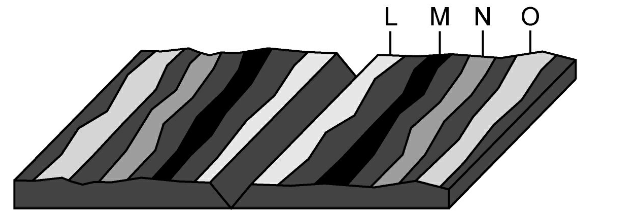
Harry Hess used magnetic reversal striping to provide evidence for which of the following theories?
Continental Drift
Seafloor Spreading
Plate Tectonics
None of the above
Which of the following best describes a proton?
It has a positive charge and the same mass as an electron
It has a neutral charge and the same mass as an neutron
It has a positive charge and the same mass as an neutron
It has a negative charge and the same mass as an electron


What landform would most likely form at this plate boundary? Choose 2 correct answers.
mountains
volcanoes
trenches
mid-ocean ridges
What did Wegener name the large supercontinent where all the continents were joined together?
Wegenerland
Gondwanaland
Laurasia
Pangaea
Wegener used matching mountain ranges across different continents as evidence to support his hypothesis of Continental Drift.
true
false
Wegener used matching matching fossils of the same organisms on different continents as evidence to support his hypothesis of Continental Drift.
true
false
Who first proposed the idea of seafloor spreading?
Alfred Wegener
Harry Hess
James Hutton
Nicolaus Copernicus
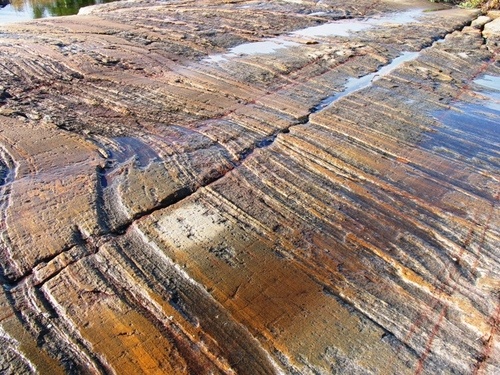

Younger crust being found near mid-ocean ridges supports the idea of Plate Tectonics because---
this indicates that new crust is being formed over time, pushing old crust outward.
this indicates that volcanoes are able to take place in different places on the Earth.
this indicates that new crust is never formed.
this indicates that the continents are stationary.

This landform is known as a _________ and forms at _________ plate boundaries.
mountain; transform
faultline; transform
faultline; convergent
trench; divergent

