
 Worksheets
Practice Test - Atomic Structure
Total questions: 40
Worksheet time: 28mins
Name
Class
Date
1.
The Atomic number of a atom equals the number of?
a)
Protons
b)
Neutrons
c)
Electrons
d)
Protons plus neutrons
2.
The Nucleus makes up the mass of an atom that contains which two subatomic particles?
a)
Electrons and protons
b)
Protons and neutrons
c)
Neutrons and electrons
3.
If oxygen has 8 protons and 7 electrons, what is its charge?
a)
-1
b)
+1
c)
+7
d)
-8
4.
Which of the following in an isotope of Boron- 11
a)
Carbon -11
b)
Nitrogen -13
c)
Boron-11
d)
Boron-12
5.
Which particle has a positive charge?
a)
electron
b)
orbital
c)
proton
d)
neutron
6.
Choose the particle that has no charge.
a)
nucleus
b)
neutron
c)
proton
d)
electron
7.
This particle determines what element you have - the elements identity.
a)
electron
b)
proton
c)
neutron
d)
valence shell
8.
What is the mass of a proton and a neutron?
a)
1amu
b)
2grams
c)
13amu
d)
10cm
9.
This causes the mass of the nucleus to increase.
a)
adding an electron
b)
adding a neutron
c)
more orbitals
d)
adding negatively charged particles
10.
An electron has a _____ charge.
a)
negative
b)
positive
c)
neutral
11.
Describe an Electron Cloud?
a)
the mist outside of an atom
b)
home of the protons
c)
where electrons are located
d)
nucleus
12.
Which particles make up the nucleus of an atom?
a)
protons and neutrons
b)
electrons and protons
c)
electrons, protons, and neutrons
d)
electrons and neutrons
13.
An element with a mass number of 10 and an atomic number of 6 has how many protons?
a)
5
b)
8
c)
6
d)
10
14.
An element with a mass number of 11 and an atomic number of 5 has how many neutrons?
a)
11
b)
5
c)
6
d)
16
15.
An atom has 10 protons, 15 neutrons and 10 electrons what is its mass number.
a)
20
b)
10
c)
5
d)
25
16.
Matter that cannot be broken down into a simpler substance – building blocks of life.
a)
neutron
b)
atom
c)
electron
d)
quarks
17.
Elements on the periodic table increase by...
a)
atomic mass
b)
size
c)
mass number
d)
atomic #
18.
An atom has 13 protons, 15 neutrons and ___ electrons what is its mass number?
a)
13
b)
26
c)
28
d)
15
19.
Most of the mass of an atom is contained here.
a)
electron orbitals
b)
nucleus
c)
shells
d)
atomic #
20.

What is the number of protons that the element in this image contain?
a)
14
b)
7
c)
15
d)
18
21.

Which letter represents the nucleus?
a)
A
b)
B
c)
D
d)
E
22.
Which letter represents an electron?
a)
A
b)
B
c)
C
d)
D
23.

What is the atomic mass of the atom pictured?
a)
9
b)
10
c)
18
d)
19
24.
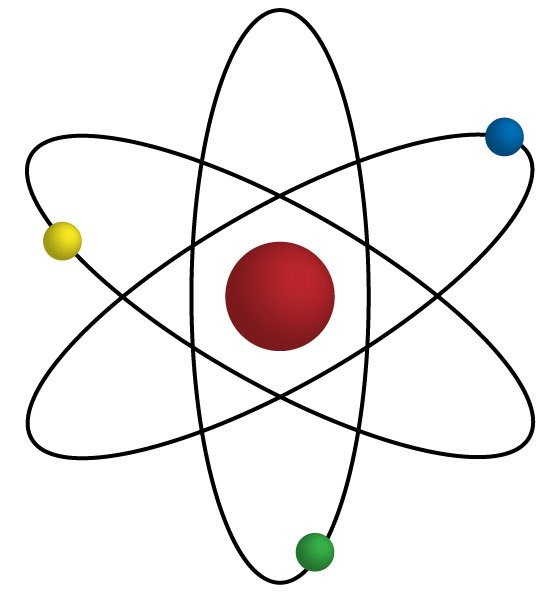
What are the 3 subatomic particles?
a)
elements, compounds, mixtures
b)
neutrons, isotopes, and electrons
c)
positives, negatives, and neutrals
d)
protons, neutrons, and electrons
25.
Atoms of the same element must always have the same number of _________
a)
electrons
b)
neutrons
c)
isotopes
d)
protons
26.
Isotopes have different numbers of
a)
protons
b)
neutrons
c)
electron
d)
properties
27.
What quantities vary between isotopes of an element?
a)
protons, electrons, and atomic mass
b)
protons, electrons, and atomic number
c)
neutrons and electrons
d)
neutrons and atomic mass
28.
Ions are:
a)
atoms with a positive or negative charge
b)
atoms with no charge
c)
atoms with ONLY a positive charge
d)
atoms with ONLY a negative charge
29.
Which 2 particles have about the same mass and contribute the entire mass of the atom?
a)
protons & neutrons
b)
neutrons and electrons
c)
protons and electrons
30.
Atoms of the SAME element but with different MASSES are called...
a)
isotopes
b)
anions
c)
ions
d)
cations
31.
If an atom becomes NEGATIVELY charged, what has happened?
a)
gains an electron
b)
gains a proton
c)
loses an electron
d)
loses a proton
32.
Isotopes of the same element contain the same number of protons but different number of...
a)
neutrons
b)
electrons
c)
both
d)
neither
33.
An atom is considered NEUTRAL when it has the same number of _________ and __________.
a)
protons and neutrons
b)
protons and electrons
c)
electrons and neutrons
d)
same number of all three
34.
An element's ATOMIC NUMBER tells you how many ____________ it has.
a)
protons
b)
electrons
c)
neutrons
35.
An ion with a +1 charge tells you that it has...
a)
more protons
b)
more electrons
c)
more neutrons
36.
A neutral atom would become an ion that has a charge of 2+ by
a)
Losing two protons
b)
Losing two neutrons
c)
Losing two electrons
37.
A negative ion is a
a)
cation
b)
anion
38.
Cations are
a)
positive ions
b)
negative ions
c)
on the right side of the periodi table.
d)
nonmetals
39.
Anions are
a)
positive ions
b)
negative ions
c)
on the right side of the periodi table.
d)
nonmetals
40.
How many electrons can the 1st electron shell hold?
a)
2
b)
4
c)
8
d)
16
100 %

