
 Worksheets
Meiosis
Total questions: 37
Worksheet time: 19mins
With mitosis you get _________ cells, but with meiosis, you get__________.
4 different, 2 identical
4 identical, 2 different
2 different, 4 identical
2 identical, 4 different
How many times in meiosis does the cell division (cytokinesis) take place?
2
4
3
1
A fruit fly has 4 chromosomes in each of its haploid cells. How many would be present in its diploid cells?
20
2
8
16
What is reason that meiosis is important?
Each gamete requires double the number of chromosomes as a body cell.
Each gamete requires half the number of chromosomes as a body cell.
Each gamete requires triple the number of chromosomes as a body cell.
Each gamete should have the same number of chromosomes as a body cell.
Due to meiosis, during fertilization the male and female sex cells will provide...
Double their chromosomes each
Half of their chromosomes each
All of their chromosomes each
What type of cells are formed by meiosis?
body
gametes
somatic
What would be the problem if mitosis and not meiosis produced sex cells?
Each generation would have twice the number of chromosomes as the previous generation.
Each generation would have the exact same DNA as the previous generation.
There would only be half the number of reproductive cells
All of these choices would be problems.
How many chromosomes are found in human gametes (haploid cells)?
23
46
92
8
Cell with two copies of every chromosome.
haploid
diploid
homologous
tetrad
Cell with only one copy of every chromosome.
haploid
diploid
homologous
tetrad
Each pair of homologous chromosomes grouped up to make a set of four.
haploid
diploid
homologous
tetrad
Process with eight stages
meiosis
mitosis
Process with four stages.
mitosis
meiosis
Crossing over occurs.
mitosis
meiosis
Produces four haploid cells.
mitosis
meiosis
Produces two diploid cells.
mitosis
meiosis
Allows an organism to grow and repair damage.
mitosis
meiosis
Produces cells for sexual reproduction.
mitosis
meiosis
Ends with diploid number of chromosomes in each cell.
Mitosis
Meiosis
Both
Chromosomes condense
Mitosis
Meiosis
Both
produces haploid cells
Mitosis
Meiosis
Both
Produces non-identical cells.
Mitosis
Meiosis
Both
Which process begins with a diploid parent cell?
Mitosis
Meiosis
Both
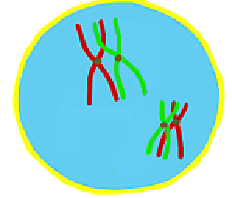
Which meosis phase is shown?
Prophase 1
Metaphase 1
Anaphase 1
Telophase 1
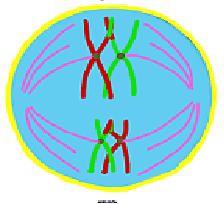
Which meosis phase is shown?
Prophase 1
Metaphase 1
Anaphase 1
Telophase 1
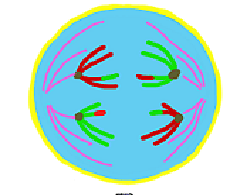
Which meosis phase is shown?
Prophase 1
Metaphase 1
Anaphase 1
Telophase 1
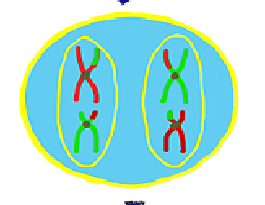
Which meosis phase is shown?
Prophase 1
Metaphase 1
Anaphase 1
Telophase 1
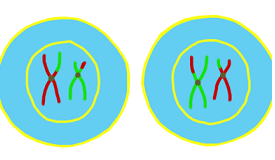
Which meosis phase is shown?
Prophase II
Metaphase II
Anaphase II
Telophase II
Cytokinesis
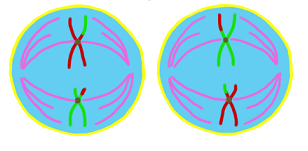
Which meosis phase is shown?
Prophase II
Metaphase II
Anaphase II
Telophase II
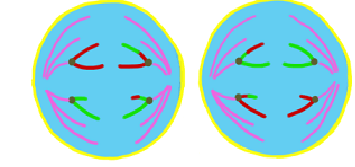
Which meosis phase is shown?
Prophase II
Metaphase II
Anaphase II
Telophase II
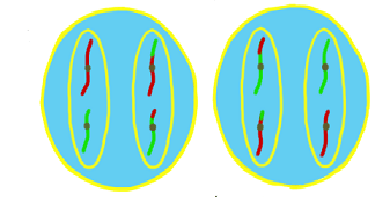
Which meosis phase is shown?
Prophase II
Metaphase II
Anaphase II
Telophase II

