
 Worksheets
How is there so much diversity?
Total questions: 37
Worksheet time: 16mins

Biologically speaking, what is a cell?
the smallest unit of life
where prisoners reside
wrapping on a candy
the sum of chromosomes

Why do human cells divide?
to repopulate earth
for reproduction
for growing and repairing the body
to increase genetic diversity

Here is the process of making chromosomes. Why is it important?
If DNA isn't condensed, then it cannot be transcribed to Messenger RNA.
Histones and proteins allow for condensed chromosomes.
The double helix is impossible to read without being in an X shape.
If DNA doesn't copy exactly, the new cell may not function properly.

How many daughter cells are formed in Mitosis?
1
2
3
4
5

TRUE/FALSE: You have a new body every seven years.
TRUE
FALSE

What does the image show?
All the different DNA in your body being turned on and off.
How different segments of DNA can be expressed in different cells.
The method by which our bodies fight off disease.
All the cell types in the human body.
When cell division goes unchecked, it is called:
meiosis
gametes
mitosis
cancer
stem cells

What is DNA made of?
carbon
hydrogen
oxygen
nitrogen
phosphorus
What is DNA made of?
nitrogenous base
proteins
sugar-phosphate backbone
electrolytes
chromosomes

If two parents that are homozygous recessive for a trait have children, what are the chances that the trait will be expressed in the children?
0%
25%
50%
75%
100%

If two parents that are heterozygous for a dominant trait have children, what are the chances that the trait will be expressed in the children?
0%
25%
50%
75%
100%

What will be the resulting mRNA from this DNA sequence:
GAT-TAC-AGA-TTA-CAT?
CTA-ATG-TCT-AAT-GTA
GAU-UAG-UGA-UUA-GUT
CUA-AUG-UCU-AAU-GUA
CAT-ACA-TAC-ATA-TAG

Amino acids are joined together in order to form
DNA
ribosomes
proteins
RNA


What is the correct sequence?
RNA --> DNA --> Protein
Protein --> RNA --> DNA
DNA --> RNA --> Protein
DNA --> Protein --> RNA

If a segment of double-stranded DNA has 40 percent A, how much of it is C?
40
10
15
20

What are the functions of genes?
instructions for producing proteins
instructions for producing DNA
instructions for producing lipids
they have no function

Which answer models central dogma?
DNA to protein to RNA
RNA to DNA to protein
DNA to RNA to protein
protein to RNA to DNA

In which organelle does transcription occur?
Nucleus
Ribosome
Mitochondria
Golgi apparatus

At which organelle does translation occur?
Nucleus
Ribosome
Mitochondria
Golgi apparatus
Proteins aren't made in the nucleus because they are too big to escape the ______________:
Nuclear Membrane
Cell Membrane

When an extra base is inserted into the DNA sequence of a gene, the protein doesn't work. Which explains why?
the base increases rate of translation
the base causes DNA to be transcribed in opposite direction
the inserted base causes the codons in the sequence to be shifted and read differently
the base signals enzymes to translate DNA rather than RNA


What type of mutation is shown in the diagram?
Point mutation - missense
Frameshift Mutation - deletion
Frameshift Mutation - addition
Point mutation - nonsense

Name the process happening at number 1 in the diagram.
DNA Replication
Translation
Mutation
Transcription

a photograph or picture of chromosomes grouped in ordered pairs is a ______________
pedigree
Punnett Square
Venn Diagram
Karyotype

Which sex chromosomes would indicate a typical human male?
XX
X
XY
XXY
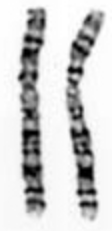
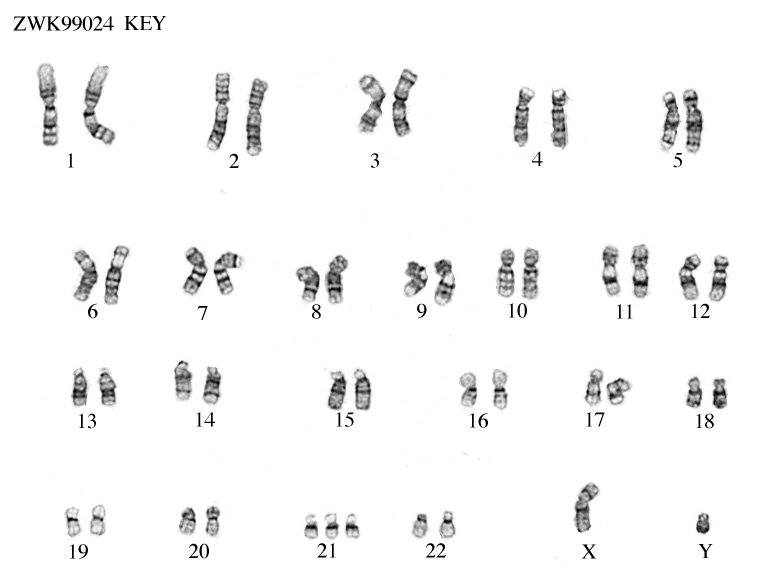
What is the mutation in this persons chromosomes?
There is only one X
7 is shaped like a hockey stick
There's an extra 21
1 is too curved

How many daughter cells are produced from meiosis ?
10
6
4
2

A fertilized egg is called
egg
lettuce
zygote
sperm


What causes genetic variation in meiosis?
chromosomes lining up
crossing over of chromosomes
separation of chromosomes
chromosomes pulling apart

So, with all that you know, why is there so much diversity within species?
Stem Cells
Meiosis
Random Fertilization
Mitosis
Mutations

