wayground logo

Free Printable Worksheets

Font size

S
M
L
XL
Worksheets

Plate Tectonics

Total questions: 100

Worksheet time: 3hrs 35mins

Name
Class
Date
1.
The outer layer of the Earth is called the __________.
a)
core
b)
crust
c)
mantle
d)
plates
2.
The scientific theory that the Earth's crust is made of moving plates.
a)
quakes
b)
seismic
c)
plate tectonics
d)
rotation
3.
In the early 1900's Alfred Wegener found evidence of identical rock types, identical fossils, and matching mountain ranges on different continents that are on opposite sides of an ocean.  What could be the explanation for these observations?
a)
All animals can swim extremely long distances 
b)
These observations have no significant meaning.
c)
In the past, continents were not located where they are today but were joined together 
d)
mountains are made through the same processes therefore they are very similar in their structure throughout the entire world.
4.
This layer of the core is made of liquid metals.
a)
outer core
b)
inner core
c)
middle core
d)
apple core
5.
As you travel from the inner core to the crust, how would temperature, pressure and density of the material change?
a)
The would all increase
b)
The would all decrease.
c)
Nothing, the layers are made of the same material throughout
d)
Temperature would decrease, but pressure and density would increase
6.
Deep cracks in the Earth's crust are called
a)
faults
b)
tear
c)
twist
d)
shear
7.
As you travel from the inner core to the crust, how would temperature, pressure and density of the material change?
a)
The would all increase
b)
The would all decrease.
c)
Nothing, the layers are made of the same material throughout
d)
Temperature would decrease, but pressure and density would increase
8.
The Earth is made up of two types of crust.  Which is more dense?
a)
Oceanic crust 
b)
Continental crust
9.
What is Pangaea?
a)
The name of a German Scientist
b)
the name of the supercontinent that existed millions of years ago
c)
another name for continental drift
d)
the name of an ancient fossil
10.
Most geologists think that the movement of Earth's plates is caused by
a)
conduction
b)
earthquakes
c)
convection currents in the mantle
d)
Earth's magnetic field.
11.
A collision between two pieces of continental crust at a converging boundary produces a
a)
mid ocean ridge
b)
deep ocean trench
c)
rift valley
d)
mountain range
12.
Mid ocean ridges are
a)
found in all of Earth's oceans
b)
found only in the Pacific Ocean
c)
located mostly along coastlines
d)
long deep ocean trenches
13.
What is happening at Z?
a)
mid-ocean ridge
b)
subduction zone
c)
transform boundary
d)
sea floor spreading
14.
Which type of plate boundary occurs at Y?
a)
divergent
b)
convergent
c)
transform
d)
sea floor spreading
15.
Why does cooler material sink while warmer material rises?
a)
Cooler material is more dense.
b)
Hot material is more dense.
16.
Name the boundary
a)
convergent boundary
b)
divergent boundary
c)
transform boundary
d)
sergent boundary
17.
Name the boundary
a)
convergent boundary
b)
divergent boundary
c)
transform boundary
d)
sergent boundary
18.
Name the boundary
a)
convergent boundary
b)
divergent boundary
c)
transform boundary
d)
sergent boundary
19.
Convection currents cause the crust to move.
a)
True
b)
False
20.
What is the thickest layer? 
a)
Crust 
b)
Mantle 
c)
Outer Core 
d)
Inner Core
21.
What is the thickest layer? 
a)
Crust 
b)
Mantle 
c)
Outer Core 
d)
Inner Core
22.
What landform is created when two continental plates collide? 
a)
Ocean Basin
b)
Volcano
c)
Canyon
d)
Mountain Range 
23.
The process that continually adds new material to the ocean floor is 
a)
Faulting
b)
Plate Movement
c)
Seafloor Spreading
d)
Ocean Construction Zone
24.
What are the processes of Convergent Plate Boundaries? 
a)
Seafloor Spreading
b)
Subduction and Collision
c)
Slide
d)
Collision and Slide
25.
This layer of Earth is the thickest part
a)
crust
b)
outer core
c)
mantle
d)
inner core
26.
What was the name given to all the continents when they were joined as one super continent? 
a)
Supreme Continent
b)
Eurasia
c)
Plate tectonics
d)
Pangea
27.
Which of these layers is ALL solid iron and nickle?
a)
inner core
b)
outer core
c)
lithosphere
d)
mesosphere
28.
Which layer of Earth is located above the outer core?
a)
crust
b)
inner core
c)
mantle
d)
lithosphere
29.
The layer that makes up most of the earth's mass and volume is the
a)
crust
b)
mantle
c)
core
d)
asthenosphere
30.
Which of the following occurs because of convection currents?
a)
Tectonic plates on the crust move.
b)
The mantle increases in size.
c)
Pressure in the crust increases.
d)
Pressure in the crust decreases.
31.
Scientists think that convection currents that move the plates flow in Earth's
a)
Continental crust
b)
Oceanic crust
c)
Asthenosphere
d)
Lithosphere
32.
The mantle of Earth is made partly of magma. When magma rises and sinks, this is called ______________. 
a)
a conduction current
b)
a hot spot
c)
a volcanic eruption
d)
a convection current
33.
What is the order of the layers? 
a)
inner core, lithosphere, mesosphere, outer core, asthenosphere
b)
asthenosphere, lithosphere, mesosphere, outer core, inner core
c)
lithosphere, asthenosphere, mesosphere, outer core, inner core
d)
crust, core, mantle
34.
If you traveled from the center of Earth to the surface, the pressure would...
a)
increase
b)
decrease
c)
stay the same
d)
unsure
35.
As you travel from the inner core to the crust, how would temperature, pressure and density of the material change?
a)
The would all increase
b)
The would all decrease.
c)
They would stay the same.  
d)
Temperature would decrease, but pressure and density would increase. 
36.
What would happen to the convection currents if the heat from the inner core disappeared? 
a)
They would stop. 
b)
They would change directions. 
c)
It would not change. 
d)
They would speed up. 
37.
The physical layer of Earth made of solid rock and soil is called the ___________. 
a)
mesosphere
b)
lithosphere
c)
asthenosphere
d)
mantle
38.
Where does the heat come from that drives this convection current in the mantle? 
a)
The sun
b)
The crust
c)
the mantle
d)
the core
39.
Which of the following occurs because of convection currents?
a)
Tectonic plates on the crust move.
b)
The mantle increases in size.
c)
Pressure in the crust increases.
d)
Pressure in the crust decreases.
40.
Where does the heat come from that drives this convection current in the mantle? 
a)
The sun
b)
The crust
c)
the mantle
d)
the core
41.
Which liquid is the least dense?
a)
oil
b)
water
c)
syrup 
d)
plastic bottle
42.
Which box has a higher density?  
a)
Box A
b)
Box B
c)
cannot be determined
d)
they are the same
43.
Created by a divergent boundary.
a)
Rocky Mountains
b)
Mariana Trench
c)
Mid Atlantic ridge
44.
Mountains form from ...
a)
plates sliding past one another
b)
collision of plates
c)
plates moving away from each other
45.
During sea floor spreading, molten material rises up from the mantle...
a)
along the continents
b)
at the mid ocean ridges
c)
deep ocean trenches
d)
at north and south poles
46.
Associated with transform boundaries.
a)
Volcanoes
b)
mountains
c)
trenches
d)
earthquakes
47.
This land formation occurs at a divergent continental/ continental boundary.
a)
mid ocean ridge
b)
deep ocean trench
c)
pacific hot spot
d)
rift valley
48.
What happens to temperature as you go deeper in the Earth?
a)
decreases
b)
increases
c)
fluctuates
d)
remains the same
49.
A ______ is a section of the lithosphere that slowly moves over the asthenosphere, carrying large slabs of continental and oceanic crust.
a)
wedge
b)
plate
c)
chunk
d)
fault
50.
A break in Earth's crust along which rocks move is called a ________.
a)
plate
b)
rift
c)
fault
d)
breach
51.
_________ are vibrations that travel through Earth carrying the energy released during an earthquake.
a)
Seismic Waves
b)
Rumbles
c)
Plate Tectonics
d)
Convection Currents
52.
What is the name of the single landmass that began to break apart 200 million years ago?
a)
Panthalassa
b)
Laurasia
c)
Gondwanna
d)
Pangaea
53.
The movement of fluid, caused by differences in temperature, that transfers heat from one part of the fluid to another is _____________.
a)
Convection current
b)
Seismic waves
c)
Sea-floor spreading
d)
Conduction current
54.
The process by which molten material adds new oceanic crust to the ocean floor is called ___________.
a)
Divergent boundary
b)
Sea-floor spreading
c)
Convergent boundary
d)
Renovating 
55.
What is an undersea mountain chain where new ocean floor is produced?
a)
Rift valley
b)
Deep-ocean trench
c)
Mid-ocean ridge
d)
Transform bounda
56.
What is the process by which oceanic crust sinks beneath a deep-ocean trench and back into the mantle at a convergent plate boundary?
a)
Subduction
b)
Induction
c)
Abduction 
d)
Reduction
57.
_____________ is a plate boundary where two plates move away from each other.
a)
Convergent boundary
b)
Transform boundary
c)
Divergent boundary
d)
Insurgent boundary
58.
A _____________ is when two plates move past each other in opposite directions.
a)
emergent boundary
b)
divergent boundary
c)
transform boundary
d)
convergent boundary
59.
A _________ is a valley that forms where two plates move apart.
a)
Fissure
b)
Rift valley
c)
Sea-floor spreading
d)
Fault
60.
A plate boundary where two plates move away from each other is called
a)
Divergent Boundary
b)
Convergent Boundary
c)
Transform Boundary
d)
Subduction
61.
A plate boundary where two plates move away from each other is called
a)
Divergent Boundary
b)
Convergent Boundary
c)
Transform Boundary
d)
Subduction
62.
A boy touches a hot cup and burns his finger.  This is an example of
a)
Radiation
b)
Conduction
c)
Convection
d)
Convection Current
63.
Scientists hypothesize that a super continent existed 200 million years ago.  This continent is called
a)
America
b)
Super Earth
c)
Pangea
d)
Eurasia
64.
A Plate Boundary where two plates move toward each other is called
a)
Convergent Boundary
b)
Divergent Boundary
c)
Transform Boundary
d)
Subduction
65.
What is the difference between the lithosphere and asthenosphere that makes up the mantle?
a)
The lithosphere is ismade of dense solid meal whle the asthenosphere is made of liquid molten metal
b)
The lithosphere is a mixture of gasses while the asthenosphere is made of solid rock
c)
The lithosphere is molten rock that moves while the asthenosphere is ridid and thin
d)
The lithosphere is made of solid rock while the asthenosphere is more flexible hot rock that moves.
66.
A Plate Boundary where two plates move toward each other is called
a)
Convergent Boundary
b)
Divergent Boundary
c)
Transform Boundary
d)
Subduction
67.
You an feel the sun's rays on your face as you lay by the beach on a warm summer day.  Which type of heat transfer is this an example of?
a)
Conduction
b)
Convection
c)
Radiation
d)
Radioactive
68.
_______________ Currents within the mantle cause the earth's plates to move and shift s molten material rises and falls due to density and gravity
a)
Convection
b)
Radiation
c)
Conduction
d)
Wind
69.

Earth's plates meet at ____________.

a)

plate tectonics

b)

plate boundaries

c)

continental drift

d)

oceans

70.

Breaks in the crust called __________ form where plates meet.

a)

mountains

b)

rift valleys

c)

faults

d)

trenches

71.

Plates slide past each other at _________________ boundaries.

a)

divergent

b)

convergent

c)

transform

d)

universal

72.

A __________ forms where plates diverge on land.

a)

rift valley

b)

mid-ocean ridge

c)

mountain

d)

trench

73.

________________ currents drive Earth's plate movement.

a)

ocean

b)

atmosphere

c)

wind

d)

convection

74.

Plates slide apart along _____________ boundaries.

a)

convergent

b)

divergent

c)

transform

d)

universal

75.

Which theory describes the motion of the force driving Earth's Plates?

a)

continental drift

b)

plate tectonics

c)

first law of motion

d)

third law of motion

76.

What is the motion of Earth's plates like?

a)

fast and in stages

b)

slow and in stages

c)

fast and constant

d)

slow and constant

77.

The San Andreas fault is an example of which type of boundary?

a)

transform

b)

divergent

c)

convergent

d)

universal

78.

Which feature forms at convergent boundaries?

a)

trench

b)

rift valley

c)

mountain range

d)

mid-ocean ridge

79.
What is a divergent boundary? 
a)
two plates moving towards each other
b)
two plates grinding/sliding past each other.
c)
two plates moving away from each other
d)
plates that don't move at all
80.
What forms at the divergent boundary? 
a)
deep-ocean trench
b)
mid-ocean Ridge
c)
land ridge
d)
the Pacific Ocean
81.
Plates move away from one another at ___________ boundaries.
a)
divergent
b)
convergent
c)
volcanic
d)
submerged
82.
Plates slide grind/slide  past one another at ____________ boundaries.
a)
divergent
b)
convergent
c)
transform
d)
submerged
83.
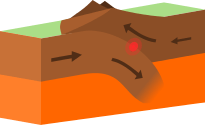
What kind of plate boundary is shown here?
a)
divergent
b)
convergent
c)
transform
d)
strike slip
84.
What is the term for the process by which a heavier, denser plate slides under a less dense plate?
a)
plate boundary
b)
submersion
c)
accretion
d)
subduction
85.
What kind of plate boundary is shown here?
a)
divergent
b)
convergent
c)
transform
d)
subducting
86.
What kind of plate boundary is shown here?
a)
divergent
b)
convergent
c)
transform
d)
submerged
87.
At which plate boundary is crust neither created nor destroyed?
a)
divergent
b)
convergent
convergent
c)
transform
d)
submerged
88.
The lithospheric plates are constantly moving at a rapid rate.
a)
True
b)
False
89.
Some volcanoes are formed without being near plate boundaries.  These are known as
a)
deep ocean trenches
b)
subduction zones
c)
faults
d)
hot spots
90.
Which land feature forms at a divergent boundary?
a)
mid-ocean ridge
b)
deep-ocean trench
91.
Which process occurres at a convergernt plate boundary?
a)
sea-floor spreading
b)
subduction
92.
What is the name of the area around the Pacific Plate in which many earthquakes occur and volcanoes are formed?
a)
San Andres Fault
b)
Atlantic Mid-Ocean Ridge
c)
Himalaya Mt. Range
d)
Ring of Fire
93.
The Himalaya Mountains were formed by the collision of 2 continental plates.
a)
True
b)
False
94.
The type of plate boundary where two plates come together is a .....
a)
Convergent Boundary
b)
Divergent Boundary
c)
Transform Boundary
d)
Plate Boundary
95.
Which of the following causes Earth's tectonic plates to move?
a)
Energy from the Sun
b)
Magnetic Pole Reversal
c)
Convection currents in the mantle
d)
Faults in Mountain Ranges
96.
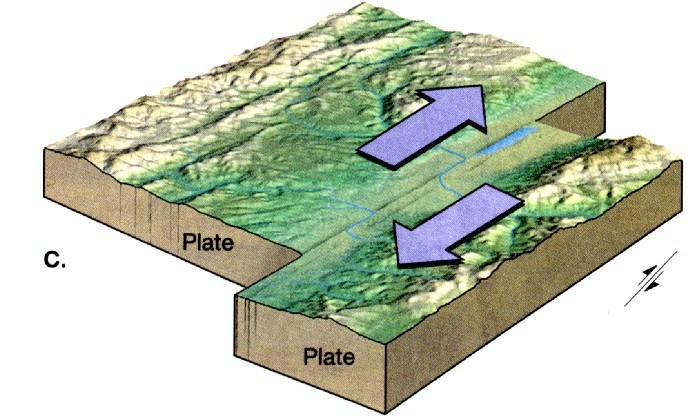
What type of plate boundary is this?
a)
Plate
b)
Divergent
c)
Convergent
d)
Transform
97.
What type of event will occur at this boundary?
a)
Earthquake
b)
Volcano Eruption
c)
Tornado
d)
Mountain Building
98.
A divergent boundary occurs when plates ....
a)
Pull apart
b)
Come together
c)
Slide past each other
d)
subducting
99.
Which of the following is the name of the ancient supercontinent formed 28 Million Years ago.
a)
Pangea
b)
Gondwanda
c)
Laurasia
d)
Neverland
100.
What type of plate boundary is this?
a)
Transform
b)
Convergent
c)
Divergent
d)
Plate