wayground logo

Free Printable Worksheets

Font size

S
M
L
XL
Worksheets

Geology

Total questions: 100

Worksheet time: 1hrs 19mins
Name
Class
Date
1.
What would you be most likely to find at a transform boundary?
a)
Earthquakes
b)
Volcanoes
c)
Mountains
d)
Rift
2.
What would you be most likely to find at a convergent boundary between two pieces of oceanic crust?
a)
Mountains
b)
Rift
c)
Mid-Ocean Ridge
d)
Island Arc
3.
What would you be most likely to find at a convergent boundary between a continental and oceanic plate?
a)
Mountains
b)
Volcanoes
c)
Mid-Ocean Ridge
d)
Rift
4.
What would you be most likely to find at a divergent boundary between two pieces of oceanic crust?
a)
Rift
b)
Mid-Ocean Ridge
c)
Island Arc
d)
Flat land
5.
What would you be most likely to find at a divergent boundary between two pieces of continental crust?
a)
Mid-Ocean Ridge
b)
Mountain
c)
Rift
d)
Island Arc
6.
What would you be most likely to find at a convergent boundary between two pieces of continental crust?
a)
Volcano
b)
Mountain
c)
Rift
d)
Island Arc
7.
A subduction zone is formed...
a)
when one tectonic plate sinks below another
b)
at every type of convergent plate boundary
c)
at every type of divergent plate boundary
d)
at transform boundaries
8.
Whenever a subduction zone is formed a ______ is formed.
a)
Mountain
b)
Island Arc
c)
Rift
d)
Volcano
9.
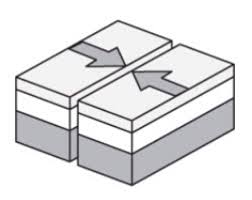
What kind of plate boundary is shown here?
a)
divergent
b)
convergent
c)
transform
d)
subducting
10.
Plates move towards one another at ______________ boundaries.
a)
divergent
b)
convergent
c)
transform
d)
detergent
11.
Plates slide past one another at ____________ boundaries.
a)
divergent
b)
convergent
c)
transform
d)
submergent
12.
The area where two or more plates meet is called a __________________.
a)
fault
b)
plate boundary
c)
plate edge
d)
ring of fire
13.
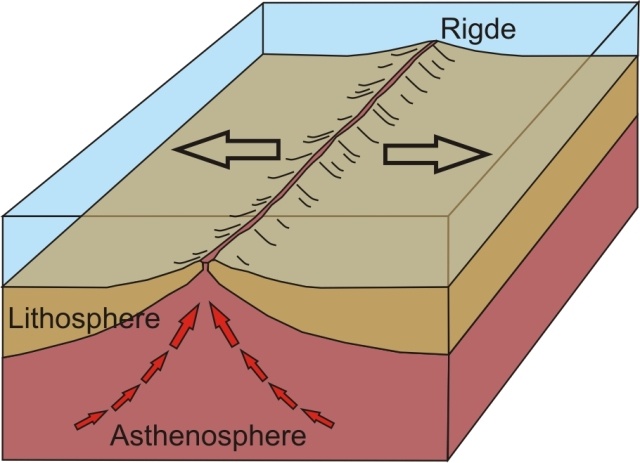
What kind of plate boundary is shown here?
a)
divergent
b)
convergent
c)
transform
d)
submergent
14.
Volcanoes typically form _______________.
a)
along plate boundaries
b)
only under water
c)
only in hawaii
d)
where it is usually hot
15.
Plate movement is caused by ______________.
a)
the rotation of the Earth
b)
ocean tides
c)
convection currents in the mantle
d)
the moon's gravity
16.
The crust and the uppermost mantle make up the ________________.
a)
lithosphere
b)
asthenosphere
c)
atmosphere
d)
hydrosphere
17.
Plates move away from one another at ___________ boundaries.
a)
divergent
b)
convergent
c)
transorm
d)
submergent
18.
A deep crack in the Earth's crust is called a _______________.
a)
canyon
b)
trench
c)
fault
d)
plate
19.
Earthquakes typically occur _________________.
a)
In the middle of tectonic plates
b)
only in California
c)
only in the middle of the ocean
d)
along plate boundaries
20.
What kind of plate boundary is shown here?
a)
divergent
b)
convergent
c)
transform
d)
strike slip
21.
What is the term for a heavier, denser plate sliding under a less dense plate?
a)
plate boundary
b)
submersion
c)
accretion
d)
subduction
22.
The plastic-like layer that is located directly under the lithosphere is known as the ____________.
a)
lithosphere
b)
asthenosphere
c)
atmosphere
d)
photosphere
23.
Name the boundary
a)
convergent boundary
b)
divergent boundary
c)
transform boundary
d)
sergent boundary
24.
In which type of boundary do the plates move away from each other?
a)
convergent
b)
normal
c)
divergent
d)
transform
25.
The area where two or more plates meet is called a __________________.
a)
fault
b)
plate boundary
c)
plate edge
d)
ring of fire
26.
When two tectonic plates are moving away from each other, the boundary between them is called...
a)
Divergent boundary
b)
Convergent boundary
c)
Transform boundary
d)
Subduction
27.
When two tectonic plates slide past each other, neither crashing together, nor pulling apart, the boundary between them is called...
a)
Divergent boundary
b)
Convergent boundary
c)
Transform boundary
d)
Subduction
28.
When two tectonic plates are moving toward each other, the boundary between them is called...
a)
Divergent boundary
b)
Convergent boundary
c)
Transform boundary
d)
Subduction
29.
Sometimes, when two tectonic plates collide, one is pushed below the other; this action at the convergent boundary is called...
a)
Divergent boundary
b)
Convergent boundary
c)
Transform boundary
d)
Subduction
30.
When an oceanic plate is subducted under a continental plate, a deep valley is formed in the ocean. What is this valley called? 
a)
a trench
b)
a rift zone
c)
ocean spreading ridge
d)
Continental crust
31.

When an oceanic plate is pulled away from another oceanic plate,, magma spews from below the crust and this is formed.

a)

a trench

b)

a rift zone or rift valley

c)

new ocean floor at an ocean ridge

d)

continental crust

32.
When convergent plates collide, if both plates are pushed upward, this forms.  
a)
Fissures
b)
Mountain Ranges
c)
Volcanoes
d)
Rock Cycle
33.
The movement of the tectonic plates continually creates new rock on the surface of the earth and pulls old rock back into the mantle and recycles it. This process is called... 
a)
Fissures
b)
Mountain Ranges
c)
Volcanoes
d)
Rock Cycle
34.

A divergent boundary on land creates what feature?

a)

Mid Ocean Ridge

b)

Rift Valley

c)

Subduction Zone

d)

Deep Ocean Trench

35.

When two continental plates converge (collide) what type of crustal feature is formed?

a)

Mid Ocean Ridge

b)

Subduction Zone

c)

Rift Valley

d)

Folded Mountains

36.

The process that occurs at a divergent oceanic boundary that creates new crust (sea floor) is called?

a)

Subduction

b)

Seafloor Spreading

c)

Continental Drift

d)

Volcanism

37.

If an earthquake occurs at the bottom of the ocean floor what could form as result?

a)

Volcano

b)

Tsumani

c)

Tidal Wave

d)

Hurricane

38.

What is the only event associated with transform boundaries?

a)

Volcanoes

b)

Subduction Zones

c)

Tsunamis

d)

Earthquakes

39.

What is the only event associated with ALL plate boundaries?

a)

Volcanoes

b)

Earthquakes

c)

Subduction

d)

Deep Trenches

40.

The only type of crust that will subduct if two plates converge is...

a)

Oceanic

b)

Continental

41.

These are NOT plate boundary features. They are areas where hot mantle plumes push up through the lithospheric plates to create volcanic islands such as Hawaii.

a)

Hotspots

b)

Convergent Boundary

c)

Divergent Boundary

d)

Transform Boundary

42.

Tsunamis are formed from what two types of convergent boundaries?

a)

Continental-Continental

b)

Oceanic-Continental

c)

Oceanic-Oceanic

43.
What was the name given to all the continents when they were joined as one super continent? 
a)
Supreme Continent
b)
Eurasia
c)
Plate tectonics
d)
Pangea
44.
Which of the following occurs because of convection currents?
a)
Tectonic plates on the crust move.
b)
The mantle increases in size.
c)
Pressure in the crust increases.
d)
Pressure in the crust decreases.
45.
Whenever a subduction zone is formed a ______ is formed.
a)
Mountain
b)
Island Arc
c)
Rift
d)
Volcano
46.
Who is the scientist who came up with the continental drift?
a)
Dement
b)
Martin
c)
Hess
d)
Wegner
47.
Oceanic plates separate from each other at a divergent plate boundary at the bottom of the ocean.  Magma comes up and cools between the plates, forming...
a)
a fault
b)
a mid-ocean ridge
c)
a rift valley
d)
a trench
48.
Which of the following words/phrases would correctly fill in the blank?
Continental Drift and Sea-floor spreading were combined into the new more recent theory of ___________.
a)
Hess
b)
Pangaea
c)
Plate Tectonics
d)
Wegener
49.
An ocean trench occurs when...
a)
plates divide and magma rises up
b)
oceanic crust subducts below continental crust
c)
we dig a hole in the ocean
d)
when plates slide past each other
50.
Where can a transform boundary be found?
a)
Himalayan Mountains 
b)
Hawaii
c)
San Andres Fault
d)
Japan
51.
What is represented by the picture? 
a)
Sea-floor spreading
b)
Pangea
c)
How the continents are arranged today
d)
Volcanoes
52.
What causes the crust to move?
a)
convection
b)
conduction
c)
tension
d)
radiation
53.
What evidence helped Wegener support his theory?
a)
Climate
b)
 Fossils
c)
Land Features
d)
All of the Above
54.
What is happening at Z?
a)
mid-ocean ridge
b)
subduction zone
c)
transform boundary
d)
sea floor spreading
55.

What causes Continental Drift?

a)

Wind

b)

Plate movements caused by convection currents

c)

Earthquakes

d)

The oceans currents pushing against land

56.

Continental Drift is an extremely fast process

a)

True

b)

False

57.

What is this picture showing?

a)

Where its hot and where its cold

b)

Earth's Plates

c)

Where the currents are in the ocean

58.

There are three types of boundaries...name them.

a)

(Continental - Continental) Convergent, (Oceanic - Continental) Convergent, Transform

b)

Convergent, Divergent, Transform

c)

Big, Medium, Small

d)

Hot, Warm, Cold

59.

Plates interacting with each other can cause natural disasters.

a)

True

b)

False

60.

What do divergent boundaries allow to come to the surface?

a)

Magma

b)

Water

c)

Hades

d)

Air

61.

What do divergent boundaries create?

a)

The sky

b)

New crust

c)

The ocean

d)

Fishies

62.

What created these?

a)

(Continental - Continental) Convergent Boundaries

b)

(Oceanic - Continental) Convergent Boundaries

c)

Divergent Boundaries

d)

Transform Boundaries

63.

What created this?

a)

(Continental - Continental) Convergent Boundaries

b)

(Oceanic - Continental) Convergent Boundaries

c)

Divergent Boundaries

d)

Transform Boundaries

64.

What created this?

a)

(Continental - Continental) Convergent Boundaries

b)

(Oceanic - Continental) Convergent Boundaries

c)

Divergent Boundaries

d)

Transform Boundaries

65.

What created this?

a)

(Continental - Continental) Convergent Boundaries

b)

(Oceanic - Continental) Convergent Boundaries

c)

Divergent Boundaries

d)

Transform Boundaries

66.

Do you feel you understood Plate Boundaries? Be honest.

a)

Yes

b)

Mostly but I'm still a little confused

c)

A little but I'm still very confused

d)

No

67.
The top layer of the Earth.
a)
Mantle
b)
Crust
c)
Core
d)
Asthenosphere
68.
This layer of Earth is solid Iron and Nickel
a)
Outer Core
b)
Mantle
c)
Inner Core
d)
Crust
69.
What is the name of the layer that contains the uppermost mantle and crust
a)
Asthenosphere
b)
Mesosphere
c)
Lithosphere
d)
Transosphere
70.
This layer of Earth is the thickest part
a)
crust
b)
outer core
c)
mantle
d)
inner core
71.
What are the two types of crust
a)
continental and oceanic
b)
ocean and upper
c)
lower and upper
d)
pizza and subway
72.
Which crust is thicker
a)
ocean
b)
continental
c)
bread
d)
pizza
73.
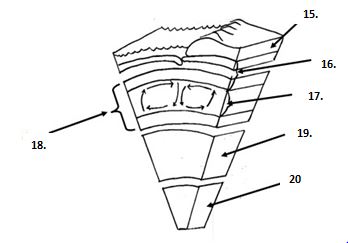
Identify layer  #20.
a)
mantle
b)
asthenosphere
c)
inner core
d)
outer core
74.

What is true about the Earth’s lithosphere AND asthenosphere?

a)

The asthenosphere floats on top of the lithosphere.

b)

The crust and the core make up the lithosphere.

c)

The crust and mantle make up the asthenosphere.

d)

The lithosphere floats on top of the asthenosphere

75.

What is the inner core mostly composed of?

a)

Basalt

b)

Granite

c)

Solid Iron and solid nickel

d)

Molten (liquid) Metals

76.
Which layer of Earth is the thinnest? 
a)
Crust
b)
Mantle
c)
Inner Core
d)
Outer Core
77.
If you traveled from the center of Earth to the surface, the pressure would...
a)
increase
b)
decrease
c)
stay the same
d)
unsure
78.
True or FalseThe most abundant elements in the Earth's crust are silicon and oxygen.
a)
True
b)
False
79.
Which layer of the earth is in the very center?
a)
Crust
b)
Mantle
c)
Outer Core
d)
Inner Core
80.
Which layer of the earth is between the core and the crust?
a)
Crust
b)
Mantle
c)
Outer Core
d)
Inner Core
81.
Which layer of the earth has the lowest temperature?
a)
Crust
b)
Mantle
c)
Outer Core
d)
Inner Core
82.
Which layer of the earth do we live on?
a)
Crust
b)
Mantle
c)
Outer Core
d)
Inner Core
83.
Which layer of the earth is under the highest pressure?
a)
Crust
b)
Mantle
c)
Outer Core
d)
Inner Core
84.
Which layer of the earth is much thinner than the others?
a)
Crust
b)
Mantle
c)
Outer Core
d)
Inner Core
85.
This layer of the earth is made up of soft solid rock that flows in convection currents.
a)
crust
b)
lithosphere
c)
asthenosphere
d)
outer core
86.
This part of the Earth has the greatest temperature
a)
crust
b)
mantle
c)
outer core
d)
inner core
87.
Less dense materials rise to the top.
a)
True
b)
False
88.
The Earth's inner core is 
a)
a layer of hot rock
b)
a dense ball of solid metal
c)
a layer of molten metal
d)
part of Earth's outer skin
89.
The Earth's solid inner core is surrounded by the hot, molten metal of which layer?
a)
Mantle
b)
Outer Core
c)
Crust
d)
Lithosphere
90.
The asthenosphere is part of which layer?
a)
Inner core
b)
Outer Core
c)
Mantle
d)
Crust
91.
The liquid portion at the center of the Earth.
a)
Asthenosphere
b)
Inner Core
c)
Outer Core
d)
Lithosphere
92.
More dense items rise to the top.
a)
True
b)
False
93.
Oceanic crust is thicker than continental crust.
a)
True
b)
False
94.
Melted rock at Earth's surface is called 
a)
lava
b)
the mantle
c)
the lithosphere
d)
magma
95.

Oceanic crust is denser than continental crust.

a)

True

b)

False

96.
Earth's plates move very _________.
a)
humorously
b)
comfortably
c)
quickly
d)
slowly
97.
The layer of Earth between the crust and core is the _______.
a)
crust
b)
core
c)
mantle
d)
fault
98.
_____________ is to break Earth’s surface into pieces.
a)
deposition
b)
erosion
c)
glacier
d)
weathering
99.
________________ is to move broken pieces to a new area.
a)
deposition
b)
erosion
c)
glacier
d)
weathering
100.
______________ is the piling of sediment in a new area.
a)
deposition
b)
erosion
c)
glacier
d)
weathering