
 Worksheets
Review, Review and Review: Biodiversity
Total questions: 100
Worksheet time: 1hrs 14mins
Name
Class
Date
1.

Individuals that are well adapted to their environment will survive and produce:
a)
Fewer mutations
b)
Stronger genes
c)
More offspring
d)
Better traits
2.

According to the cladogram, which organism is most distantly related to the human?
a)
crayfish
b)
rat
c)
perch
d)
frog
3.
Cladograms are constructed by grouping organisms together based on their____________ characteristics.
a)
shared
b)
different
c)
similar
d)
opposite
4.
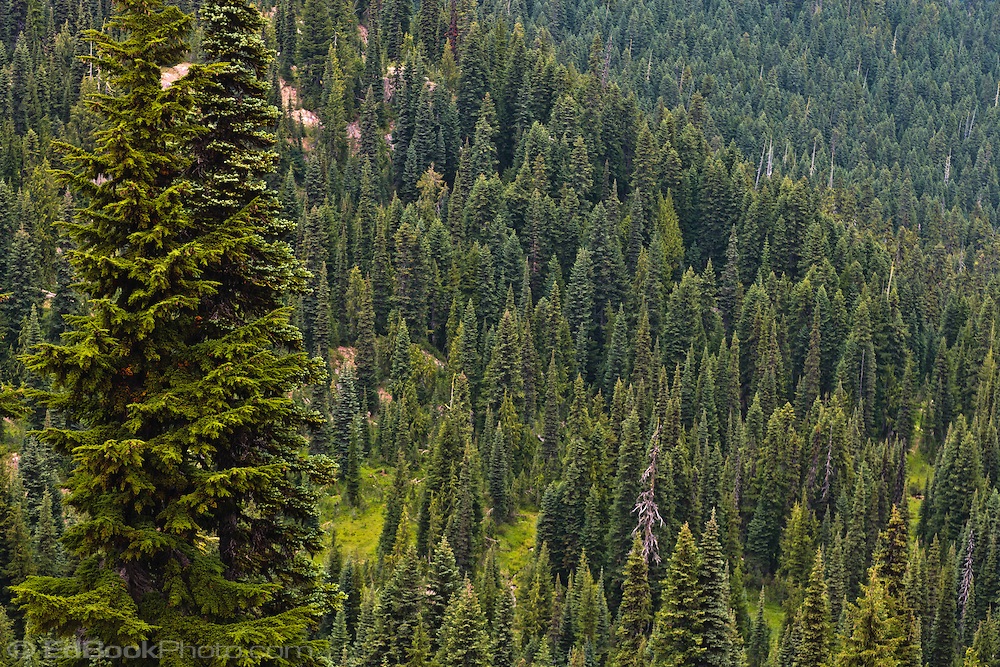
Which biome has coniferous trees (which don't lose their leaves)?
a)
Taiga
b)
Temperate Forest
c)
Tundra
d)
Grasslands
5.
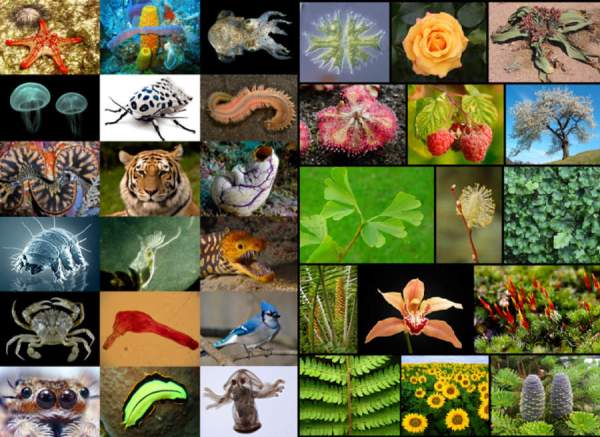
Which biome has the most variety of plants and animals?
a)
Temperate Forest
b)
Rainforest
c)
Tundra
d)
Grasslands
6.

In which 2 biomes can only plants/animals with adaptations survive?
a)
Taiga/Temperate Forest
b)
Grasslands/Desert
c)
Tundra/Desert
d)
Rainforest/Tundra
7.
An otter makes an oil to keep its skin watertight
a)
physiological
b)
structural
c)
behavioral
8.
A grouse drums
a)
structural
b)
physiological
c)
behavioral
9.
protective coloration (blending in with your surrounding colors) is
a)
structural
b)
behavioral
c)
physiological
10.
__________________ is a tool for tracing through generations of family members.
a)
Pedigree
b)
Probability
c)
Purebred
d)
Punnett Square
11.

Chromosomes are found in the ____________ of the cell
a)
Chloroplast
b)
Nucleus
c)
Cytoplasm
d)
Mitochondria
12.

A couple has 6 children, all girls. If the mother gives birth to a 7th child, what is the probability that the seventh child will be a girl?
a)
7 out of 7
b)
6 out of 7
c)
1 out of 2
d)
1 out of 7
13.
B - black, b - brown. Two black mice mate and have some black and some brown mice. What is the genotype of the parents?
a)
BB x Bb
b)
BB x bb
c)
Bb x Bb
d)
Bb x bb
14.

B = brown fur b = white fur
In the Punnett square, what is the probability for white fur?
In the Punnett square, what is the probability for white fur?
a)
0%
b)
25%
c)
50%
d)
75%
15.

What is the genotypic ratio here?
a)
25% blue eye 75 % brown eye
b)
BB = 25% Bb = 50% bb = 25%
c)
BB= 50 % bb = 50%
d)
All brown eye
16.
The female part of the flower is known as the ____.
a)
stamen
b)
anther
c)
filament
d)
pistil
17.
The male part of the flower is known as the _____.
a)
stamen
b)
pistil
c)
ovary
d)
petal
18.

What is #1 pointing to?
a)
ovary
b)
petal
c)
stigma
d)
stamen
19.

What is #8 pointing to?
a)
petal
b)
stamen
c)
pistil
d)
ovary
20.

What is #2 pointing to?
a)
anther
b)
filament
c)
ovary
d)
style
21.

What is #3 pointing to?
a)
stigma
b)
filament
c)
ovary
d)
anther
22.

What is #4 pointing to?
a)
anther
b)
style
c)
stigma
d)
ovary
23.

What is #5 pointing to?
a)
anther
b)
filament
c)
stigma
d)
style
24.

What is #6 pointing to?
a)
stigma
b)
style
c)
ovary
d)
petal
25.

What is #7 pointing to?
a)
anther
b)
ovary
c)
ovule
d)
petal
26.
The yellow, powdery stuff on the stamens
a)
Pollen
b)
Dust
c)
Mites
d)
Germs
27.
The sepal_________
a)
smells good
b)
protects and supports the flower
c)
attracts other animals
d)
produces pollen grains
28.
Which does not belong in the female part of the flower?
a)
style
b)
stigma
c)
filament
d)
ovaries
29.
What plant structure advertises to pollinators?
a)
leaves
b)
roots
c)
stems
d)
flowers
30.
In what part of the flower does fertilization take place?
a)
anther
b)
stigma
c)
ovary
d)
filament
31.
Where is pollen made?
a)
ovary
b)
petal
c)
pistil
d)
anther
32.
What is the sticky part of the flower that catches pollen?
a)
style
b)
stigma
c)
ovary
d)
petal
33.
What part of the flower will turn into a fruit?
a)
petal
b)
ovary
c)
ovule
d)
stamen
34.
What part of the flower will turn into a seed?
a)
ovary
b)
anther
c)
ovule
d)
filament
35.
The thin stalk that supports the anther.
a)
Pistil
b)
Stamen
c)
Anther
d)
Filament
36.
The long stalk-like part that supports the stigma.
a)
Filament
b)
Anther
c)
Stigma
d)
Style
37.
The bottom of the style is this part which produces the eggs or ovules through meiosis.
a)
Pollen
b)
Ovary
c)
Stigma
d)
Pistil
38.
The flower parts that are a varied color
a)
Seed
b)
Petals
c)
Stem
d)
Leaves
39.
The part of the flower that is under the petals
a)
Stem
b)
Roots
c)
Sepal
d)
Stalk
40.
The male part of the plant that sits on top of the filament
a)
Stamen
b)
Stigma
c)
Anther
d)
Style
41.
This part is responsible for collecting the pollen so that reproduction can occur
a)
style
b)
pistil
c)
stamen
d)
stigma
42.
True/False: Pollination can occur within the same flower.
a)
True
b)
False
43.
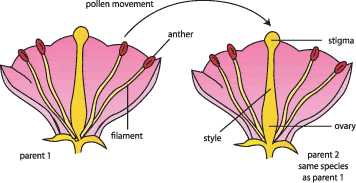
True/False: Pollination can occur between flowers of the same plant.
a)
True
b)
False
44.

True/False: Pollination can occur between flowers of the different plants of the same species.
a)
True
b)
False
45.
I have large petals and are usually brightly colored. How am I pollinated?
a)
By animals
b)
By birds
c)
By insects
d)
All of the above
46.
I am a flower that produces nectar. What is the function of the nectar?
a)
To provide food for the flower
b)
To attract pollinators
c)
To attract animals to disperse the fruits
d)
To produce perfumes for Man
47.
Pollination is the process by which the pollen grains are transferred from the ________ to the _________.
a)
anther... ovary
b)
anther ... stigma
c)
stigma ... ovary
d)
stigma ... filament
48.
Which of the following is/are types of pollination?
A) wind pollination
B) Insect pollination
C) explosive pollination
A) wind pollination
B) Insect pollination
C) explosive pollination
a)
B only
b)
A and B only
c)
All of the above
49.
Wind-pollinated flowers usually have ______ and ________ petals.
a)
big ... bright
b)
small .... bright
c)
big ... dull
d)
small ... dull
50.
My flowers are not sweet-scented and I do not produce nectar. How am I likely dispersed by?
a)
By wind
b)
By insects
c)
By water
d)
By explosive action
51.
I have long and feathery stigma that sticks out of the flower. How am I likely to be pollinated by?
a)
By wind
b)
By insects
c)
By water
d)
By explosive action
52.
My pollens are usually sticky and spiky so that they can _______________.
a)
stay on the pollinators' body without falling off easily
b)
prevent pollinators from eating them
53.

What does an ovule become when it is pollinated?
a)
a seed
b)
a sprout
c)
a fruit
d)
it stays an ovule
54.
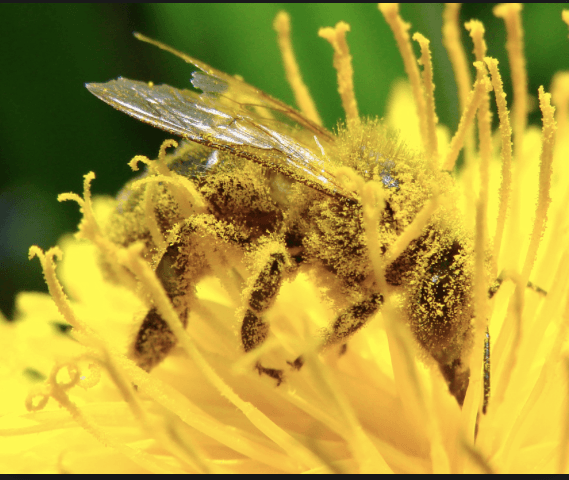
Pollination is the process by which pollen
a)
causes people to sneeze
b)
is formed inside a plant
c)
moves from stamen to pistil
55.

Fertilization is the process by which an
a)
egg and pollen combine
b)
embryo grows into a plant
c)
animal carries pollen between plants
56.

Can a plant reproduce if it doesn't make seeds?
a)
yes
b)
no
57.

What is the sticky part of the flower that catches pollen?
a)
style
b)
stigma
c)
ovary
d)
petal
58.

Which does not belong in the female part (pistil) of the flower?
a)
style
b)
stigma
c)
filament
d)
ovaries
59.
Do pine cones and flowers serve a similar function?
a)
Yes
b)
No
60.
What is an ovary?
a)
the female part of the flower that becomes a fruit
b)
the female part of the flower that accepts the pollen
c)
the male part of the flower that produces pollen
d)
another name for the stem of the plant
61.
What is a flower called if it has both male and female parts?
a)
a happy flower
b)
a perfect flower
c)
an imperfect flower
d)
an pristine flower
62.
If a bee does not come in contact with a flower's pollen...
a)
the plant is not likely to reproduce
b)
the plant is more likely to reproduce
63.

Some trees shed their leaves in time for winter. Why is this adaptation useful?
a)
The trees save energy during the darker, colder months.
b)
The trees take in more sunlight through their branches.
c)
The trees attract animals to spread their seeds.
d)
The trees blend into their environment and hide.
64.
The tundra is very cold year round. So plants will....
a)
grow together in a lump to protect from wind and cold.
b)
have hair to keep them warm
c)
"follow" the direction of the sun to stay warm and obtain a lot of sunlight for Photosynthesis.
d)
All of the above.
65.
True/ False: All fruits have seeds.
a)
True
b)
False
66.

Students were surveyed about their favorite sports to play in physical education. The results are represented in this circle graph. If 48 students were surveyed, how many chose soccer?
a)
10
b)
12
c)
15
d)
14
67.
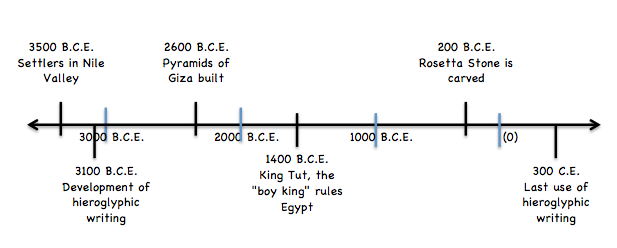
How many years passed between the development of hieroglyphic writing and the carving of the Rosetta Stone?
a)
3,300 years
b)
3,200 years
c)
2800 years
d)
2,900 years
68.
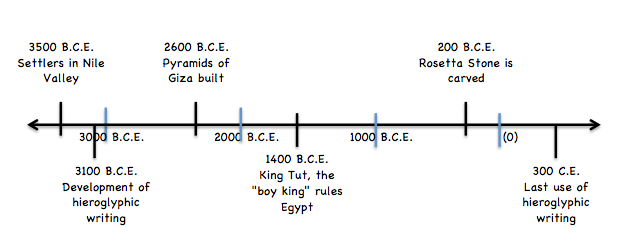
How many years passed between King Tut's rule of Egypt and the last use of hieroglyphic writing?
a)
1,600 Years
b)
1,100 Years
c)
1,700 Years
d)
4,700 Years
69.

What is the correct order of the rock layers from oldest to youngest?
a)
B, C, D, E, A
b)
A, B, C, D, E
c)
E, D, C, B, A
d)
B, C, D, A, E
70.

What is the correct order of the rock layers from oldest to youngest?
a)
F, E, C, B, A, D
b)
A, B, C, D, E, F
c)
F, E, D, C, B, A
d)
D, F, E, C, B, A
71.
The Law of Superposition helps scientists to determine what?
a)
The absolute age of rock layers
b)
The age of fossils
c)
The relative age of rock layers
d)
the super powers of rocks
72.

Look at the diagram, what layer did animal E first show up in?
a)
Layers #4
b)
Layers #5
c)
Layers #6
d)
Layers #7
73.
Which one is NOT an example of a decomposer?
a)
mushroom
b)
leaves
c)
mold
d)
worm
74.
What four things do every organism need for survival?
a)
food, water, dirt, and a hat
b)
protection, water, food, and air
c)
air, sun, dirt, and water
d)
light, electricity, and worms
75.
Examples of a producer
a)
frog
b)
algae
c)
worm
d)
mouse
76.
Example of a consumer
a)
worm
b)
bacteria
c)
mushroom
d)
hawk
77.
Mold is a
a)
producer
b)
consumer
c)
decomposer
78.
A tree is a ....
a)
composer
b)
decomposer
c)
producer
79.
Humans are considered...
a)
consumers
b)
decomposers
c)
producers
80.

What is a producer?
a)
an organism that gets energy from eating other organisms
b)
an organisms that uses sunlight to make its own food
c)
an organism that gets energy from eating dead organisms, non-living material or waste
d)
an organism that uses chemical energy to make its own food
81.
Grass is considered a ...
a)
consumer
b)
producer
c)
decomposer
82.

What is a herbivore?
a)
an animal that gets energy from eating other animals
b)
an organism that gets energy from eating only plants
c)
an animal that gets energy by eating both plants and other animals
d)
an animal that eats only herbs
83.

An organism that gets energy from eating other organisms is a ______________
a)
producer
b)
consumer
c)
decomposer
d)
prey
84.

A connection of food chains with many food energy paths in an ecosystem is a ____________
a)
ecosystem
b)
food web
c)
environment
d)
population
85.

An animal that is hunted and eaten for food is a
a)
predator
b)
prey
c)
population
86.
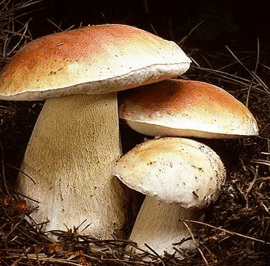
An organism that gets energy from breaking down dead organisms, non-living material or waste
a)
producer
b)
consumer
c)
decomposer
d)
autotroph
87.
Sac within the cytoplasm that is full of fluid; plants have one large; stores food, water, etc.
a)
vacuole
b)
cell wall
c)
lysosome
d)
ribosome
88.
Gives the cell a rigid, box-like shape; outside of the cell membrane; in plants.
a)
cytoplasm
b)
chromatin
c)
cell wall
d)
cell membrane
89.
Consists of a jellylike substance that contains many organelles.
a)
ribosomes
b)
cytoplasm
c)
chloroplasts
d)
cell wall
90.
Which part of the cell is often called "the brain of the cell"?
a)
nuclear membrane
b)
endoplasmic reticulum
c)
nucleus
d)
ribosomes
91.

I make proteins for the cell. What am I?
a)
ribosome
b)
mitochondria
c)
chloroplast
d)
lysosome
92.

You might think of me as the trash collector or agent of "detoxification". What am I?
a)
cytoplasm
b)
lysosome
c)
vacuole
d)
ribosome
93.

I am a protein packaging and shipping machine! Who am I?
a)
vacuole
b)
ribosome
c)
endoplasmic reticulum
d)
golgi apparatus
94.

I store water in both plant and animal cells. What am I?
a)
cytoplasm
b)
ribosomes
c)
vacuole
d)
lysosomes
95.
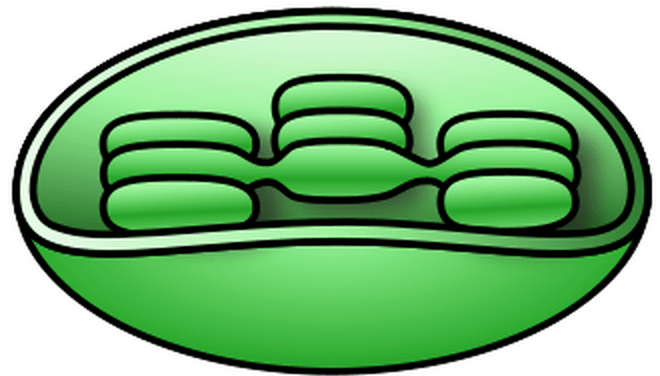
I am only found in a plant cell. What am I?
a)
cell wall
b)
mitochondria
c)
cytoplasm
d)
chloroplast
96.

What is this?
a)
mitochondria
b)
lysosomes
c)
chloroplast
d)
endoplasmic reticulum
97.
Am I "rough" or "smooth"?
a)
smooth
b)
rough
98.

What does this structure do?
a)
supports the cell
b)
cell's control center
c)
converts energy to food
d)
makes proteins
99.

What is this a picture of?
a)
ribosome
b)
nucleus
c)
cell wall
d)
mitochondrion
100.

What are tiny organelles that convert energy from organic molecules into ATP?
a)
Ribosomes
b)
Vesicles
c)
Cytoskeleton
d)
Mitochondria
100 %

