
 Worksheets
H-R DIAGRAMS, GALAXIES, AND STARS
Total questions: 96
Worksheet time: 1hrs 24mins
Name
Class
Date
1.
What is a large celestial body that is composed of gas and that emits light?
a)
Nebula
b)
Star
c)
Galaxy
d)
Planet
2.
A collection of stars, dust, and gas bound together by gravity is...
a)
Universe
b)
Solar System
c)
Planet
d)
Galaxy
3.
The distance that light travels in one year...
a)
Light year
b)
Quantumyear
c)
Stellar-year
d)
1 million kilometers
4.
A large cloud of gas and dust in interstellar space; the predecessor to stars...
a)
Constellation
b)
Black hole
c)
Nebula
d)
Galaxy
5.
What is the graph that shows the relations between a star's surface temperature and absolute magnitude?
a)
H-R Diagram
b)
Star Cluster Map
c)
Einstein's Diagram
d)
Newton's Chart of Stars
6.
Space and all the matter and energy in it is...
a)
Universe
b)
Galaxy
c)
Solar System
d)
Ecosystem
7.
Nebulae are considered "Stellar Nurseries" because...
a)
Planets are created from the gases
b)
Stars form from them
c)
Asteroids are formed from them
8.
The Hertzprung Russell Diagram consists of two axis that are labelled...
a)
Luminosity and Size
b)
Luminosity and Temperature
c)
Luminosity and Age
9.

In the diagram given, what happens as we move to the left?
a)
Stars Get Larger
b)
Stars get Colder
c)
Stars get hotter
10.
Which of these stars is hottest?
a)
Red Star
b)
Yellow Star
c)
Orange Star
d)
Blue Star
11.

Which star is the coldest?
a)
Yellow Star
b)
Red Star
c)
Orange Star
d)
Blue Star
12.
What else does the H-R Diagram tell us besides the luminosity and temperature?
a)
Size, color and element make up
b)
Location and distance from Earth
c)
Constellation structures
13.
Compared to the rest of the stars, our sun is considered...
a)
Extremely Large and Cold
b)
Small with a medium temperature
c)
Medium size with medium temperature
14.
Which category is our Sun located in?
a)
White Dwarfs
b)
Supergiants
c)
Main Sequence
d)
Giants
15.
The category that contains the most stars is...
a)
Main Sequence
b)
Supergiants
c)
Giants
16.

As a whole, Giants are considered hotter than White Dwarfs.
a)
True
b)
False
33.

What type of galaxy is this?
a)
spiral
b)
elliptical
c)
irregular
d)
quasar
18.

What type of galaxy is this?
a)
spiral
b)
elliptical
c)
irregular
d)
quasar
19.

In the diagram given, what happens as we move to the left?
a)
Stars Get Larger
b)
Stars get Colder
c)
Stars get hotter
20.

Which star is the coldest?
a)
Yellow Star
b)
Red Star
c)
Orange Star
d)
Blue Star
21.
The Hertzprung Russell Diagram consists of two axis that are labelled...
a)
Luminosity and Size
b)
Luminosity and Temperature
c)
Luminosity and Age
22.
Which category is our Sun located in?
a)
White Dwarfs
b)
Supergiants
c)
Main Sequence
d)
Giants
23.
What are the the 3 types of galaxies?
a)
Spiral Galaxies, Regular Galaxies, and Lliptical Galaxies
b)
Spiral Galaxies, Irregular Galaxies, and Elliptical Galaxies
c)
Milky Way, Elliptical Galaxies, and Spiral Galaxies
d)
Milky Way, Elliptical Galaxies, and Irregular Galaxies
24.
The closest star to the sun is the...
a)
Sirius A
b)
Barnard's Star
c)
Luhman16
d)
Proxima Centauri
25.
How many stars are in a galaxy.
a)
millions or billions
b)
thousands
c)
hundreds
d)
Ten
26.
What are in galaxies?
a)
ice and rock
b)
dust, gas, and stars
c)
stars and ice
d)
water and dust
27.
What is the process that occurs in the core of a star, like the sun, that produces energy?
a)
fission
b)
fusion
c)
decay
d)
convection
28.
According to the Big Bang Theory how old is the universe?
a)
Thousands of years.
b)
Millions of years.
c)
Billions of years.
d)
Eternal.
29.
The event that marks the beginning of our known universe
a)
Theory of Evolution
b)
Big Bang Theory
c)
Cell Theory
d)
Blackhole theory
30.
Galaxies that are moving away from us are _ shifting?
a)
red
b)
blue
c)
yellow
d)
green
31.
Which section of the spectrum is the ONLY one we can see?
a)
X-rays
b)
Visible Light
c)
Gamma Rays
d)
Ultraviolet Rays
32.

Stars are formed in a cloud of gas and dust called a
a)
nebula
b)
black hole
c)
white dwarf
d)
Super Giant
33.
What type of galaxy is this?
a)
spiral
b)
elliptical
c)
irregular
d)
quasar
34.

What type of galaxy is this?
a)
spiral
b)
elliptical
c)
irregular
d)
quasar
35.

Our solar system is located inside a galaxy called the _____________.
a)
Local Group
b)
Milky Way
c)
Andromeda
d)
Constellation
36.

Red stars are the _____________.
a)
hottest
b)
coolest
c)
biggest
37.

Blue stars are the _____________.
a)
hottest
b)
coolest
c)
smallest
38.
Which one is the correct order from hottest to coolest stars?
a)
blue, yellow,orange, red
b)
red, orange, yellow, blue
c)
blue, red, yellow, orange
d)
yellow, blue, orange, red
39.

What is the best title for this picture?
a)
Birth of a Star
b)
Birth of a Universe
c)
Life Cycle of a Low Mass Star
d)
Life Cycle of a High Mass Star
40.

Look at the H-R diagram. Which star is
sort of cool, dim (not too much light), and red?
sort of cool, dim (not too much light), and red?
a)
Betelguse
b)
Sirius B
c)
Procyon B
d)
Barnard's star
41.

Which one shows the correct location of the Sun in the Milky Way galaxy?
a)
A
b)
B
c)
C
d)
none of the above
42.

Which fact about the SUN is FALSE?
a)
The sun is a medium sized star.
b)
The sun is near the center of a disc-shaped galaxy of stars.
c)
The sun is thousands of times closer to the Earth than any other star.
d)
The sun is about 2/3 of the way out from the middle of the Milky Way.
43.
Scientist use Light years to measure objects in space rather than units such as Miles or Kilometers because of how massive the Galaxy and Universe is.
a)
True
b)
False
44.

What is found on the x axis of an H-R diagram?
a)
Luminosity
(or brightness)
(or brightness)
b)
Temperature
c)
Star Size
d)
Distance
45.

Which is an example of a Main Sequence star?
a)
Betelgeuse
b)
our Sun
c)
Sirius B
d)
Polaris
46.

Which star has the lowest temperature?
a)
A
b)
B
c)
C
d)
D
47.
Stars produce
a)
Heat
b)
light
c)
both heat and light
48.
Which of the following terms should be listed first chronologically?
a)
Main-Sequence
b)
Protostar
c)
White Dwarf
d)
Red Giant
49.
H-R diagrams are used for classifying stars and showing the evolution of their lives.
a)
True
b)
False
50.
Which of the following star remnants is the least massive?
a)
White Dwarf
b)
Neuton Star
c)
Black Hole
51.
Which of the following star remnants is the most dense?
a)
White Dwarf
b)
Neutron Star
c)
Black Hole
52.

What star category has the largest stars?
a)
Super giants
b)
White Dwarfs
c)
Giants
d)
Main Sequence
53.
Which of the following is the largest?
a)
star
b)
universe
c)
cluter
d)
galaxy
54.

This is an H-R Diagram of a star cluster. Which of the following is true about the stars in Area 1 (bound by the red box)
a)
These stars are red giants.
b)
These stars are white dwarfs.
c)
These stars are main sequence stars.
d)
These stars are in the first half of their life span.
55.

This is an H-R Diagram of a star cluster. The stars that are not in Area 1 or Area 2 are part of the...
a)
main sequence
b)
white dwarf group
c)
blue giant group
d)
instability strip
56.
The color index of a star provides information about that star’s
a)
age
b)
luminosity
c)
absolute magnitude
d)
temperature
57.
Spectral class is a way of describing a star’s
a)
size
b)
luminosity
c)
age
d)
color
58.
The effective temperature of a star is related to its...
a)
solar system
b)
luminosity
c)
absolute magnitude
d)
color
59.
Which of the following is not an accepted use of an H-R diagram?
a)
Visual way to “graph” and categorize stars based on their characteristics
b)
Allows astronomers to recognize patterns in types of stars
c)
Allows us to track the life cycle of stars as they change over time
d)
Allows us to determine the distance of stars with great accuracy
60.

In which region of the H-R Diagram would you be likely to find Blue Giants?
a)
W
b)
X
c)
Y
d)
Z
61.

In which region of the H-R Diagram would you be likely to find the oldest stars?
a)
W
b)
X
c)
Y
d)
Z
62.
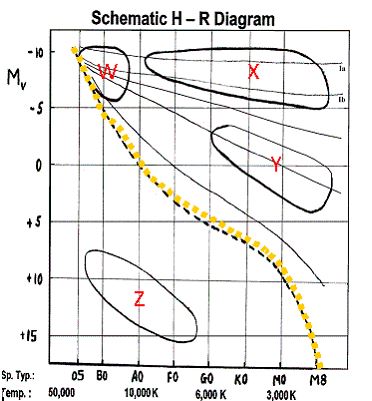
In which region of the H-R Diagram would you be likely to find stars fusing hydrogen to make helium in their cores?
a)
W
b)
X
c)
Y
d)
The orange dashed line
63.

In which region of the H-R Diagram would you be likely to find the brightest, reddest stars?
a)
W
b)
X
c)
Y
d)
The orange dashed line
64.

What is the primary difference between a star of spectral class K0 in the Y region, compared to a star of spectral class K0 in the X region?
a)
temperature
b)
color
c)
brightness
d)
color index
65.
The luminosity of a star correlates most closely with a star's...
a)
size
b)
color
c)
spectral class
d)
temperature
66.

Which corner of the H-R diagram has the stars with the shortest life spans?
a)
upper left
b)
upper right
c)
lower left
d)
lower right
67.

Where on the H-R diagram would you find the brightest stars?
a)
At the top
b)
At the bottom
c)
On the left
d)
White Dwarfs
68.

Which H-R diagram category would have the the largest stars?
a)
Giants
b)
White Dwarfs
c)
Main Sequence
d)
Super Giants
69.

Where on the H-R diagram would you find the coolest star?
a)
At the top
b)
At the bottom
c)
On the Left
d)
On the Right
70.
What measurement do we use to measure distances to a star?
a)
Light Day
b)
Light Year
c)
AU
d)
Kilometer
71.
The Sun makes up over 99% of the solar system's mass.
a)
True
b)
False
72.

Put the stars in order from coolest to hottest.
a)
Blue, White, Yellow, Orange, Red
b)
Red, Orange, Yellow, White, Blue
c)
Red, Orange, Yellow, Blue, White
d)
Red, Yellow, Orange, White, Blue
73.

What star are we revolving around now?
a)
Proxima Centauri
b)
Jupiter
c)
The sun
d)
Pluto
74.
What H-R Category does our sun belong to?
a)
Supergiant
b)
Main sequence
c)
White dwarf
d)
black dwarf
75.

What is the color of the coolest stars?
a)
blue
b)
yellow
c)
red
d)
orange
76.

what is the luminosity of the sun?
a)
100
b)
1
c)
.001
d)
1,000
77.

A plot of the surface temperatures of stars compared to their absolute magnitude is called
a)
an H-R diagram
b)
constellation map
c)
a graph
d)
spectrum.
78.
Very hot stars are what color?
a)
Blue
b)
Yellow
c)
Red
d)
Orange
79.
Our sun is average-sized and average temperature.
a)
False
b)
True
80.
All stars are formed from a __________?
a)
giant
b)
black hole
c)
white dwarf
d)
nebula
81.

What category on the H-R diagram has the majority or the most stars?
a)
Super giants
b)
White Dwarfs
c)
Giants
d)
Main Sequence
82.

What type of galaxy is this?
a)
Spiral
b)
Elliptical
c)
Irregular
d)
Irrational
83.

What type of galaxy is this?
a)
Sprial
b)
Elliptical
c)
Irregular
d)
Irrational
84.

What type of galaxy is this?
a)
Spiral
b)
Elliptical
c)
Irregular
d)
Irrational
85.

What type of galaxy is this?
a)
Spiral
b)
Elliptical
c)
Irregular
d)
Irrational
95.

Which star has the lowest temperature?
a)
A
b)
B
c)
C
d)
D
94.

Which star has the lowest luminosity?
a)
A
b)
B
c)
C
d)
D
94.
Which star has the lowest luminosity?
a)
A
b)
B
c)
C
d)
D
96.

Which star is considered a Main Sequence Star?
a)
A
b)
B
c)
C
d)
D
90.
Why are black holes black?
a)
No light can escape the black hole's gravity
b)
No light is reflected from the closest stars
c)
They are transparent, so you see space
d)
Plants around it prevent light from hitting the black hole.
91.
All stars begin as a __________?
a)
giant
b)
black hole
c)
white dwarf
d)
nebula
92.
A star is born and lit up when ______ happens and provides the star with energy that it will use for millions of years.
a)
nuclear fusion
b)
gravity
c)
hydrogen
d)
iron
93.

Which of these puts the main parts of an average star's life cycle in the correct order?
a)
protostar>
main sequence>
red giant >
white dwarf
main sequence>
red giant >
white dwarf
b)
protostar>
main sequence>
white dwarf>
red giant
main sequence>
white dwarf>
red giant
c)
main sequence>
protostar>
white dwarf>
red giant
protostar>
white dwarf>
red giant
d)
protostar>
red giant >
main sequence>
white dwarf
red giant >
main sequence>
white dwarf
94.
Which star has the lowest luminosity?
a)
A
b)
B
c)
C
d)
D
95.
Which star has the lowest temperature?
a)
A
b)
B
c)
C
d)
D
96.
Which star is considered a Main Sequence Star?
a)
A
b)
B
c)
C
d)
D
100 %

